Department of Sociology
Kenyon College
Treleaven House
105 West Brooklyn Street
Room 202
Gambier, Ohio 43022
USA
Telephone:
Office: (740) 427-5849
Department Office Manager:
(740) 427-5855
Email:
McCarthy@Kenyon.edu
Website Address:
http://personal.kenyon.edu/mccarthy/
EARLY BOOKS
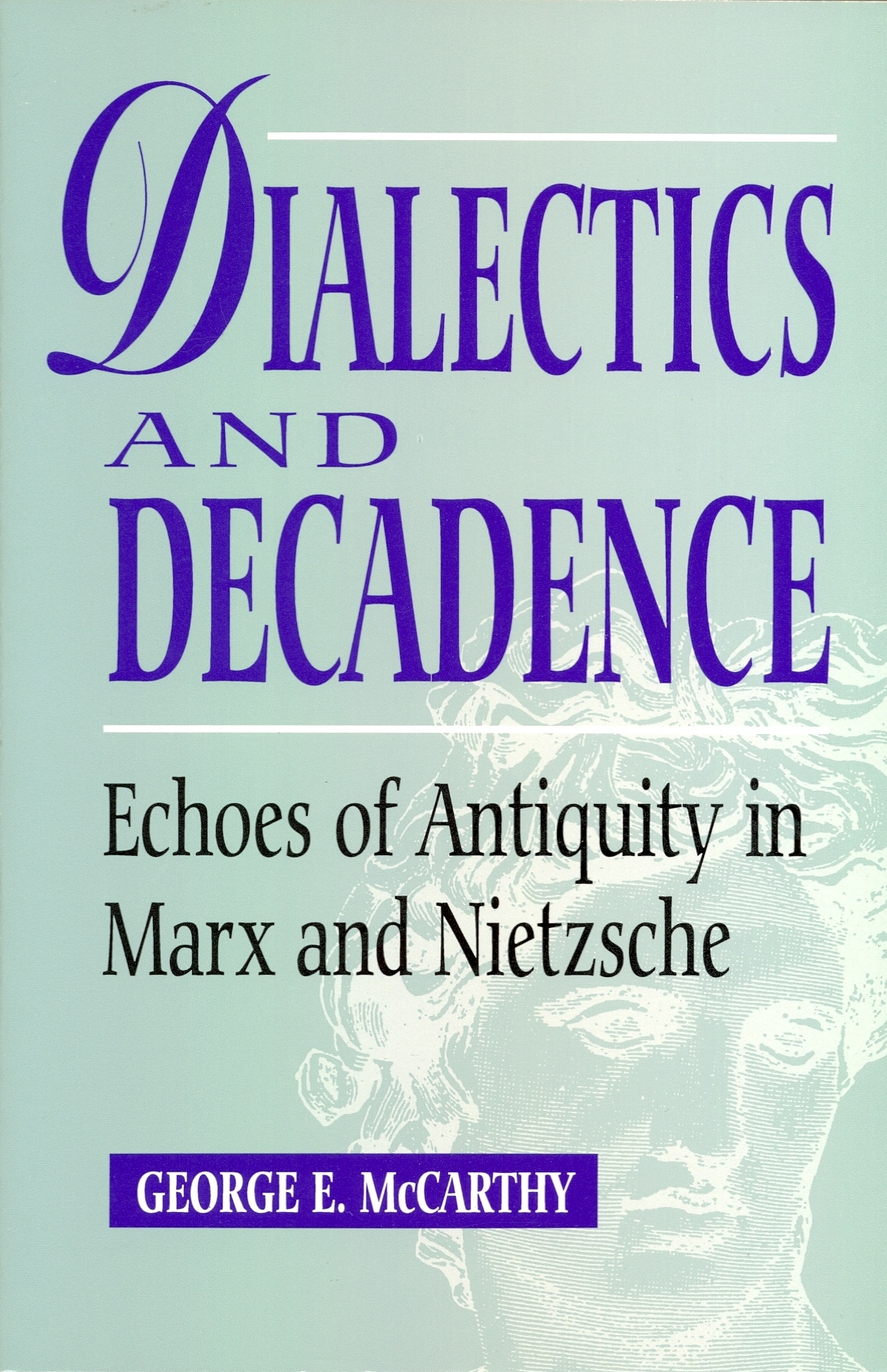
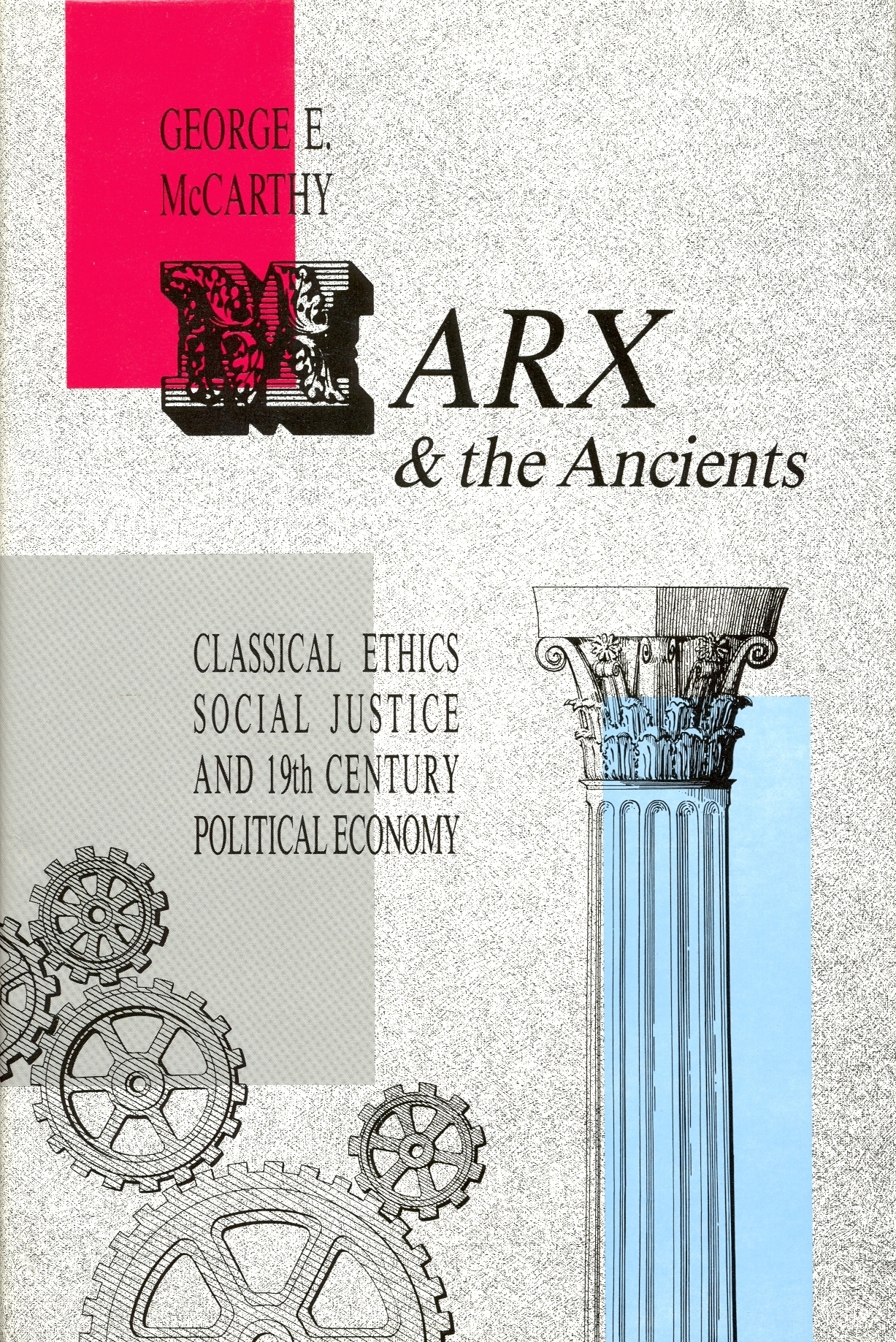

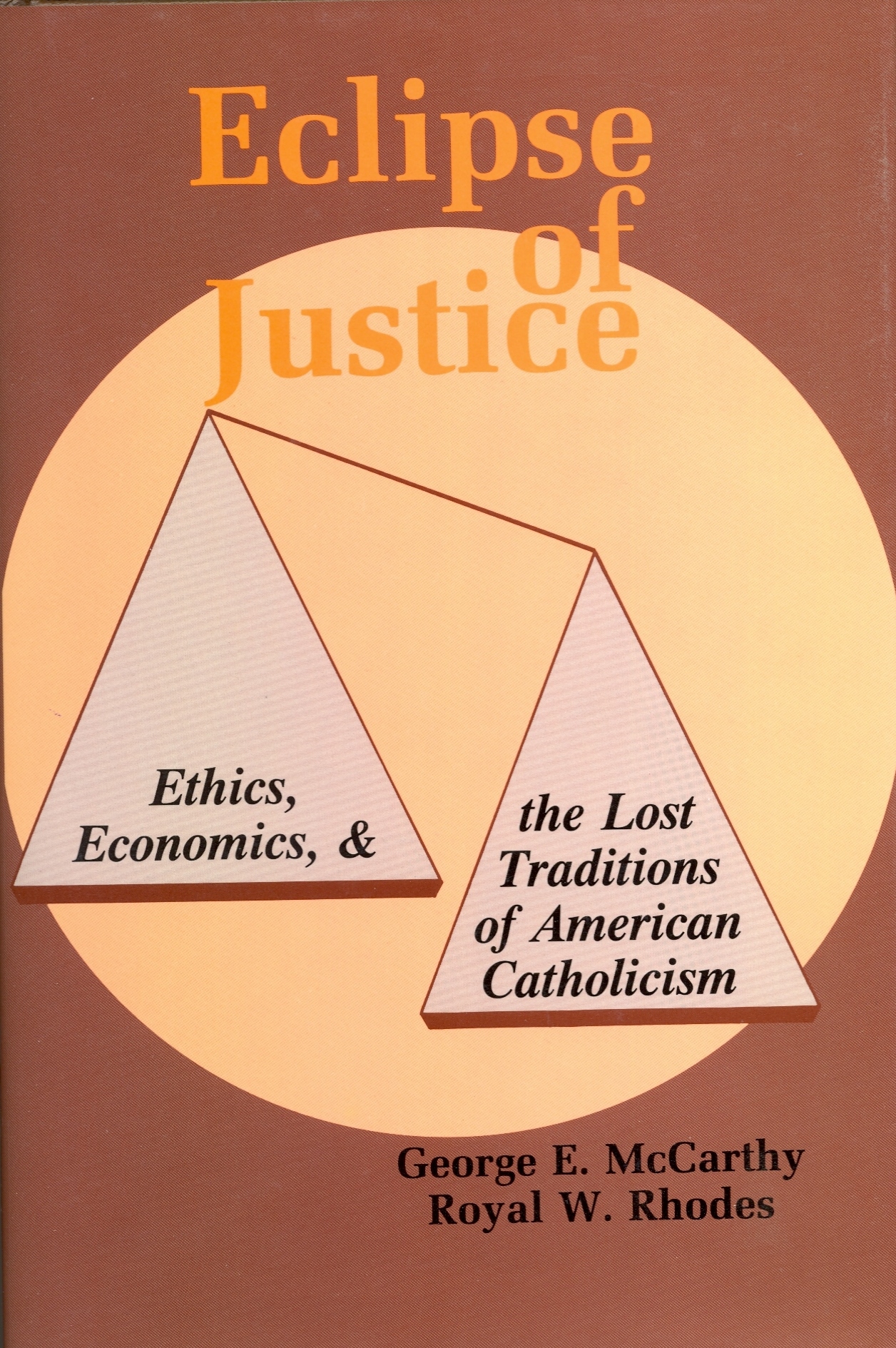
(Click on the jacket cover image for more information about the Table of Contents and Introduction)
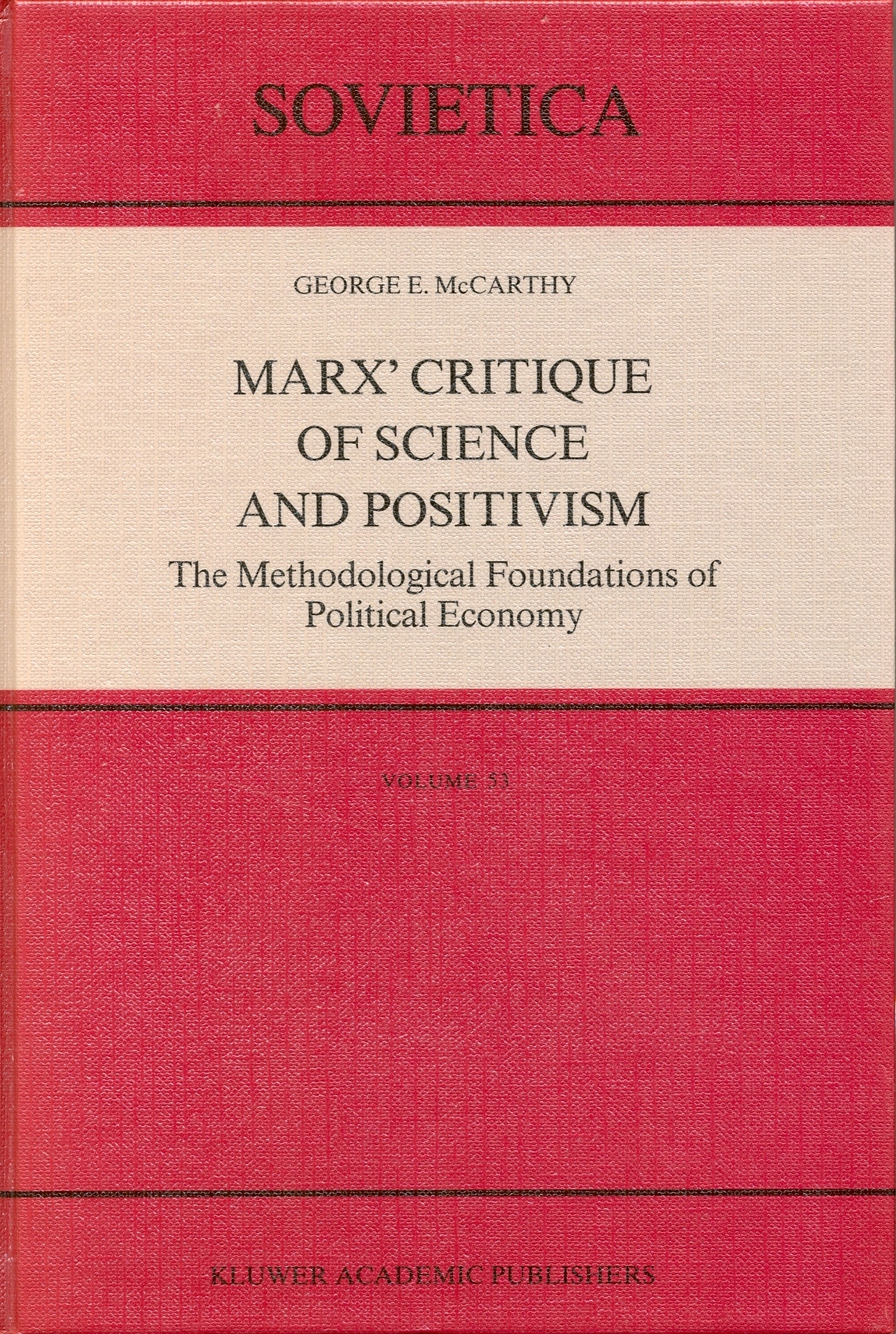
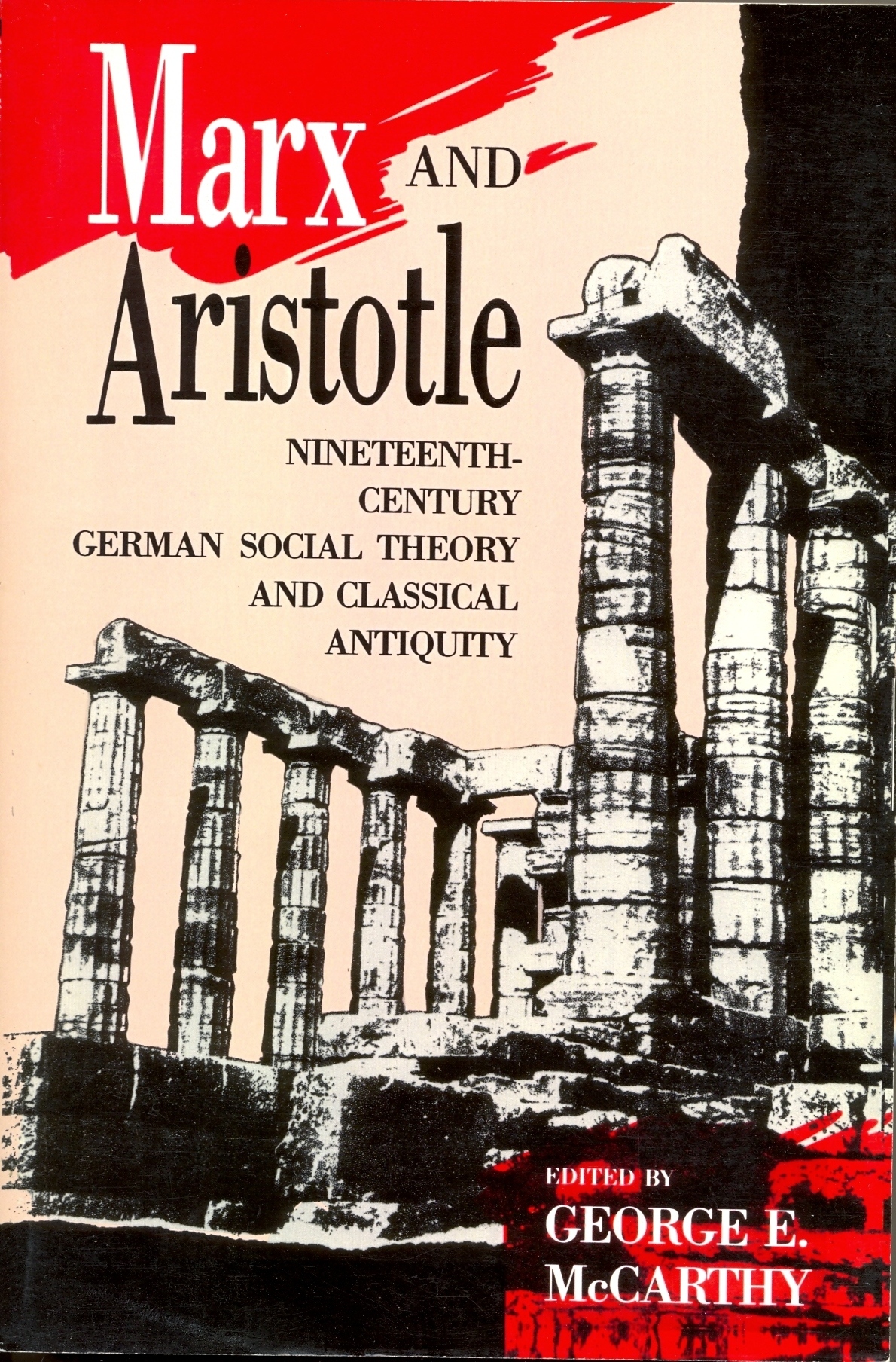
MORE RECENT
BOOKS
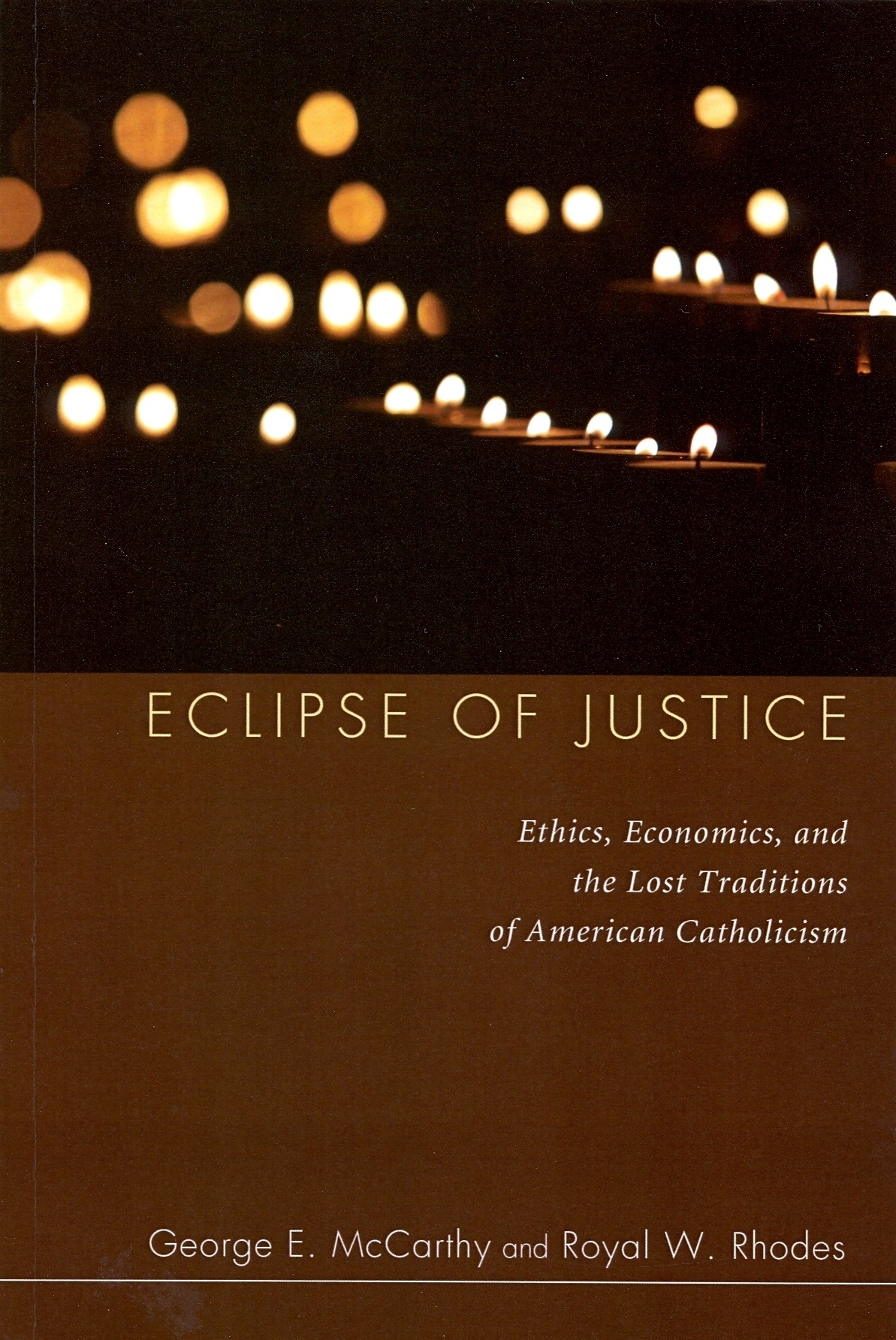
(Click on the jacket cover image for more information about the Table of Contents and Introduction)
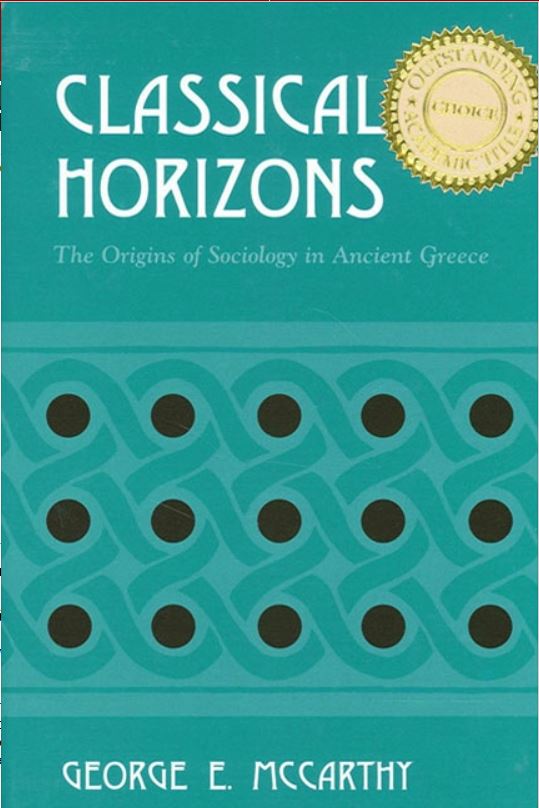
Classical Horizons won the Choice Outstanding Academic Title Award in 2003
LATEST BOOKS
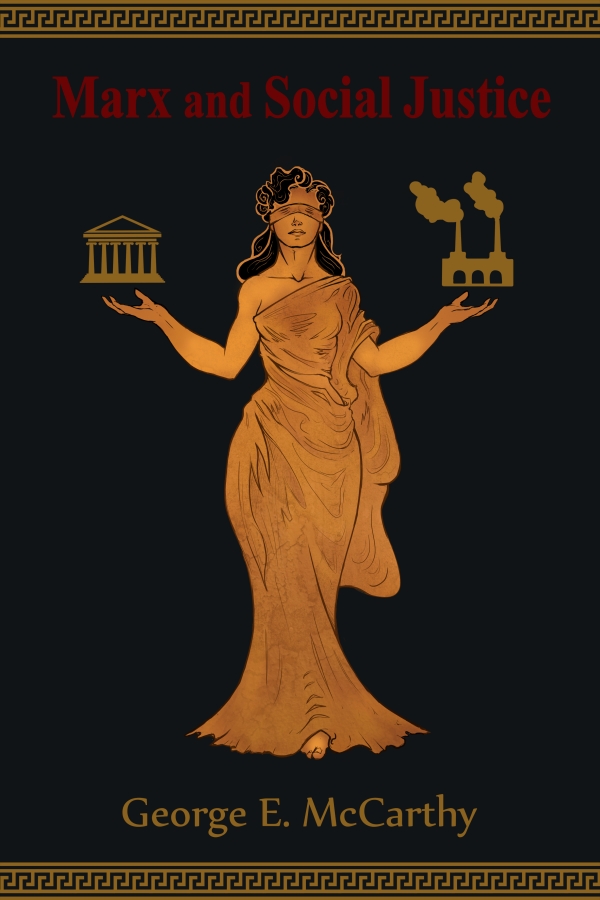
Hardbound Cover 2018
Frontispiece
by Devin S. McCarthy
Greek goddess of Justice
Dike
balancing and integrating the Ancients and the Moderns --
Athenian justice and beauty with modern labor and industry --
as the classical inspiration and imaginative vision of Karl Marx's
Griechensehnsucht
(Longing for Ancient Greece)
and
Horizontverschmelzung
(Fusion of Horizons and Traditions).
with the purpose of creating a classical
vision of workers' associations, economic
democracy, and self-government
"of the people, by the people"
in
The Paris Commune
of 1871
150th anniversary of Marx's Capital (2017) and
200th anniversary of Marx's birth (2018)
NEW PAPERBACK REPRINT EDITION
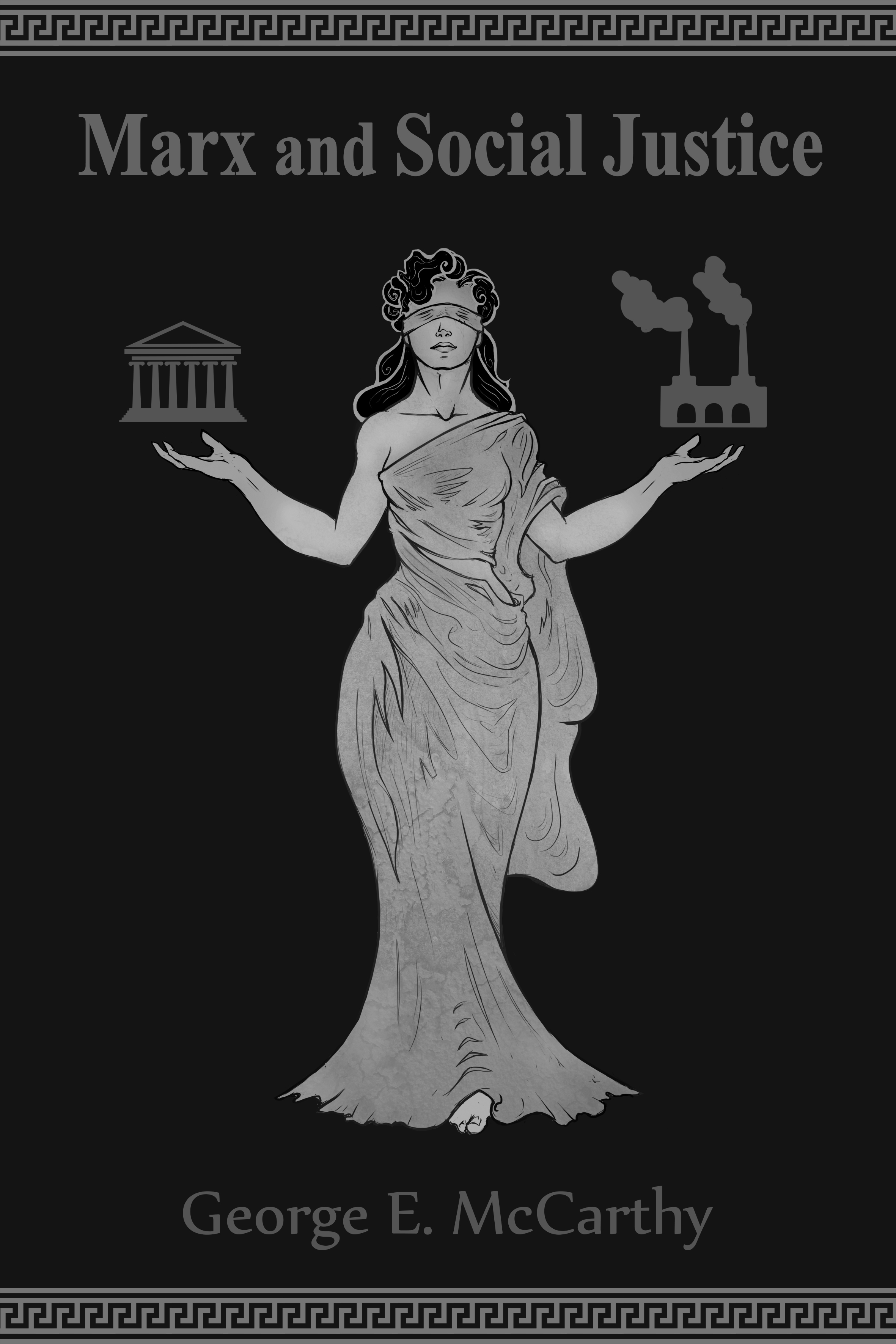
Paperback Jacket Cover
2019
B&W Frontispiece
Haymarket Books
by Devin S. McCarthy
Historical Materialism Series #147
Following closely Aristotle's definition of social justice based on universal and particular justice,
human needs and economic reciprocity, and a critique of the structures and contradictions
of a trade economy (chrematistike), Marx's theories of abstract labor, surplus value,
exchange value, economic crisis theory, overproduction of capital, tendential fall
in the rate of profit, and high unemployment in the Grundrisse and Capital
are an essential part of his modern theory of ethics and social justice.
Marx rewrites and reconfigures Aristotle's Nicomachean Ethics
(morality and virtue) and Politics (political economy and democracy)
into the language of German Idealism of Kant and Hegel, classical
political economy of Smith and Ricardo, and French socialism of
Rousseau, Fourier, Saint-Simon, and Proudhon. Both Aristotle
and Marx argue for the beauty and dignity of a rational and
virtuous life -- moral and intellectual virtue -- within a
democratic polity and moral economy based upon
creative self-determination, human need,
reciprocal fairness, equality, and
the common good.
Social justice refers to the total restructuring of
society and political economy that allows for
the full development of human potentiality,
economic democracy, rights of the citizen,
individual freedom, and human dignity.
This new book on Marx's theory of social justice
attempts to show how he applies and makes
relevant Aristotle's ethics and politics
to an understanding and transformation
of the class institutions and structures
of modern industrial capitalism --
Marx portrays how the heights and
majesty of Ancient Greece provided
Modern Society with its Classical
Humanism -- that is, with
its lost ideals, political
vision, and inspiration
for social justice.
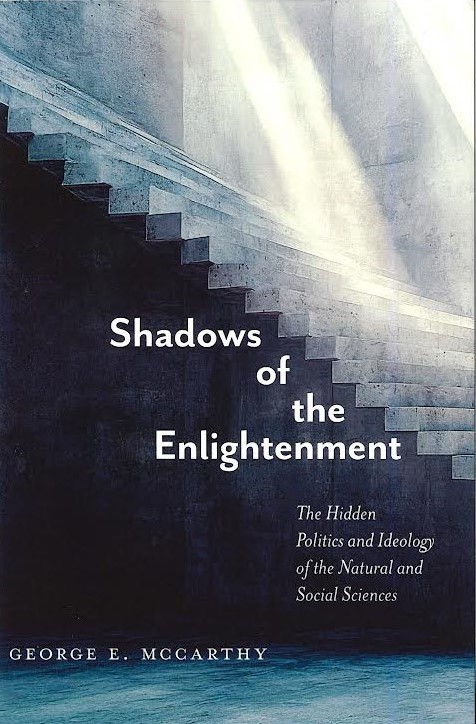
The Enlightenment as the Stairway to the Acheron and Cocytus
Shadows of the Enlightenment examines the dark shadows, political shades, and lost ideas of Enlightenment reason which shed light on the hidden assumptions and values underlying Western "science" -- and reveals it as a dark specter haunting society -- from the so-called "Age of Reason" to the present. George McCarthy uncovers the economic, social, and historical origins of modern science, and shows that, deep within the metaphysics, epistemology, methodology, nominalism, and explanatory theories of the natural sciences, lay a priori and innate features which provided the philosophical and political justifications for the technical domination and control of nature and humanity. As we read, we understand that traditional positivist claims to scientific objectivity, realism, and neutrality are in fact embedded with intensely subjective political drives, riven with unarticulated social values and unconscious assumptions. Far from conveying an objective and accurate reflection of nature, the scientific arena fashioned its own concept of "reality," and the field of natural science in particular came to be an ideological mirror of alienation and its social relations of production and exchange.
Breaking with the medieval scholastic tradition, modern science constructed nature as a reified mechanism which could be mathematically measured, empirically predicted, and causally explained and managed. Nature itself was recast as a dead machine suspended in time and space, stripped of any inherent meaning or purpose. The natural sciences were born of a market economy, commercial trade, and industrial production, and were furthermore expressions of the values and institutions of modern capitalism and its class system in the seventeenth and eighteenth centuries. As such, one of the central roles of Western science has been to provide the formal legitimation for its theoretical imperative to dominate and exploit nature and to reorganize human labor for private profit, property, and power on the basis of rational calculation and technical efficiency.
Examining the importance of the antipositivist traditions within philosophy and sociology, each chapter of Shadows of the Enlightenment highlights a different school of thought, including the (1) German Idealism of Kant and Hegel, the (2) Postanalytic and Postmodern Pragmatism of Quine, Kuhn, Rorty, and Burtt, the (3) Phenomenology of Husserl, Scheler, and Weber, the (4) Existentialism of Schopenhauer and Nietzsche, the (5) Marxism of Sohn-Rethel, C. Wright Mills, Borkenau, Merchant, Leiss, and Balbus, the (6) Critical Rationalism of Albert and Popper, and the Critical Theory of Adorno, Horkheimer, Marcuse, and Habermas. The first half of this work provides an immanent and dialectical critique of the philosophy and sociology of modern science and technology, while the second half develops a critical theory of science, democracy, and social justice. Kantianism, Phenomenology, Pragmatism, Post-Analytic Philosophy, Existentialism, Critical Rationalism, Critical Theory, Neo-Marxist Political Economy, and Classical Social Theory provide the epistemological and philosophical foundations for a critique of the dark side and hidden ideology of modern science as a form of technical domination and control (Herrschaftswissen) over nature and society, while Marx and contemporary critical sociology provide an alternative theory for understanding the possibilities of science and technology within a free society. The modern analyses of Western science in the history of philosophy is extensive and critical as mentioned above, but also in its practical and technical applications to the economy and human labor, nature and ecology, and the academy and social sciences. The application of natural science in the process of production leads to scientific management and economic exploitation, while in the academy and social sciences, it leads to the eclipse of reason and the twilight of social theory. Building upon the critical insights of Marx and the debates within the Frankfurt School over the nature of Western science, Shadows of the Enlightenment articulates a new liberatory postmodern science and technology grounded in Aristotle's and Marx's theories of social justice, integrating ancient and modern traditions from classical Greece to the French Revolution and Constitutions of the 1790s, "Declaration of the Rights of Man and of the Citizen" of 1789, the Paris Commune of 1871, the Gotha Program of 1875, and the Native American Iroquois Confederacy. Shadows of the Enlightenment invites us to move beyond the falsely mechanical, mathematical, and deterministic view of reality imposed upon the entire planet since the Enlightenment, and to break free from the sense of alienation that binds us all in order to dream of a better and more perfect political and economic democracy "of the people, by the people." Marx's theory of social justice moves beyond the abstract and philosophical debates over the nature of modern science and technology in Marcuse's theory of one-dimensional man and his aesthetic rejection of capitalism and Habermas's theory of public discourse and democratic consensus. Following the outline, arguments, and logic in Aristotle's ethics, politics, and sociology, Marx provides the missing concrete historical, political, and economic foundations for both the critical theory of the Frankfurt School and for the political economy and economic democracy of modern social ethics.
Regarding the impact of the Shadows of Enlightenment science, technology, & positivism on the Environment, Workplace, and the Academy --
"For the master's tools will never dismantle the master's house....they will never enable us to bring about genuine change," Audre Lorde, 1984. The rise of Capitalism, Liberalism, and the Enlightenment helped produce the social and structural pathologies of (1) Alienation of the mode of production, human sensibility and dignity, and reason (Marx), (2) Anomic Derangement and the loss of collective consciousness and social meaning (Durkheim), (3) Decadence and Disenchantment of substantive reason in the last man of the iron cage (Nietzsche and Weber), and continues today with the Repression of the unconscious Acheron (Freud) and the Eclipse of Objective Reason and European social theory (Horkheimer). The loss of reason occurred, and continues to occur, because the classical social theorists held views of "science" that did not conform to the epistemology and methodology of positivism and modern natural science. In the process, the political and ideological shades of Enlightenment reason and science covered and suppressed the "classical horizons" of the ancient and modern traditions of knowledge, as well as the non-positivist views of science in classical sociology, including Marx's immanent, dialectical, and ethical science, Weber's historical, comparative, hermeneutical, and structural science, Durkheim's neo-Kantian pragmatism, scientific rationalism, and theory of cultural representations, and Freud's depth-hermeneutics, psychoanalysis, and discursive reason.
And with these changes and denials of alternative views of science and knowledge came the loss of critical and non-positivist concepts, methods, ideas, and theories -- Silence. This is the "deafening silence of the primeval forest" and rediscovery of Dante's Inferno for the modern world as we walk down into the darkening and blinding void of existential absurdity, meaninglessness, moral silence, and social inaction of the modern hell (Camus, The Fall, 1956). In the ninth circle of hell is the frozen lake of "Cocytus" where Judas, Brutus, and Cassius can't speak because they are being chewed in the three mouths of the winged Lucifer for being traitors. Camus through powerful images, enlightening symbols, and literary hints describes the Fall of Western Civilization from the Old and New Testament, ancient Greek tragedy, the Renaissance and Dante's inferno, and World War II and the Holocaust to modern Liberalism and Capitalism. In modern times, the Enlightenment provides the stairway to the river Acheron and Cocytus because there is a Silence of Reason -- a lack of concepts and ideas by traitors to humanity for being silent in the face of overwhelming brutality and violence, class inequality, economic insecurity, anxiety, and human misery, on the one hand, and the poverty of our ideas, hopes, and the academy, on the other.
Silenced in the twilight of reason are the alternative methods, theories, and forms of science in Classical and Continental Sociology and Philosophy -- Geisteswissenschaften -- including critical, moral, dialectical, historical, symbolic, interpretive, hermeneutical, depth-hermeneutical, and qualitative science. This silence is unusual because it is not the traditional moral and political silence of the public sphere, but the silence of alternative scientific methods of inquiry and social theories which are non-positivistic approaches. (Positivism is defined as a specific method of materialistic and empirical observation, hypothesis testing and predictions, and the creation of objective and explanatory universal laws of human behavior and social phenomena using the methodology of the natural sciences.) The fragmentation of ideas and disciplines in the corporate liberal arts has produced a disenchantment and eclipse of reason. Critically reacting to this, Continental Sociology, as an holistic and integrative discipline incorporating social philosophy, political economy, and history, searched for a new and sustaining voice based on the principles and ideals of concrete ethics and social justice. It represented a rejection of the distorting Shadows of the Enlightenment with its narrow view of technical and explanatory science and formal and hypothetical reasoning resulting in the degradation of moral and social ecology to the nothingness, loneliness, and despair of liberalism and capitalism. Imagination and creativity, reason and thought, and democracy and the environment all die in the darkness and shadows of the "hard times" of the Enlightenment and modern positivism.
**********************************
FOREIGN LANGUAGE TRANSLATIONS
Chinese Translation
of
Marx and the Ancients:
Classical Ethics, Social Justice, and
Nineteenth-Century Political Economy
Ma ke si yu gu ren:
Gu dian lun li xue, She hui zheng yi he
19 shi ji zheng zhi jing ji xue
(2011)
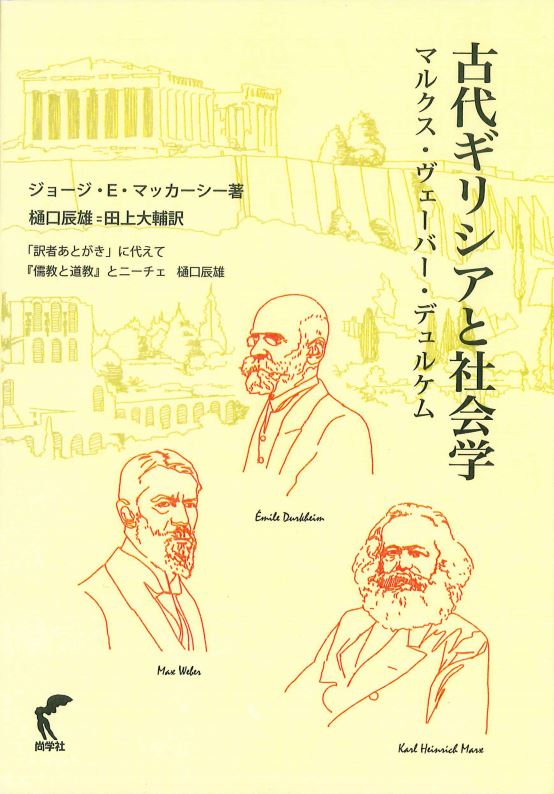
Japanese Translation
of
Classical Horizons:
The Origins of Sociology
in Ancient Greece
Kodai girishia to shakaigaku:
marukusu veba dyurukemu
(2017)
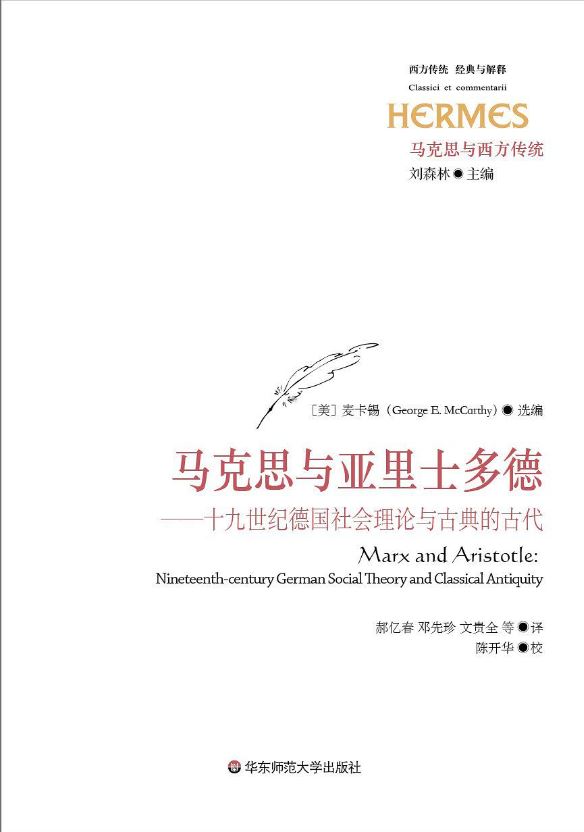
Chinese Translation
of
Marx and Aristotle:
Nineteenth-Century German Social Theory
and Classical Antiquity
Ma ke si yu ya li shi duo de:
Shi jiu shi ji de guo she hui li lun yu gu dian de gu dai
(2015)
EDUCATION
1964-1968
Manhattan College
4513 Manhattan College Parkway
Riverdale, New York 10471
B.A. in Philosophy, honors
June 1968
1968-1972
Boston College
Chestnut Hill, Massachusetts 02467
M.A. in Philosophy, August 1969
Ph.D. in Philosophy, June 1972
Dissertation Topic:
The Social Anthropology of Hegel and Marx
Summer 1972
U. S. Department of Justice
United States District Court
Southern District of New York
Foley Square, Manhattan, NY 10007
Indictment, Arrest Warrant, and Federal Trial
for Moral Resistance to Vietnam War and Draft Refusal
Felony Indictment: Failure to Report for Armed Services Induction
Summer 1973
Goethe Institute in Language Study
Blaubeuren, Baden-Württemberg, near Ulm
(2 months)
and
Brannenburg-Degerndorf, Bavaria, near Munich
(2 months)
West Germany
Deutscher Akademischer Austauschdienst
German Academic Exchange Service
Four-Month Language Fellowship (DAAD)
1973-1975
Johann Wolfgang Goethe Universität
Universität Frankfurt am Main
Institut für Sozialforschung
(The Frankfurt School of Critical Theory)
Bockenheim, Frankfurt am Main, West Germany
Deutscher Akademischer Austauschdienst
German Academic Exchange Service
Two-Year Research Fellowship (DAAD)
in Philosophy and Sociology
1971-1973 and 1975-1979
Graduate Faculty of Political and Social Science
The New School for Social Research
"University in Exile"
66 West 12th Street
New York, New York 10011
M.A. in Sociology, June 1973
Ph.D. in Sociology, June 1979
Dissertation Topic:
Systems Theory and the Engineering of Utopia:
Urban Technology and Planning in the Post-Industrial City
PUBLICATIONS:
BOOKS
Marx' Critique of Science and Positivism:
The Methodological Foundations of Political Economy
"Sovietica Series," vol. 53
Institute of East-European Studies
University of Fribourg, Switzerland
edited by T. J. Blakeley, Guido Küng, and Nikolaus Lobkowicz
(Dordrecht, Netherlands; Boston, Massachusetts; and
London, England: Kluwer Academic Publications, 1988)
Marx' Critique of Science and Positivism:
The Methodological Foundations of Political Economy
"Sovietica Series," vol. 53
edited by T. J. Blakeley, Guido Küng, and Nikolaus Lobkowicz
new publisher and reprint paperback edition
(Dordrecht, Netherlands: Springer Publishing, 2012)
Marx and the Ancients:
Classical Ethics, Social Justice, and Nineteenth-Century Political Economy
(Savage, Maryland; London, England: Rowman &
Littlefield Publishers, 1990)
Marx and the Ancients
Chinese translation
Ma ke si yu gu ren:
Gu dian lun li xue, She hui zheng yi he 19 shi ji zheng zhi jing ji xue
translated by Wennan Wang
"Western Tradition: Classics and Interpretation -
Marx and the Western Tradition Series"
edited by Liu Forest
paperback edition
(Shanghai, China: East China Normal University Press, 2011)
Eclipse of Justice:
Ethics, Economics, and the Lost Traditions of American Catholicism
with Royal W. Rhodes
hardcover edition
(Maryknoll, New York: Orbis Books, 1992)
Eclipse of Justice:
Ethics, Economics, and the Lost Traditions of American Catholicism
with Royal W. Rhodes
new publisher & reprint paperback edition
(Eugene, Oregon: Wipf and Stock Publishers, 2009)
Marx and Aristotle:
Nineteenth-Century German Social Theory and Classical Antiquity
collection of essays
edited by George E. McCarthy
"Perspectives on Classical Political and Social Thought Series"
(Savage, Maryland; London, England: Rowman & Littlefield Publishers, 1992)
Marx and Aristotle
Chinese translation
Ma ke si yu ya li shi duo de:
Shi jiu shi ji de guo she hui li lun yu gu dian de gu dai
translated by Hao Yichun, Deng Xianzhen, and Wen Guiquan
"Western Tradition: Classics and Interpretation -
Marx and the Western Tradition Series"
edited by Liu Senlin
commentary by Chen Kaihua
paperback edition
(Shanghai, China: East China Normal University Press, 2015)
Dialectics and Decadence:
Echoes of Antiquity in Marx and Nietzsche
(Lanham, Maryland; London, England: Rowman &
Littlefield Publishers, 1994)
Romancing Antiquity:
German Critique of the Enlightenment from Weber to Habermas
(Lanham, Maryland; Oxford, England: Rowman &
Littlefield Publishers, 1997)
Objectivity and the Silence of Reason:
Weber, Habermas, and the Methodological Disputes in German Sociology
(New Brunswick, New Jersey; London, England: Transaction
Publishers, 2001)
Classical Horizons:
The Origins of Sociology in Ancient Greece
Choice Outstanding Academic Title Award, January 2004
(Albany, New York: State University of New York Press,
2003)
Classical Horizons:
The Origins of Sociology in Ancient Greece
Recording for the Blind & Dyslexic
(Princeton, NJ: Audiobook on Compact Disk, 2003)
Classical Horizons:
The Origins of Sociology in Ancient Greece
Japanese translation
Kodai girishia to shakaigaku:
marukusu veba dyurukemu
(Japanese title)
Ancient Greece and Sociology:
Marx, Weber, and Durkheim
translated by Tatsuo Higuchi & Daisuke Tagami
paperback edition
(Tokyo, Japan: Shogakusya Publishers, 2017)
Dreams in Exile:
Rediscovering Science and Ethics in Nineteenth-Century Social Theory
(Albany, New York: State University of New York Press, 2009)
Marx and Social Justice:
Ethics and Natural Law in the Critique of Political Economy
"The Historical Materialism Book Series," vol. 147
hardcover edition
(Leiden, The Netherlands; Boston, Massachusetts:
Brill Publishers, 2018)
Marx and Social Justice:
Ethics and Natural Law in the Critique of Political Economy
"The Historical Materialism Book Series," vol. 147
new publisher & reprint paperback edition
Haymarket Books at the
Center for Economic Research and Social Change
(Chicago, Illinois: Haymarket Books, 2019)
Shadows of the Enlightenment:
The Hidden Politics and Ideology of the Natural and Social Sciences
(New York, New York: Monthly Review Press, 2025
Distributor: New York University Press)
************************
*********************************
**************
Justice Beyond Heaven:
Natural Law and Economic Democracy in
U.S., German, and Irish Catholic Social Thought
co-authored with Royal W. Rhodes
(Amherst, New York: Humanity Books,
forthcoming: the first three chapters on German
Catholic social thought have been completed)
Existentialism and Classical Social Theory:
The Foundations of Sociology in the European Crisis of Meaning
(future project)
COURSES AT KENYON COLLEGE
(LISTEN TO AUDIO LECTURES OF COURSES)
(Click on the blue course number in the left-hand column for more information about
the syllabus, course description, required readings, and digital audio recordings for each course)
Socy
102 |
Social Dreamers:
Marx, Nietzsche, and Freud
(Introductory Sociology Course)
|
| Socy
222 |
State and Political Economy:
Profits and Poverty in the
Welfare State |
| Socy
234 |
Communitarianism and Social
Democracy |
| Socy
242 |
Science, Society, and
the Environment:
Integrating Ecological and
Social Justice
(Environmental Studies Program)
|
| Socy
243 |
Social Justice:
The Ancient and Modern
Traditions
(Legal Studies Program)
|
| Socy
248 |
Modernity and the Ancients |
| Socy
324 |
Natural Law and Natural Rights
Theory |
| Socy
360 |
Kant, Hegel, and
Modern Social Theory |
| Socy 361 |
Classical Social Theory:
Marx, Weber, and Durkheim |
| Socy
362 |
Contemporary Social Theory |
| Socy
461 |
German Social Theory:
From Freud to Habermas |
| Socy
474 |
Western Marxism:
Critical Theory of the
Frankfurt School |
| National
Endowment for the Humanities Project |
Democracy and Social Justice:
Ancient and Modern |
****************************
MANY OF THE COURSES LISTED ABOVE ARE ON DIGITAL
AUDIO AND VIDEO HARD DRIVES IN THE ARCHIVES
OF CHALMERS LIBRARY AT KENYON COLLEGE
ACADEMIC AND INTELLECTUAL
BIOGRAPHY
PROF. GEORGE E. MCCARTHY
NATIONAL ENDOWMENT FOR THE HUMANITIES
DISTINGUISHED TEACHING PROFESSOR
OF SOCIOLOGY
KENYON COLLEGE
Professor George E. McCarthy is an American and Irish philosopher/sociologist who teaches nineteenth- and twentieth-century European philosophy, classical and contemporary social theory, ethics and social justice, philosophy and sociology of science, and critical political economy at Kenyon College, Gambier, Ohio. He holds a B.A. in philosophy from Manhattan College (1968), an M.A. and Ph.D. in philosophy from Boston College (1972), and an M.A. and Ph.D. in sociology with a minor in political economy from the Graduate Faculty, New School for Social Research (1979). He studied progressive and Marxian economics at the New School with Professors David Gordon and Stephen Hymer. At an early stage in his academic career, there was a time (1971-1972) when he was enrolled simultaneously in two different universities, in two different graduate programs, in two different academic disciplines -- Philosophy and Sociology -- in two different cities, in two different states, while he was also under federal indictment, prosecution, and trial at the U.S. District Court for the Southern District of New York (SDNY) in Foley Square, Manhattan, NY, for military draft refusal, based on his moral resistance to the Vietnam War. And, in between these two American graduate school experiences, he spent four months at a Goethe Institute in Blaubeuren and Brannenburg-Degerndorf and two years studying the critical social and political theory of the Frankfurt School at the University of Frankfurt and the Institute for Social Research in Frankfurt/Main, Germany (1973-1975). In summary, it was during these 10 years after college between 1968 and 1979 that McCarthy attended graduate schools in philosophy and sociology in Boston and New York; received multiple graduate degrees; undertook scholarly research in Frankfurt, Germany; and was tried in a federal district court for refusal to serve in an immoral war of American imperialism and genocide.
Earlier at Manhattan College in the mid-nineteen sixties he received an unusual classical education in the Great Books Curriculum of the Liberal Arts whose readings went from the primary texts of Greek and Roman antiquity to the modern Continental classics. During the four years of undergraduate training at Manhattan, all students enrolled at the college in the humanities and sciences were required to take four courses each semester in History, Philosophy, Literature, and Art in addition to two other classes usually in language and their academic major. During his first year of study, he took the four required courses focusing on Classical Greece and Rome. In these classes he read Plato and Aristotle; Herodotus and Thucydides; and Homer, Aeschylus, Sophocles, Euripides, and Aristophanes. His first experiences and classes as a young undergraduate student were in readings about the philosophical discoveries and differences between Socrates and Plato in The Symposium and The Republic, Aristotle's reflections in the Nicomachean Ethics and the Politics (Aristotle's lecture notes) on the ethics and politics of the good and virtuous life within the ideal and best forms of government; Homer's epic poetry of the Iliad and Odyssey detailing the Trojan War and the exciting and romantic adventures of Odysseus throughout the Mediterranean as he returned home to Penelope and the island of Ithaca; Herodotus's The Histories of the Persian War and the battles of Marathon, Thermopylae, and Salamis; Thucydides's The History of the Peloponnesian War between Sparta and Athens and Pericles's Funeral Oration about the need to protect and preserve Athenian democracy; the tragedies and comedies of classical Greece; and the exquisite and enrapturing beauty and grace of the Athenian Parthenon and Greek sculpture and art. Later in the second semester of his first year his attention turned to Roman philosophy, literature, art, and history with special emphasis on the writings of Polybius and Livy on the Punic Wars between Rome and Carthage and the battles of Cannae and Zama with the generals Hannibal and Scipio Africanus and Gibbon's Decline and Fall of the Roman Empire. During the second year he repeated these same four subject areas for Medieval Europe. His third and fourth years continued this same approach and course listings with their emphasis on the primary texts for Modern and Contemporary European authors respectively. In addition to these four required courses each semester for four continuous years, he also took three years of German language and two years of additional Continental Philosophy classes in his major. This resulted in students at Manhattan College taking on average six courses per semester. The academic emphasis was clearly on Continental philosophy, history, and culture. At the time, there were very few social science courses offered at the college and they were usually connected with the business school since they were not considered part of the liberal arts tradition.
Having received an exciting and unforgettable classical education at Manhattan College in the sixties, his later scholarly inquires into modern sociology, political economy, and history were always grounded in the political vision, aesthetic creativity, and classical horizons of the democratic polity of ancient Athens from the Pnyx and the discursive Assembly to the heights of the Acropolis and the overwhelming beauty of the Parthenon, and from the funeral oration of Pericles during the Peloponnesian War with Sparta to the funeral oration of Karl Marx after the execution of the last citizens of the Paris Commune at the Communards' Wall in the Pere Lachaise Cemetery. The classics help us overcome the disenchanted blindness and dark shadows of Enlightenment reason and capitalist society in order to hope and dream of alternative social possibilities for a better future and more humane and compassionate society. The ultimate goal of education is not to produce formal knowledge and technical skills, but to encourage students and faculty to imagine and dream -- to create Beauty in art, ethics, and politics and in the fashion of Aristotle to integrate philosophy and ethics with political economy and history. That is, to integrate social dreams and imagination with the concrete reality of social institutions and political structures as in Aristotle's lecture notes in the Nicomachean Ethics, Politics, and The Athenian Constitution where he integrated public virtue (ethics) and happiness and the good life (eudaimonia) with the ideal form of a democratic and constitutional Polity (politeia) for the Athenian polis. Note: the two other forms of possible ideals of government mentioned by Aristotle in his lectures at the Lyceum in Athens included Monarchy and Aristocracy which were accepted for many years as Aristotle's true political ideals. However, more recently these apparent ideals were understood as part of Aristotle's use of the Socratic and dialectical method beginning with an initial acceptance of them as political ideals; followed by a detailed clarification of their inner inconsistencies and contradictions; and then later rejected as legitimate possibilities of governance. The purpose of this method was to set up, highlight, and then expand upon his actual ideal of a democratic Polity that would later become so essential in the writings of Marx and his view of the socialist polis. For more on this topic, see below in the first essay.
After his formal education, McCarthy would then spend a good portion of his academic career searching the classical foundations and horizons of nineteenth- and twentieth-century European social theory and continental philosophy and raising the crucial question of why the modern authors of these theories would return to the Ancients for their creative inspiration, insight, and direction. Herein lies the true foundations of Classical and Contemporary European Social Theory. From this perspective, his main educational goal was to show how modern social theory reunited these lost humanist traditions by rediscovering the ancient classics and integrating them with British political economy and anthropology, German and French social theory and philosophy, the German historical school of economics, and German, French, and British romantic poetry. To dream of a better life and more hopeful future requires remembering the hopes and dreams of the past; to reach the future, one must first return to the ancient texts and their classical horizons. The true goal of education is to help students dream and become better human beings who are more self-reflective, sensitive, and open to a more egalitarian, democratic, and ethical world. However, in order to accomplish this, professors must themselves learn how to dream. This involves the intimate connection between teaching and scholarship, where you Share your Dreams, Publish your Lectures, and Teach your Books, and not simply those of others. Ideally, Scholarship is a form of teaching for the future and the goal of Teaching is both for the present and the future. What would it have been like if the great works of the classical traditions were for those living at that time and only for those particular people? This is important because one does not just teach for the present, but like key figures in the different classical traditions, one should write for the future in order to expand human possibilities, a virtuous life, and civic happiness (Aristotle). Teaching is for the moment and can help particular students, while writing provides guiding principles and ideals of a better life and social justice for future generations and societies. This is what the Greeks saw as true Beauty and Art. Truth is Beauty and Beauty is the Polis and true egalitarian Democracy. Walk around the Acropolis and one is immediately overwhelmed by the exquisite beauty, elegant grace, and formidable age of the Parthenon and Pynx -- art, architecture, and politics for the future. And, if you do not write for the future, why would you think you have something to say to the present? For example, in the nineteenth century Marx, after studying at the universities of Bonn and Berlin and writing a dissertation on the philosophy of nature of Democritus and Epicurus, combined the German romanticism of Schiller, Goethe, and Heine, the British romanticism of Wordsworth, Byron, Shelley, and Keats, the British classical economics of Smith, Malthus, and Ricardo, the idealism of Kant, Hegel, and Schelling, and the socialism of Rousseau, Fourier, Saint-Simon, and Proudhon with the beauty, creativity, and democracy of classical Greece to be able to imagine and dream about a better political and economic life beyond liberalism and capitalism in his comprehensive theory of social justice. And it is in this theory of social justice that he examined the nature of civil/legal, workplace, political, economic, distributive, and ecological justice.
These invaluable experiences provided the foundation for his later professional career with his integration of philosophy, sociology, and political economy and his synthesis of ancient and modern traditions. Classical Greece and the Athenian polity provided the inspiration and dreams for a better ethical and political life in continental social theory, while political economy and history provided the substance and structures for a more critical, concrete, and relevant theory of social justice. Philosophy without social theory and political economy is abstract, empty, and metaphysical -- without relevance and application to historical and social reality, while social theory and political economy without philosophy are meaningless and blind -- without political vision and ethical purpose. Sociology represents the modern Odyssey in search of our intellectual, ethical, aesthetic, and political ideals and homeland as we travel from Troy to Ithaca and then Athens throughout the 19th and 20th centuries. Sociology is the Odyssey of the Mind, Spirit, and Heart in search of social dreams, social justice, and true political and economic democracy. It is the concrete ideals and soul of our classical horizons. Finally, sociology examines the integration and reciprocal interrelationships between the various component parts of society as an historical, functional, interconnected, and comprehensive whole -- how the economic, political, social, cultural, religious, and psychological structures of the social system causally interact with and affect each other. This is the very nature of Human Ecology. It maintains that any social issue, question, or problem must be examined within this totality of society and history, and not through a variety of fragmented, specialized, and isolated disciplines which reflect less the actual complexity of the historical and social reality, but rather, are more the negative and alienated reflections of that reality.
Marx's Ideal of True Democracy and Workers' Cooperatives:
Synthesis of the Athenian Polis and the Paris Commune of 1871
Synthesis of Ancient Political and Modern Economic Democracy
Creating a Socialist or Communal Polity
This new modern State was based on the political and institutional ideals of French and German socialism, Aristotle's Athenian politeia and oikonomia, the French Revolution of the late 18th century and its various Constitutions of 1791, 1793, and 1795, and the Paris Commune of 1871. These political structures were then integrated with the social ethics of a virtuous life found in Aristotle's Ethics and Politics. Aristotle's ideal polis was to form a happy and virtuous political and economic community based on the mutual love of friends (philia), affection (philein), harmony (homonoia), and a beautiful and good will (eunoia) for a shared life of civic virtue (arete) and happiness (eudaimonia) in the good life of the polity. This ideal was to be accomplished by citizens participating in the everyday political, legal, administrative, and financial decisions of the Athenian polis. It was to be grounded in rational discourse, collective responsibility, and an economy of relative equality and satisfaction of basic human needs. The Ancient political and ethical principles of classical Athens were then integrated with the Modern collective and communal forms of worker control and producer cooperatives of the Paris Commune of 1871. And it was this new socialist society of the nineteenth century -- "political and economic democracy" -- that would also provide the foundations for Marx's theory of Social Justice:
(1) Classical Greece, the Athenian Polis, and the Virtuous Life of Compassion, Love, and Friendship: Classical Athenian polity and "true democracy" in Thucydides's The Peloponnesian War, Pericles's Funeral Oration, and Aristotle's Nicomachean Ethics, Politics, and On the Athenian Constitution -- these works provided a concrete and historical picture of the virtuous life of citizens (eudaimonia) within the ethics and politics of the Athenian polis (politeia) and the Athenian economy of household management (oikonomia), where the purpose of private property was to help create communal happiness, harmony, and public and private virtue. In the Politics and On the Athenian Constitution, Aristotle outlined an exciting vision of the Athenian polis with its public participation and rational discourse in the Boule (Council of 500), Ekklesia (Assembly), and the Dikasteria (Jury Courts). The ideal modern state in the form of a democratic "Socialist Polity," was to be achieved by integrating Marx and Aristotle -- Socialism and the Athenian Polis. These ideas run throughout The Economic and Philosophic Manuscripts of 1844
(2) The Paris Commune of 1871 and Workers' Cooperatives and Workers' Collectives in Factories and Production: the second key element and concrete social and historical institution providing Marx with the foundations for his ideal society was created on March 18, 1871 during the Franco-Prussian War. The Paris Commune provided Marx with a working knowledge of an actual socialist community based on economic democracy, workers' ownership and workers' control of properties and industrial factories (worker cooperatives) -- workers' control over the means of production, communal socialism, and a proposed decentralized and independent federation of cities and communes from all across France with a central council based on the "Declaration to the French People" (April 19, 1871). At the beginning of the 72 day revolution influenced by the socialists Blanqui and Proudhon, the factories owned and controlled by workers were only those which originally belonged to the employers and owners who fled to Versailles at the beginning of the revolution, but later the workers' associations (workers' unions) called for full worker control and ownership of all production facilities in Paris. On May 28, 1871 the last of the Communards were executed by the regular French Army at the Pere Lachaise Cemetery on the famous Mont-Louis hill after the recapture of Paris. The analysis of the Communards and the Paris Commune may be found in The Civil War in France, 1871
(3) Natural and Political Rights of the French Revolution and the French Constitutions of 1791, 1793, and 1795: Marx's analysis of the universal natural rights of the citizen in the "Declaration of the Rights of Man and of the Citizen" in the French Constitutions of 1791, 1793, and 1795, as a protection of individual human rights and liberties, is to be found in his early work On the Jewish Question, 1843. Examining the French Constitution of 1793, Marx distinguishes between two entirely different types and traditions of Constitutional Rights found in the French Constitution: the Economic or Private Rights of Man (droits de l'homme or rights of man) in Articles 2, 3, 6, 8, 9, and 16 and the Political or Public Rights of the Citizen (droits du citoyen or rights of the citizen) in Articles 1, 4, 5, 7, 10, 11-15, and 25 . By so doing, he differentiates between the inner contradictions within the modern liberal state between "political emancipation" of civil society (capitalism) with its formal economic and human rights of isolated and estranged individuals in a market economy -- rights to liberty, property, equality, and security (Locke) and "human emancipation" with its political and community rights to freedom of speech, press, thought, assembly, common good, democracy, natural law, and social justice in a real democracy (Rousseau). According to Marx, Locke's ideal of natural rights without the political rights of Rousseau only lead to illusions and ideology. The dramatic political documents and liberatory constitutions of the French Revolution hide the actual underlying reality and illusions of the bourgeois "rights of man," political emancipation, and individual rights, liberties, and freedoms in civil society. In reality, they hide from critical review, even unto today, the actual political repression and economic exploitation of civil society, private property, and the industrial system. The initial private or human rights discussed by Marx are egoistic, self-interested market rights of man designed to protect and ensure individual isolation, liberties, and private property in a society characterized by alienation, exploitation, and class inequality, while the community or political rights of the citizen promote equality, freedom, political participation, and the common good. These distinctions between political and human emancipation, human or private rights and political or community rights, natural rights and natural law, and liberal rights and communal freedom provide Marx with a profound critique of capitalism, class, and economic inequality and an initial articulation of the ideals of human rights within a true political democracy. The natural rights to liberty, property, and consumer rights in civil society undermine and distort the political rights to freedom, self-determination, natural law, social justice, and the general will in an emancipated society. The political system of democracy and the common good is incompatible with an economic system of egoism, power, and materialism. In the process, Marx reveals the underlying contradictions and split between civil society and the state with his distinctions between political and human emancipation -- between capitalism, self-interest, greed, and structural inequality, on the one hand, and democracy, the common good, general welfare, species freedom, and political community, on the other. Wage slavery cannot exist within a free society. Marx will expand his analysis of human emancipation in his essay "Private Property and Communism" (1844) to include issues of the brotherhood of man, friendship, love of neighbors and citizens, virtue, beauty, satisfaction of human needs, human creativity, and democracy
**********************************************************
(4) British and French Communal Socialism, Producer Cooperatives, and Worker-Owned Workshops of the 19th Century: Marx's concrete vision of worker communities and cooperatives based on the writings and concrete ideals of the Utopian Socialists Robert Owen, Charles Fourier, Philippe Buchez, and Pierre-Joseph Proudhon and the Ricardian Socialists and political economists David Ricardo, William Thompson, and Thomas Hodgskin
(5) Marx's "Critique of the Gotha Program": written in 1875 as a critique of the draft program of the followers of Ferdinand Lassalle-- The Gotha Program -- for the united German Social-Democratic Party. Marx rejected the liberal fair economic distribution based on a the bourgeois centralized State to help implement worker cooperatives and socialism. Rather, he supported the ideal of economic redistribution based on the ethical principle "from each according to their ability, to each according to their needs." This principle is also found in the Old and New Testament of the Bible: Acts 2: 44-45, 4: 34-35, and 11: 29, Corinthians 8: 13-15, and Deuteronomy 15: 7-11. Marx rejected the coercive bourgeois or liberal State control over the means of production. The transitional and temporary state between capitalism and democratic communism he referred to as "the dictatorship of the proletariat." This transitional state is necessary in order for workers to gain power and control in order to dismantle the military, production, and economic power of the liberal state, private property owners, and the class structure of society for the main purpose of protecting the workers organizations from capitalist oppression. However, his goal is ultimately a democratic society based on workers' cooperatives and collectives with a decentralized and federal Workers Council similar to the Paris Commune of 1871. His focus in this essay was on the nature of distributive justice which includes economic costs, social costs, labor costs of production, and human need. Distributive justice is based on fair wages and equal exchange of labor, contribution and effort, and human need for a virtuous life. (According to Aristotle, social justice involves a virtuous life of happiness (eudaimonia) -- that is, a life of relative equality, no oppressive class structure, reason, deliberation, and public discourse in a true democratic polity run by the Athenian citizens, while, for Marx, it means a virtuous life of praxis, creativity, and beauty in work, ethics, and politics in a political and economic democracy run by worker collectives and worker ownership of the science, land, technology, factories, and general means of production). It also includes the abolition of private property, commodity exchange, and the law of value which are to be replaced by a socialism which emphasizes labor certificates, equality, labor contribution, and a natural inequality of human need. Marx's theory of human rights should be understood within the broader historical context of Locke's theory of natural rights (1690), Marx, The Paris Commune (1871), Lassalle, The Gotha Program (1875); Jefferson, Declaration of Independence (1776), Lafayette, Declaration of the Rights of Man and of the Citizen (1789), and Lincoln, Gettysburg Address (1863)
(6) Democratic Assembly of the Grand Council of the Iroquois Confederacy and the Great League of Peace: Indigenous American form of participatory democracy -- political and economic democracy -- which rejected patriarchy and sexism and was founded upon the values of equality, human rights, political consensus, and a democratic assembly called The Council of the Gens. This understanding of the oldest form of democracy may be found in Marx's The Ethnological Notebooks (1880-1882), which contain extensive excerpts from the anthropological studies and writings of Henry Lewis Morgan's Ancient Society (1881). The Iroquois Nation (Haudenosaunee or "People of the Long House") was a matriarchal society based on political equality (that rejected private property, individual land ownership, and capitalist distribution and exploitation), federalism, communal living of extended families, individual liberty, justice and righteousness, separation of political powers through checks and balances, political decision-making through public consensus, communal property, and the authority of the Clan Mothers. The Clan Mothers chose the male chiefs who represented the different clans chosen from the Six Nations (Mohawk, Oneida, Onondaga, Cayuga, Seneca, and Tuscarora) for the governing Grand Council of the Confederacy. From a population of about 8,000-10,000 in the 19th century, there were 50 clan chiefs representing the various tribes in the Grand Council. The chiefs, as tribal caregivers and representatives, could also be recalled or "deposed" by the Clan Mother, if they neglected the common good, acted selfishly, or violated the Great Law of Peace which consisted of 117 articles of the oral constitution or laws of the Iroquois Confederacy from the 12th century. And it was the Clan Mothers who decided on the actual economic distribution of community property and clan resources and goods, such as land, soil, food, crops, etc. within the tribe. After Marx's death in 1883, Engels would use the former's notes from Morgan's book on the Iroquois Nation to write, The Origin of the Family, Private Property, and the State, 1884. (Also, it was this Constitution of the Iroquois Confederacy which was very influential on the founders of the U.S. Constitution and Bill of Rights - Franklin, Jefferson, Adams, and Madison. This influence of the Iroquois Great Law of Peace on the formation of the U.S. government was officially recognized by the 100th U.S. Congress, October 1988 when it passed the House Concurrent Resolution 331)
(7) Ethics, Classical Economics, and Chrematistic Industrial Production: economic and social theories of Capital and the Grundrisse based on Aristotle's Politics, Book I (chapters 8-11), which examine the inner ethics and logic of capital using the classical labor theory of value, the theories of Smith and Ricardo, and Hegel's dialectical logic. Here Marx moves from Aristotle's analysis of unnatural wealth acquisition in commercial trade to unnatural wealth acquisition in the profits and capital of production. It is an ethical and political analysis of the economy within Marx's broader concepts of ethics, politics, and social justice. In the multi-volumes of Capital, Marx outlines the logical and structural contradictions and irrationalities of the capitalist economic system. For a more detail understanding of these issues, see McCarthy, Marx and Social Justice, Chapter 8, pp. 309-341
(8) Art, Creativity, Beauty, and Human Labor in the Ethics and Politics of Democracy: primacy of human creativity and beauty in the German Idealism of Kant and Hegel, the German Romanticism of Schiller, Goethe, Hoelderlin, and Heine, the British Romanticism of Byron, Shelley, and Keats, and the socialism of Rousseau, Fourier, Saint-Simon, and Proudhon that are incorporated into Marx's early writings of the Economic and Philosophic Writings of 1844
Marx and Democratic Socialism in summary represents a subtle blending and synthesis of the following Ethical (moral values) and Political (social institutions) traditions for the purpose of realizing the beauty and dreams of democracy and social justice:
(1) Political Democracy and Public Institutions -- Athenian Polis: the establishment of the Athenian Assembly, Council of 500, and the Jury Courts for democratic self-determination, collective participation, and public freedom in the political, legal, and judicial institutions of Athens from 508 BCE to 322 BCE
(2) Political Democracy and Political Rights of the Citizen -- French Revolution: the multiple constitutions of the 18th-century French Revolution which declared for human emancipation and the political rights of citizenship, free speech, thought, and assembly in the name of the common good and general welfare of its citizens
(3) Economic Democracy and Moral Economy -- Athenian Polis: the political and ethical ideals of the Classical Athenian polis in Aristotle's Nicomachean Ethics, Politics, and On the Athenian Constitution for the purpose of living a virtuous life of happiness, friendship, beauty, equality, good will, and the common good of the political and economic community
(4) Economic Democracy and Workers' Cooperatives in Industry and Production -- Paris Commune of 1871: dismantling and abolition of private property, wealth acquisition, and class inequality through the democratic organization and public ownership and control over work, factories, and production by the workers' cooperatives and workers collectives of the Paris Commune of 1871 instituted for worker self-determination, freedom, human creativity, economic equality, and the satisfaction of human needs in the economy
Marx's vision of a democratic and socialist society was never clearly stated, outlined, or integrated in any particular work, which makes a clear picture of his utopian goals difficult to see or appreciate. However, elements of his theory are spread throughout his early and later writings, which can be integrated into a clearer view of the future with a critical and systematic hermeneutics. This reluctance to create a systematic view can be attributed to two key factors: first, his intellectual creativity and theoretical innovation evolved slowly over time as he put the complex pieces together into a comprehensive social theory and political economy and second was his reluctance to follow Plato's philosophical approach because it would be up to the workers themselves to create their own democratic future, not follow a pre-formed and mechanical essence of the Republic designed by a political philosopher. His vision is grounded in Classical Greek philosophy and Aristotle's Ethics, Politics, and On the Athenian Constitution, the evolution of the classical democratic polity of Athens, the political rights of the late 18th century French Revolution, the communal and moral economy of the Paris Commune of 1871, and key figures in French socialism, including H. Saint-Simon, C. Fourier, L. Blanc, British socialism of R. Owen, and German socialism of W. Weitling. Together they give us the beginnings of a clearer picture of his ideal democratic society which is quite different from and antithetical to the traditional views of his scientific socialism, his economic and state communism, and his authoritarian workers government. Succinctly stated, his ideal is a communal French society integrated into the moral economy and democratic polity of classical Greece -- this reflects the integration of the best of the Ancients and Moderns.
(Note that Marx did not have an idealized theory of authoritarian state socialism that would own and control the economic means of production as did F. Engels, F. Lassalle, and H. de Saint-Simon. Although mentioned once in the political pamphlet "Communist Manifesto" of 1848 written by Marx and Engels, it never gained credence in Marx's later thinking about socialism. This was quite different from the radical position of Engels's later writings in Anti-Duehring, 1878, Dialectics of Nature, 1886, and the various Prefaces to the three volumes of Capital, where he argued for a deterministic and predictive positivist science. Marx had rejected in both his early and later writings the idea of positivistic and scientific socialism in favor of an historical materialism grounded in dialectical science and social justice.) Marx's believed that after the overthrow of the bourgeois state, there would initially be only a transitional, centralized state run by the proletariat that would be a temporary "dictatorship of the proletariat" and eventually wither away and be replaced by a democratic communal government (Critique of the Gotha Program, 1875). The modern state is an instrument of class oppression and defense of private property and must be replaced by a decentralized, participatory, and democratic Commune. In the Paris Commune of 1871 (The Civil War in France, 1871), he maintained that the centralized state located in Versailles would disappear and be replaced by a decentralized, self-governing Commune based on universal suffrage and worker control and self-determination. Note, too, that Marx was not a scientific socialist or positivist who attempted to predict the inevitable crisis and breakdown of capitalism, although this appears to be the case in his early, preliminary ideas held in the Communist Manifesto (Tucker-Wood thesis within Analytical Marxism); nor was his goal to scientifically study the empirical and explanatory laws of a competitive market economy, marginal utility, and supply and demand. His ultimate goal was to develop a critique of political economy and a theory of social justice.) Today in the twenty-first century, it is the task of social theorists to expand and develop the critical ideals of socialism to reflect the historical and structural transformations of contemporary society in various countries. The ultimate goal of empirical and historical research is to examine the actual institutional changes in political economy that have been attempted in one form or another in European and Nordic countries to implement some elements of true democracy and socialism based on the above mentioned principles and ideals.
Academic Experience, Study, and Research in Germany: McCarthy has been a DAAD Research Fellow (Deutscher Akademischer Austauschdienst) at the Johann Wolfgang Goethe Universität (University of Frankfurt) and the Institut für Sozialforschung (home of the Frankfurt School of Critical Theory) in Frankfurt am Main, Germany (1973-1975). He has been a guest research professor at the Geschwister-Scholl-Institut für Politikwissenschaft at the Ludwig-Maximilians-Universität München (1986-1987) with a DAAD research grant. He was also a visiting research fellow at the Katholische Sozialwissenschaftliche Zentralstelle in Mönchengladbach (Summer 1994) and a Senior Fulbright Research Scholar and Guest Professor in the Department of Philosophie und Erziehungswissenschaft-Humanwissenschaften at the Gesamthochschule, Universität Kassel, Kassel, Germany (1994-1995). In the spring of 2000 he received the National Endowment for the Humanities Distinguished Teaching Professorship in Sociology at Kenyon College. More recently, he has been the recipient of a twelve-month National Endowment for the Humanities Research Fellowship (2006-2007) for his project, "Aristotle and Kant in Classical Social Theory," which examined the relationship between nineteenth-century European social theory and Greek and German philosophy. Over the years these major research opportunities have been accompanied by a number of smaller National Endowment for the Humanities summer seminars and research grants with the most unusual and exciting being that of studying ancient history and archaeology at the Isthmia Excavations at the American School of Classical Studies in Isthmia and Ancient Corinth, Greece (Summer 1991).
His main educational goals are: (1) to investigate the philosophical foundations of nineteenth- and twentieth-century European social theory with a special focus on the integration of the Ancients (Ancient Hebrews, Hellenes, and Hellenists) and the Moderns (German Romantics, Idealists, Historians, and Critical Materialists); (2) to help rediscover the nature of sociology as an empirical/historical and practical/ethical science by making it more relevant and concrete in the manner of Aristotle's Ethics and Politics; (3) to reconfigure and rebuild Sociology with Continental Social Theory, Critical Philosophy, History, and American Political Economy; (4) to expand the nature of 'social science' beyond traditional quantitative and qualitative methods to include the full range of critical social science, including interpretive and hermeneutical science (Hermeneutische Wissenschaft or verstehende Soziologie), cultural science (Kulturwissenschaft), historical science (Geschichtswissenschaft or sociology of social institutions and structures), human or moral science (Geisteswissenschaft), historical materialism (political economy), dialectical or critical science (Kritische Wissenschaft: immanent critic of the values, logic, and dialectic of capital), and depth hermeneutics (Tiefenhermeneutik: neo-Freudian analysis of the unconscious mind), while rejecting the methodology of the natural sciences: positivism, empiricism, critical rationalism, naturalism, and nominalism; (5) to develop a critical social theory that incorporates classical and contemporary European social theory -- philosophy, history, and political economy -- into a comprehensive theory of social justice; (6) to integrate the vision and ideals of philosophy with the structures and historical reality of economic and social theory; (7) to expand quantitative and qualitative methods while liberating them from the narrowness of analytic philosophy and positivism (scientism and naturalism); and (8) to interpret Marx's labor theory of value, abstract labor, surplus value, and exchange value, as well as his theory of the structural contradictions (Widersprüche) and economic crises of capitalism in his later writings, not as part of a theory predicting the inevitable breakdown of the economic system, but as a critical theory of ethics and social justice. McCarthy has attempted to integrate these goals in his eleven published books mainly in the area of 19th- and 20th-century German social theory, with another forthcoming, and three translated works in Chinese and Japanese. For him, teaching and publishing are dialectically interrelated and interdependent since they reinforce, reinvigorate, and support each other. Scholarship and classroom presentations, book outlines and lecture notes, and the love for the ancients and the moderns are intimately bound together, since in the end, one teaches one's books and writes one's lectures.
The main purpose of these eight points in education and scholarship is to revive the spirit of nineteenth- and twentieth-century European social theory and their classical horizons at a time when we are witnessing the decline and eclipse of reason in the American academy. Higher education has been turned into a technical and specialized education business and corporate structure with a corresponding split between the humanities and the social and natural sciences. The result has been a narrowing and shallowing of disciplines without theoretical imagination, creativity, and critical insight. Important ethical, historical, and theoretical questions are no longer capable of being considered due to the limited range of issues under discussion within the various disciplines themselves. Theory within sociology, along with epistemology, methodology, and metatheory, is being reduced to a peripheral and unnecessary afterthought of literature review, content analysis, research summary, and a perfunctory history of ideas. Theory is reduced to a quantitative and naturalistic analysis of theoretical texts, themes, and ideas that abandon critical hermeneutics, intellectual history, and philosophical traditions. In the process, theory is reified into a scientific data base that loses all meaning and relevancy. Classical and contemporary social theory becomes irrelevant to the examination of society as a whole, since its sole purpose is to precipitate a scientific study of society; the connections between sociology and the humanities are lost, as well as the profound questions of Continental Social Theory.
More specifically, Marx's goal was to draw the connections between Ancient philosophy and the Greek polis and Modern social theory and political economy in order to reconfigure and reinterpret Aristotle's major works Nicomachean Ethics (Philosophy: human excellence and happiness characterized by a virtuous and rational life of political participation, deliberation, public discourse, and general welfare (eudaimonia), and the good life of moral and intellectual virtue (arete) from courage, moderation, and wisdom to friendship and citizenship) and The Politics (Sociology: institutions and structures of political economy, moral economy, and political democracy) for the modern age. This rewrite took the form of joining together Ethics, Social Theory, and Social Justice. The main academic goal behind this effort was to fuse the intellectual horizons (Horizontverschmelzung) of Philosophy and Sociology, Ethics and Social Theory, Virtue & Natural Law and Political & Economic Democracy, and Social Justice and Social Science, thereby creating a critical and dialectical discipline or Science with Heart (Herz: ethics, virtue, and moral/social principles) and Spirit (Geist: social ethics, political community, social institutions, moral economy and social justice). Aristotle's ethics define the actual substance, meaning, and underlying values of politics; the former helps articulate the purpose, ideals, social values, and telos of a constitutional polity, while the latter gives it relevance, structure, breadth, and life. The moral or household economy (oikonomia) for a virtuous and happy life and the political constitution of the polity (politeia) frame the manner in which virtues, morals, courage, intellect, and wisdom are attained and realized. The two aspects of society are intimately, concretely, and historically intertwined. Social ethics, moral and intellectual virtues, and political ideals without a democratic constitution, public assembly, and equitable economy are not real or relevant, while, in turn, a just economy and democratic polity without ethical values and a moral heart are empty and meaningless. This insight represents the true foundation of Continental Sociology as the integration of Heart and Spirit -- Philosophy and ETHICS (political and ethical philosophy) and Sociology and POLITICS (social theory, political economy, and history) -- in the ideal polity of classical Athens.
In order to hope and dream beyond modern capitalism and liberalism and imagine a greater, more enlightened and more democratic future for humanity, the classical social theorists of the 19th and early 20th centuries were inspired by the experience of the unimaginable elegance, grace, and beauty of the architecture, sculptures, and paintings of the Parthenon and the Erechtheion; the exciting Greek tragedies of Aeschylus and Sophocles and the comedies of Aristophanes played in the Theater of Dionysus on the south slope of the Acropolis; the learned philosophical discussions and reflections of Socrates, Plato, and Aristotle at the public Lyceum gymnasium, cultural and civic center, and military training ground outside the city walls surrounding Athens; the open-air presentations and readings in the Agora of Herodotus's own historical writings on the Persian Wars and his descriptions of the famous battles of Marathon, Thermopylae, and Salamis, which were attended by a young Thucydides who would later write on the Peloponnesian War between Sparta and Athens and on Pericles's Funeral Oration and his defense of the Athenian ideal of democracy; the discussions and deliberations of the popular jury courts (Dikasteria) which met daily and were chosen by lot for the administration of legal justice, the Council of 500 (Boule), consisting of citizens also chosen by lot and serving a full year who undertook the daily operations and oversight of the finances of the Athenian state, and market place vendors also meeting in the Agora which was the center of Athenian civic life and the marketplace; and the political debates and collective wisdom of Athenian democracy led by Solon, Pericles, Demosthenes, and Themistocles at the Assembly (Ekklesia), which met 40 times a year with an average of 5,000-6,000 citizens in attendance on the Pynx. (For a pictorial documentary of archaeological ruins on the origins of Classical Greek Democracy during the time of Cleisthenes, see "Athens: Birth of Democracy," PBS, NOVA, Season 53, Episode 8, April 29, 2026.) And it is from the Philopappos Hill or Hill of the Muses that the modern social theorists metaphorically stood as they viewed the Acropolis and the surrounding ruins of classical Athens framed by the exquisitely beautiful blue sky and mysterious emerald waters of the Aegean Sea forming a colorful and inspiring background that gave birth to their critical social theories and political ideals. However, without the classical horizons and substantive politics and ethics of the ancient Greeks, there are no dreams, no ideals, and no hope for modern civilization. What are lost with the rise of Enlightenment rationalism and liberalism are (1) the dreams of the aesthetic and public beauty of the Athenian polity; (2) a polis democracy based on communal love, civic virtue, friendship, and a meaningful public life; (3) collective ethical solidarity and rational public discourse; (4) individual freedom, creativity, self-determination, and happiness (eudaimonia) based on compassion, friendship, and citizenship; (5) a household economy (oikonomia) for a virtuous life favoring the relative and proportional equality of a strong middle class, while rejecting economic and destructive class divisions and unnatural retail trade (kapelike) with its unlimited pursuit of money, profits, and wealth (chrematistike); and (6) a more nuanced and subtle view of the ethics, politics, and polity of the nature of the Athenian democracy presented by Pericles and Aristotle. And someday in the near future, we may travel to distant planets and even meet extraterrestrial beings, while having nothing to offer them except for the hollowed, humiliating, and oppressive ideas of capitalism, racism, and militarism (Martin Luther King, speech delivered at the Southern Christian Leadership Conference, March 30, 1967 and 5 months later "The Three Evils of Society" speech). Without the Athenian polis integrated into a modern critical and democratic socialism and without the distinctive social theories, political economy, and scientific methods of the classical tradition of Marx, Weber, and Durkheim, there are no dreams for humanity, only the existential meaninglessness and theoretical void of contemporary social and political thought. The dreams of reason and classical horizons have lost their voice in the specialized, fragmented, and narrow world of positivism with its explanatory, materialist, and mechanical science.
With the rise of Enlightenment positivism and scientific rationalism in the American academy, and the corresponding technical specialization and fragmentation of disciplines in the humanities and social sciences in the 20th and 21st centuries, there has been a profound ethical and political silence resulting in the "eclipse of reason" and "the twilight of social theory." Although members of the academy and government may have residual moral, religious, and political values to criticize the conditions of modern society, thereby accepting a form of the modern welfare state which helps the poor, homeless, hungry, and elderly, they do not understand and are, thus, unable to challenge or change the underlying structures of power and class that caused these social problems in the first place. They have lost the second key ingredient of classical Greece -- the ability to connect ethics and politics (philosophy and sociology) into a comprehensive and integrated critique of capitalism (chrematistike) and vision of an alternative ideal society. Marx attempted to reconnect the lost traditions of the ancients and tie them into a new ideal of democratic socialism based on the Athenian polity. Aristotle was the first sociologist among the Ancients, as Marx was the first sociologist among the Moderns. Marx's ideal society represented a synthesis of the Ethics of a virtuous life and moral economy of the ancient Athenian polity with the Politics and political economy of a decentralized democracy of the Paris Commune of 1871, thereby creating a modern Socialist Polis.
Understanding this ancient approach to ethics and politics helps to create a more modern and critical hermeneutical method of interpretation of classical and modern texts by which great ancient and modern writings in social theory, politics, economics, and ethics were read and interpreted within and through the traditions that gave them birth and identity. With their help and the fusion of the ancient and modern theorists, it became possible to dream of a future democratic, egalitarian, and just society within a moral economy. It became possible to creatively dream with critical insight and practical vision while also looking back to the Ancients for inspiration, compassion, and hope (Griechensehnsucht). These ideas can best be expressed in a summary of McCarthy's academic interests and writings in the following areas of research: (1) Aristotle's theory of the Athenian democratic polity as the primary and best constitution in Classical Greece; (2) the connections between Marx's early writings on philosophy and his later works on democracy and political economy as reflecting the connection between Aristotle's Ethics and Politics); (3) Marx's ideal political economy in the form of social justice; and (4) Marx's debt to Moses and the Prophets of the Old Testament, Apostles and Followers of the Way in the New Testament, philosophers of classical Greece, and medieval Schoolmen for his critical understanding of communalism, democracy, and social justice.
In a fashion similar to Aristotle, Marx in his early writings joined together Ancient Ethics and Modern Political Economy in his focus on the centrality of human excellence, virtue (moral and dignified life and social justice), practical human activity, and creative moral and political action/work (Praxis). Marx took the ideals of a virtuous life -- the values, principles, and actions that help citizens realize their potential as true rational human beings -- and the essential happiness of moral existence from Aristotle and combined it with the world of eighteenth- and nineteenth-century "Creative Subjectivity" found in epistemology, moral philosophy, art, and economics. That is, he borrowed from the Romantic poetry of art, beauty, and creativity and the Kantian and Hegelian idealism of the constitution theory of truth (transcendental and phenomenological subjectivity) and morality (categorical imperative and social ethics). To these central themes he added the importance of modern economics and the virtue and value of human labor, industrial and agricultural production, political rights and democratic polity, and economic cooperatives of equality, freedom, and collective sharing of material wealth (French socialism). To Aristotle's ethics, politics, and defense of the Athenian democratic polity as the best constitution in Classical Greece, Marx added the crucial importance of the social, practical, and moral value & virtue of human labor in modern industrial society. Human physical, mental, and spiritual labor helped to provide the moral, political, and material foundations for human excellence, happiness, and the good life. And where Aristotle began his Nicomachean Ethics with the moral virtues of love, compassion, and friendship among family, friends, and citizens to establish the foundations and integrity of the Athenian polis and democracy, Marx focused instead in his Early Economic and Philosophical Manuscripts of 1844 on the nineteenth-century values and virtues of artisans, co-workers, and co-creators and their collective moral responsibilities of economic cooperation and mutual sharing within both the workplace and the polity. In the end, however, they both completed their works with the ethical dreams of Ancient and Modern democracy and the possibilities for the historical realization of humanity's essence as moral and social beings -- the realization of virtue, excellence, and happiness in political economy.
The following three essays below are only more concise and expanded outlines and summaries of previous writings. They were written mainly during the Covid pandemic (2020-2022): (1) summary of Aristotle's Ethics and Politics and their influence on Marx's humanistic ethic, political economy, and theory of social justice; (2) a chapter-by-chapter outline of the classical traditions -- Ancient Hebrews (Old Testament), Hellenes (Greek philosophy), Hellenists (New Testament), and Hegelians (German Idealism) -- and their incorporation into Marx's social theory; and (3) critical analysis of the epistemology, methodology, metaphysics, and politics of the natural and social sciences and the resulting eclipse and loss of social theory in American positivism (empiricism and rationalism) and sociology (quantitative and qualitative methods). The third essay is part of a larger work and assumes the critique of natural science in phenomenology, existentialism, post-analytic philosophy, American pragmatism, Marxian sociology, and critical theory as it examines the negative and destructive impact of positivism and its scientific model on social science and sociology in particular. The result is a specialization and fragmentation of naturalistic disciplines, reduction of social theory to a narrow scientistic methodology and metatheory, a nominalist loss of substantive and ethical reason, and the inability to develop a holistic and comprehensive theory of modern industrial and neo-liberal society. The result of this evolution of contemporary "scientific sociology" represents a loss of empirical and historical research, a loss of holistic and critical social theory, a loss of the historical and philosophical traditions grounding social theory, and a loss of an evaluative theory of social justice. In positivism, method creates objectivity and truth in both its empirical facts and predictive validation, its scientific experiments and social reality.
Positivist science does not reflect reality, but rather, constructs a certain form of reality that makes critical social theory impossible, as well as any serious attempt at intelligently talking about an emancipated society based on the principles of social justice. The result of this approach and reductionist understanding of "science" ends in a "silencing, liquidation, and eclipse of reason" in the academy. This is the contemporary form of the last man in the iron cage who cannot dream, imagine, or create living and depth theory; this is a person who no longer has a concept of a "dancing star" or illuminating ethical principles and political ideals. Today in the U.S. academy and the social sciences, Method creates Social Theory, while in the European tradition, esp. German and French social science, it is the theory that creates the various methods of research and science. This explains why social theory in the U.S. disappears as an integrative, holistic, structural, and critical element in contemporary sociology to be replaced by hypothesis construction, scientific experiments, and research summaries. This is the "eclipse and liquidation of reason." Social theory is replaced by a mechanical and formalistic history of ideas as the disenchantment and separation between the humanities and social sciences only widens and the possibility for reflective and critical social change only lessens. Theory is stripped of its classical horizons and traditions; is eclipsed of all substantive and objective reason; and disappears in the form of social amnesia from the American academy. Theory simply becomes an ad hoc addition, an afterthought, an ahistorical and asocial content analysis, or a simple a summary of positivist research and science. But the grand theories of classical and contemporary Continental thought are gone in the grand academic eclipse. All this occurs because of the apparent objectivity, neutrality, and demagoguery of formal, scientific reason -- "the Shadows of the Enlightenment."
Things have radically changed. When Prof. McCarthy started his academic career, there were eight irrefutable and universally accepted truths within the humanities and social sciences: (1) Aristotle's ideal societies were considered Monarchy and Aristocracy with Democracy a very distant and irrelevant third (Aristotle was viewed as a Platonist from Augustine and the Medieval Scholastics to the recent Moderns); (2) Aristotle's ideal polis was the polity (politeia) or synthesis of an oligarchy (rule by the few/rich) and democracy (rule by the poor); (3) Marx was a positivist following the method of the natural scientists projecting the inevitable breakdown of capitalism (Tucker-Wood thesis), while his early philosophical writings were considered undeveloped and irrelevant to understanding his later more sophisticated and scientific studies of the capitalist system; (4) Marx did not have an ethical and political theory of social justice and therefore did not rely upon classical Greece or Aristotle's ethics and politics; (5) both Weber and Durkheim were also viewed as positivists which helped classify sociology as a real, explanatory science; (6) John Stuart Mill was a utilitarian defender of liberalism and representative government and a vehement critic of socialism; (7) Locke's State of Nature and Natural Rights were based upon a communal and biblical understanding of Natural Law grounded in love, compassion, and friendship; and (8) democracy and capitalism were considered to be inseparable and necessary foundations for a free society.
But these accepted truths of the academy have drastically and excitingly changed over the years. The following essays and general course narratives below reveal some of the dramatic changes to these official doctrines that have occurred over the past few years which reveal a more complex and exciting history of Western thought: (1) after viewing his critical analysis and use of the Socratic method of inquiry, Aristotle's original and true political ideal of the Athenian polis was, in fact, the polity (politeia) which was a real democracy; (2) Aristotle's ideal polis was a true democracy created, not by blending the rich and poor together, but by the elimination of class divisions and conflicts between the oligarchy and poor entirely, thereby creating a relative egalitarian society based on communal love, compassion, friendship, and citizen participation in the Athenian Assembly, Boule, and Jury Courts. His initial rejection of "democracy" was a rejection of the polis based on the tyrannical rule of the deviant and self-interested poor, not a free and open egalitarian society. But Aristotle's term "polity" is closer to the modern concept of a "real democracy." The apparent positive views of Monarchy and Aristocracy were simply a dialectical introduction to and set up for his primary and systematic defense of the Polity, his first and only choice of ideal polis; (3 and 4) Marx integrated his early ethical and political ideals with his later economic theory to form a comprehensive theory of social justice based on Aristotle's Nicomachean Ethics and The Politics; (5) the classical social theorists of Continental Sociology provided expanded views and meanings of science as Weber used the methods of historical and interpretive science and Durkheim applied a neo-Kantian idealism with empiricism and quantitative analysis; (6) John Stuart Mill evolved into a democratic socialist toward the end of his life after spending most of his life defending liberalism and liberal democracy; (7) Locke's Second State of Nature did away with the divine Natural Law and communal and equal Natural Rights by grounding the Natural Rights of the Second State of Nature in a market economy, money, private property, and possessive individualism -- a set of values and institutions contradictory to both the biblical tradition and the Anglican theology of Richard Hooker; and (8) after reading Aristotle, Locke, Mill, and Marx, it becomes very clear that contemporary capitalism (political oligarchy, monopoly capital, military industrial complex, war economy, neo-colonialism, class structure, market inequality, extensive and structural poverty, disturbingly inadequate access to food, housing, and health care, failing welfare state, possessive and consumer individualism, Hobbesian self-interest, authoritarianism, racism, loss of moral and substantive reason, etc.) is structurally and historically contradictory and antithetical to a moral economy, political and economic democracy, and social ecology. That is, capitalism is incompatible with communal equality and freedom (Locke), political nobility and wisdom (Mill), and worker creativity, freedom, self-determination, and beauty (Marx). Capitalism is incompatible with the heart, mind, and soul of the Western religious and philosophical traditions.
The fundamental question remains: How can one maintain a political democracy based on a moral economy and a virtuous life of equality, freedom, liberty, discourse, public participation, nobility, beauty, wisdom, and happiness when the major portion of one's life is spent in a working economy based on materialism, self-interest, competition, greed, extensive inequality, alienating and oppressive work, poverty, human misery and suffering, and class privilege and power? Capitalism, as an economic and political system, has been incompatible with the long history of the ethical ideals and values of Western thought from the Ancient Hebrew Prophets of the Old Testament (Isaiah, Amos, Micah, and Jeremiah), Classical Hellenes (Socrates, Plato, and Aristotle), New Testament Hellenists ("Followers of the Way" and Synoptic Gospels of Matthew, Mark, and Luke), Medieval Communitarians (Basil, Augustine, Aquinas, Francis of Assisi, and Bonaventure) to the Modern Traditions of the Romantics (Heine, Hoelderlin, Goethe, Schiller, Wordsworth, Byron, Keats, and Shelley), Idealists (Kant, Schelling, and Hegel), Socialists (Saint-Simon, Owen, and Fourier), Communitarians (Bellah, MacIntyre, Sandel, Taylor, and Walzer), Latin American Liberation Theologians (Gutierrez, Boff, Miranda, and Sobrino), Critical Theorists (Adorno, Horkheimer, Marcuse, and Habermas), and Political Economists and Historians (the Hammonds, Polanyi, Braverman, Gordon, Bowles, Gintis, Baran, Sweezy, Weisskopf, Edwards, Reich, Harrison, and Bluestone). Each one of these traditions from the Old and New Testaments to Modern Political Economy and History have formed a central part of a number of the courses listed above taught by McCarthy at Kenyon College.
Horizons at the End Reflecting on the Beginning: To dream of the future and change it, it is first necessary to creatively remember the classical horizons of the past. Now at the end, the beginning must be recalled and a memory of those who helped start the process of revisiting the classical and critical horizons must be remembered and recognized -- thanks to the early philosophical insights and theoretical scholarship of Erich Fromm, Bertell Ollman, Shlomo Avineri, Herbert Marcuse, and Max Horkheimer and the creative imagination and teaching commitments of William McCormick, Alfred Di Lascia, William Moran, Thomas Blakeley, David Gordon, and Trent Schroyer. Finally, mention should be made of Royal Rhodes with whom McCarthy had team-taught the course Social Justice: The Ancient and Modern Traditions for 36 years ending in the Fall of 2018 (see course outline and syllabus above). Rhodes, who holds an M.Div./B.D. from Yale Divinity School and a PhD in the history of religion from Harvard University, provided the imaginative and creative inspiration and poetic vision for the course. In the end, the ultimate goal of education is to help others to dream and to guard their Thermopylae.
Honor to those who in the life they lead
define and guard a Thermopylae.
Never betraying what is right,
consistent and just in all they do
but showing pity also, and compassion;
generous when they are rich, and when they are poor,
still generous in small ways,
still helping as much as they can;
always speaking the truth,
yet without hating those who lie.
And even more honor is due to them
when they foresee (as many do foresee)
that in the end Ephialtes will make his appearance,
that the Medes will break through after all.
C.P. Cavafy, Thermopylae (1901), trans. by Edmund Keeley and Philip Sherrard
**************************************************
*************************************
Aristotle and Marx on Social Justice:
Ethics and the Natural Law of Freedom, Creativity,
and Self-Determination in the Critique of Political Economy
Analytical Marxism and The Tucker-Wood Thesis: There have been a number of social and political theorists within the Analytical Marxist and Anglo-American traditions between 1970 and 1990 who have argued that Marx did not have an ethical or moral philosophy or a theory of social justice, at least comparable to John Rawls and Robert Nozick. There are three distinct groups of thought within this broad theoretical and philosophical tradition that evolved over time. They argued that (1) Marx clearly did not have a theory of justice because of his critical theory of liberalism, labor theory of value, wage labor, historical materialism, and his epistemology and theory of science -- concepts of justice and morality are "outdated verbal trivia" and pure ideology (Tucker and Wood); (2) although he did not have a theory of justice, he did have an ethical philosophy based on clearly articulated moral principles of freedom, equality, fairness, alienation, and economic distribution; and (3) contrary to 1 and 2, Marx did have a limited theory of justice but it was based on a liberal understanding of civil law, individual rights, and distributive justice. This famous thesis, that Marx rejected social justice and moral thought, was originally developed in the writings of Robert Tucker and Allen Wood and continued by D. Allen, A. Collier, A. Buchanan, and A. Skillen. Some of the main arguments in the broader analytical tradition critical of any theory of social justice in Marx are as follows:
(1) There is no need for the liberal ideals of justice in socialism since justice is an ideological concept of the capitalist economy and, thus, Marx did not use the term of "justice" in his writings
(2) Justice is simply a juridical category and civic principle applicable only within liberalism and capitalism and refers mainly to issues of the state's legal system, that is, civil and legal rights for the protection of individual possessions, property, and liberty. This approach represents an ahistorical, deterministic, and mechanical interpretation of Marx's theory of historical materialism
(3) Marx's goal was to leave behind the old ideals of liberalism and, by rejecting natural rights and medieval natural law, he also was rejecting the use of the idea of justice -- in the process, they separated ethics and politics or civic morality from the moral economy and democratic polity
(4) Moral philosophy was viewed as limited and historical and therefore reflective of the principles of relativism and historicism as defined by a certain interpretation of historical materialism
(5) Liberal justice does not refer to issues of worker's self-determination, creative freedom, moral community, the laws of beauty, and human need
(6) The Analytical Marxists reduce justice, rights, and liberties to legal and civil rights of the natural rights tradition
(7) Justice is a form of religious or false consciousness, moral ideology, or useless moralizing that ultimately ends in justifying capitalism
(8) Following the path of neo-classical economics and rational choice theory, they thought that the market was ultimately fair and rational; wage labor was not exploitative or unjust; and that surplus value was necessary for further economic development and expansion (Ricardo) -- in the process they missed the ethical importance of the distinctions among labor, labor power, and surplus labor in Marx's theory of value by maintaining that profits came from the exchange process and not from production and labor exploitation of the social relations of production
(9) By rejecting justice, Marx was simply reduced by some Analytical Marxists to demanding fair wages and fair employment contracts in commodity production, and, thus, fair economic distribution -- others argued that, because of his criticisms of Proudhon and Lassalle, he also rejected the idea of distributive justice
(10) Marx in his later writings left behind his early and less mature philosophical writings of his post-graduate days and focused more on developing a positivistic and naturalistic science of economics -- scientific socialism -- with its prediction of economic crises and inevitable structural breakdown and collapse of capitalism in his voluminous work on Capital. This was his science of historical and dialectical materialism. They also maintained that science in the form of naturalism and nominalism is contradictory to ethics and moral critique, thus separating ethics from science, morality from political economy, Moralität from Sittlichkeit, and his early from later writings
(11) they denuded Marx of his critical and dialectical theory of capital, his labor theory of value, secular and historical natural law, theory of work, human potentiality, creativity, and self-determination (epistemological and practical constructivism), and human need, historical materialism, theory of exploitation, alienation, and surplus value, and his theory of economic and communal democracy
(12) the Analytical Marxists replaced German Idealism (which they saw as a speculative, superficial, and a false metaphysics), German and British Romanticism, French Socialism, and Classical Economics with neoclassical economics and critical rationalism (Popper). Some even rejected Hegel's dialectic and returned to Rawls and Nozick for insight; according to the methodology of historical materialism, others rejected morals and ethics as pure ideology since they were an historical and social production of modern society. They reduced Marxism to a form of neoliberalism, positivism, and the belief that justice only represents fair wages and payment for labor power and proper distribution -- they, too, reduce justice to abstract moralizing
(13) They thought Marx's ideal was "beyond justice," since in a socialist society there would be no need for justice. Analytical Marxism is Marxism without Marx and without his return to the classical traditions as the former reduced justice to simple legal categories, rights, and liberties, as well as a narrow interpretations of economic distribution based on market exchange and rational self-interest. In the end, justice is not necessary for a social critique, since it was ultimately a moral ideology justifying capitalism and liberalism. They failed to see that Marx integrated the Ancients and the Moderns into a comprehensive critical theory of social justice. The Analytical Marxists fused the method of modern science with neo-classical economics eliminating any need for discussing issues of social justice. The latter group thought Marx was "beyond justice." The Analytical Marxists began to redefined the areas of Ethics, Economics, Politics, Science, and Justice in new ways.
(14) There is another group within this Marxist tradition that, although rejecting a theory of Justice in Marx, argued that he did have a moral philosophy grounded in the ethical principles of equality and freedom. These modern theorists incorporated and retranslated Marx to fit the contemporary ideas in epistemology, politics, science, and the academy. This failure or unwillingness to see that Marx had a broader and more comprehensive theory of social justice is also based on a number of false premises and misunderstandings of the nature of justice itself. The Analytical Marxists defined the concept of justice in the very narrow terms of liberalism, civil rights, and economic distribution thereby limiting its application only to liberal politics and economics. They interpreted the concept mainly through the writings of John Rawls (A Theory of Justice, 1971) and not those of Aristotle. They also saw justice as a form of false consciousness and political ideology that ran counter to modern rationality and science, neo-classical economics, critical rationalism, and the principles of socialism itself. In order to fully appreciate Marx's theory of social justice one must first view his ideas in the context of his appreciation and integration of the history of Western thought and the classical traditions.
(15) Summary: The early Analytical Marxists and Neo-Positivists of the 1980s (Elster, Roemer, Cohen, Olin Wright, and Przeworski) rejected much of Marxian economics including his labor theory of value as the basis for surplus production, surplus value, and economic exploitation, his classical humanism, ethics, and theory of social justice, and his reliance on Hegel's logic and dialectic. Hegel's idealism, logic, and method were rejected as forms of speculative metaphysics and theoretical obscurantism. Marx, in turn, was criticized for not emphasizing the social world of empirical facts, causal laws, and scientific verification and truths, but making the distinctions between (1) the empirical appearances and underlying social reality; (2) the empirical world of market exchange and capitalist production and the hidden reality of worker alienation and exploitation; (3) the empirical world and its claims to individual rights, political freedoms, and market fairness and the hidden realm of false consciousness and political ideology; (4) historical and economic crises and the logical contradictions of capitalist production; and between (5) the laws of a market and industrial economy and the non-empirical ethical principles of classical humanism and social justice. Issues of alienation, exploitation, false consciousness, ideology, and the structural contradictions of capital, along with the moral principles of species being and social justice, are not scientifically and empirically measurable or testable aspects of society; the methods of critical continental sociology in general are not reducible to positivist methodology and research techniques. Nor are they capable of experimentation or reduction to universal and explanatory laws, nor reducible to intentional and individualistic decisions. They are humanistic borrowings from the Ancient Greeks, Modern Socialists, and German Idealists, and could thus be classified, and then ignored, as Marx's "early immature and philosophical writings" as opposed to his later more developed economic works.
(16) Exploitation Occurs within the Market and not Production: The Analytical Marxists replaced the classical and modern traditions of social justice by the logic of natural science, analytic philosophy, methodological individualism, rational choice theory and game theory, neoclassical economics, and a crude materialism of technological and economic determinism. Marx's theories of exploitation and alienation are removed from the arena of industrial production and placed in the market, that is, removed from the social relations of production and the labor theory of value, and placed in an analysis of unfair market exchange and individualistic intentionality. Finally, some of these themes within Analytical Marxism were rejected, adjusted, and modified by later members of this school of thought.
Summary of the Tucker-Wood Thesis: Iron Cage of Liberalism and Positivism: Marx from his early to his later writings did not have a theory of ethics or social justice because of the following scientific, epistemological, methodological, and historical reasons:
(a) Scientism and Naturalism: belief that Marx's methodology as an empirical scientific researcher made it impossible for him to undertake a moral or ethical critique of capitalism
(b) Nominalism and Relativism: the epistemological separation of facts from values, empirical research from ethical judgements also made an ethical critique of the industrial and class system of wage slavery impossible
(c) Positivism and Economism: interpreted Marx's view of science as focusing on the explanations, causes, and predictions of the structural contradictions, economic crises, and inevitable historical breakdown of capitalism
(d) Materialism and Historicism: argued that ideas, concepts, and theories are historically grounded and thus the direct product of a particular political economy and society that gave birth to them and cannot be used beyond that concrete historical moment as the basis for future social criticisms or the foundations for future social institutions
(e) Liberalism and Capitalism: argued that issues of legal rights, liberties, and justice in civil society and the state were exclusively products of modern liberal society and are not applicable to a future form of workers' control and democratic socialism.
The problem with the interpretation found in the Tucker-Wood Thesis outlined above is that it imprisoned Marx in various theories and traditions of science, knowledge, and history that he did not rely upon. As opposed to the Analytical Marxists, the Classical Marx was grounded not in positivism and analytic philosophy, but in the Aristotelian tradition of classical Greece. That is, his views of science and history were based in different intellectual traditions, both Ancient and Modern, that emphasized historical science, immanent critique, ethics, secular and historical natural law (practical humanism in art, literature, poetry, and philosophy, not religion or metaphysics), and dialectical science. In their analysis of Marx, Tucker and Wood emphasized modern positivism and not German idealism and constructivism; deterministic and mechanical materialism and not historical materialism; and Comtean and analytic philosophy of science and not the philosophy of Aristotle, Kant, and Hegel. They were caught in the logic of Liberalism and Positivism and, thus, were unable to imagine the emancipatory possibilities of social justice that lay within Marx's own critical social theory.
Marx concluded his famous work Capital not with an analysis of the historical and economic inevitability of the breakdown of capitalism as is generally believed, but with the recognition of the structural, logical, and ethical contradictions (Widersprüche) of the capitalist system that cannot be negated or overcome. His writings ended where they began in the mid-1840s with an emphasis on Aristotle and Hegel and an ethical critique of the moral and political failures of modern society -- the economic system is alienating and exploitative, irrational and immoral. (Note: Marx is aware in Capital that capitalism is a resilient economic system capable of transcending and negating these logical contradictions in history. Marx does not appear to develop an actual economic crisis theory that explains particular historical crisis, but rather, he develops a general theory of the overproduction of capital and the tendential fall in the rate of profit that explains the structural irrationality and immorality of this particular class system. See Paul Mattick, Marx and Keynes: The Limits of a Mixed Economy. pp. 60-82.) In the final analysis, the analytical tradition of Marxist thought in the 1970s mistook his rejection of isolated and ahistorical moral philosophy and their separation of Ethics and Politics for a critique of social justice. They eliminated any theory of justice in Marx by misreading and misinterpreting his critique of ideology and moralism and his theories of science, dialectics of ideals and economic structures, the logic of history, historical materialism, and political economy. Finally, and perhaps their most serious error, was to forget the Ancient and Modern traditions upon which Marx developed his theory of modern industrial society. And in so doing, they lost the soul (Ancient Hebrews and Early Christians), the heart (Ancient Greeks), and the spirit (Modern French and Germans) of his social theory, ideals, and vision -- they lost his ability to imagine and dream. As an alternative to this analytical perspective, Professor McCarthy recently published a book outlining Marx's six-point theory of social justice (see below in Part I: Ethics and Part II: Politics), while integrating the latter's early and later writings into an ethical and political whole. But first review the introductory summary of Marx's theory of social justice listed below.
*************************************************************************
Integrating Ethics, Politics, and Social Justice in Aristotle and Marx -- The Socialist Polis and Aristotelian Socialist: Marx's theory of social justice was not limited to civil law or issues of worker's wages, fairness, or economic redistribution. It was much broader, comprehensive, and more profound than that. It delved into the question of the emancipation and self-realization of the historical essence of humanity in ethics, culture, law, politics, production, work, and its species being as a 'political and productive animal.' It focused on issues of happiness, moral and intellectual virtue, friendship, moral economy, political and economic democracy, human and natural rights, self-realization and self-determination of species being in political economy, individual freedom, dignity, beauty, and human creativity in material, cultural, spiritual, and political work, and economic distribution based on reciprocity and the satisfaction of fundamental human needs. Marx's true goal was the realization of the ethical values and political ideals of classical humanism in modern society in order to create a moral economy and self-government "of the people, by the people" for the common good. Marx borrows the phrase from Lincoln's Gettysburg Address as an expression of admiration and respect for Lincoln, but he does not add the final part of the sentence -- "for the people." Marx had moved beyond indirect administration and representative government "for the people" to the government of the Paris Commune of 1871 of direct workers' self-determination through ownership and collectives. At one point in his addresses on the Paris Commune, he attempted to integrate the classical ideals Aristotle and Lincoln. The goal of justice was to affirm the existential meaning, purpose, beauty, and dignity of human life in its various social forms; it was to elevate humanity to a higher level of existence and value than a commodity of production, exchange, and consumption. Following the development in Aristotle's thought between the Nicomachean Ethics and The Politics, Marx, too, emphasized in his theory of justice the distinctions among morality, ethics, and virtue, social institutions and social structures, and social ethics. He incorporated Aristotle's Nicomachean Ethics and Politics (Aristotle's lecture notes) into his general social theory by expanding the nature of virtue, goodness, and happiness into a critical theory of political economy and the nature of a moral economy, physical, intellectual and moral labor, and economic democracy. Marx was very influenced by the philosophy of Classical Greece from his early German translation of Aristotle's De Anima (1840) and his doctoral dissertation in 1841 entitled Difference Between the Democritean and Epicurean Philosophy of Nature to his later parallel integration of Aristotle's ethics and politics in Capital (see Scott Meikle, Essentialism in the Thought of Karl Marx, 1985 where Aristotle is connected to Marx's Capital and Claudio Katz, "The Socialist Polis: Antiquity and Socialism in Marx's Thought," Review of Politics, vol. 56, issue 2, Spring 1994).
Ethics is an area of study that reflects the highest moral values, principles, and ideals of the good and virtuous life, while Politics examines the social institutions of political economy which nurture, protect, and ensure that existence of that moral life of humanity; these very institutions make virtue, happiness, and communal existence possible. The overall Structure, Logic, and Substance of Marx's theory of justice mirrors very closely that of Aristotle's theory: the latter begins with the classical humanism of ethics, moral virtue, happiness, and friendship in his Ethics and then evolves into a concrete historical and institutional examination of the Athenian polity and assembly, household and moral economy, and critique of unnatural wealth acquisition in a commercial market economy in his Politics. Marx, in turn, begins in his early philosophical writings with his examination of the political rights of the citizen and ethical humanism of species being and aesthetic human labor and then develops into a study of political and economic democracy, moral economy, and a critique of the irrationality and immorality of unnatural capitalist production, consumption, and market exchange in his later writings on Capital. Although Marx, for all practical purposes, does not have or use the terms "justice" or "social justice" in his writings, the overall Formal, Logical, and Substantive Structure of both authors' works and evolution of their theories are very similar and parallel each other closely.
As shown below, Marx borrows from Aristotle's Ethics and Politics the overall structure, logic, and much of the classical content of his critical analysis of capitalism from his early to his later writings, including his theory of participatory democracy, moral economy, forms of social justice, the ethical and humanistic foundation of society in human virtue, moral community, individual freedom, and personal dignity, and his critique of class property, privilege, and economic capitalism (class trade). This is then supplemented by his borrowings from the more modern traditions of French, German, and British idealism, romanticism, and socialism in order to explain the historical and social structures and contradictions of modern industrial capitalism. The generally accepted interpretation of the differences between Marx's early and later writings is that they expressed his transition from university philosophy to practical economics, Kant and Hegel to Smith and Ricardo, and abstract theory to social science. However, a more accurate picture is that these differences reflect his translation and integration of Aristotle's model and the movement from early Ethics (classical humanism) to later Politics (actualization of ethics in the ideal and best political and economic institutions).
Summary of the Marx/Aristotle Thesis: Stated succinctly, the overall logic and structure of Marx's theory of democratic socialism and social justice reside in Aristotle's The Nicomachean Ethics and The Politics. Marx borrows the ethics and politics, the moral philosophy, classical humanism, and institutional sociology of the economy and state from Aristotle adjusted for modern political economy, history, art, and philosophy. That is, between Aristotle's ethics and politics, Marx inserts modern economics, philosophy, literature, art, and democracy:
(1) Classical Greek Ethics: values and ideals of classical humanism expressed as moral and intellectual virtue, wisdom, and the good life
(2) Moral Economy and Distributive Justice: critique of early market capitalism, self-interest, and class wealth and property. Rejection of unequal distribution of wealth, commercial trade (kapelike), and money making and wealth acquisition (chrematistike) as disruptive of the ethics and politics of a real democracy
(3) Politics and the Athenian Constitution: Athenian constitution of citizenship and a democratic polity (a real democracy of the middle class which eliminates the dangerous extremes of both Wealth (oligarchy) and Poverty (false democracy of the poor) -- see The Politics, Books IV and VI, including the examination of the different political institutions of the polis -- the Council, Assembly and Jury Courts. Books VII-VIII focus on the ideal polis of a happy, virtuous life of moderate citizenry, political wisdom, and general participation for the common good grounded in a moral economy and Book IX returns to The Nicomachean Ethics and the nature of virtue in the polis. Marx will expand upon these classical insights to include socialist Ethics and ideals of virtue and happiness to include modern democracy, work, human creativity, romantic beauty, art, self-determination, freedom, and equality. According to Aristotle, the true or natural form of democracy (politeia) was necessary to produce virtue and wisdom, political participation and discourse, collective judgement and wisdom, social stability, honesty and moderation, liberty, and the relative equality of property ownership, the common good, satisfaction of human needs, and practical judgement and public deliberation (The Politics, Book III). These ideals of political virtue, freedom, equality, and public discourse cannot be attained within a monarchy, aristocracy, or commercial trade economy. None of these institutions could provide the foundations for a moral economy, egalitarian society, political wisdom, or public happiness. As already stated, a Monarchy and Aristocracy were used for the purposes of Socratic reasoning to be dialectically negated and transcended in order to establish the true priority of a real democracy of the Polity. The Polity was always Aristotle's primary and first ideal polis and constitutional government for the general welfare and common good of the Athenian citizens; it represented the original and distinct form of political ideal and not simply the formal and mechanical integration of the rule of the few wealthy and many poor as his last and only possible choice. Some have confused his Socratic method of beginning with these latter forms of government for his primary choices, when, in fact, he rejected them all in favor of an ideal view of the polis for the benefit of all its citizens based on the ideals of political and economic equality. By critically juxtaposing and comparing the Ethics and Politics of these different political and economic systems, Aristotle is able to show that political inequality within a monarchy or aristocracy or the property, wealth, and class divisions created by commercial capitalism undermine the very possibilities of a true democratic society and a moral economy of household management (Oikonomia). Their values and institutions are antithetical to each other; concentrated political power and economic wealth are indifferent to democratic principles and institutions.
(4) Commercial Trade Economy vs Moral Exchange Economy & Capitalist Trade vs Household Economy and Democratic Polity: A material and successful life of commerce and trade dedicated to making money and acquiring property is not a noble or virtuous life. Aristotle argues that property should not be communally owned (critique of Plato), but there should be "a friendly arrangement for its common use" for the friendship, common good, and betterment of the political community (chapter 7, 1329b36); "property should belong to the people" (1329a17). The wealth of the polity should be used to facilitate virtuous citizenship, participation, political discourse, practical wisdom for a virtuous life and the common good in the Athenian polity (phronesis), and a good and happy life. All citizens must have access to property (The Politics, Penguin Books edition, 1981, pp. 115, 183, 201, 327, 370, 375, 393, 415-416, and 419). This is necessary for a polity based on equality, freedom, moderation, human dignity, public discourse, and political participation. All citizens participating in the good and virtuous life must be "sufficiently supported by material resources to facilitate participation in the actions that virtue calls for" (1323b36). Aristotle's theory of the incompatibility of commercial trade (kapelike) and unnatural wealth acquisition (chrematistike) with the ideals of a moral economy (oikonomia) and a real democratic polity (politeia) are later retranslated and incorporated into Marx's theory of social justice and the contradictions between capitalism and democracy, self-interest, private property, and a class system and a society based on human dignity, creativity, self-determination, and the satisfaction of human needs -- physical, ethical, and aesthetic. Both social theorists believed that the principles and institutions of commercial capitalism and a trade economy (Aristotle) and industrial capitalism based on capital and private property (Marx) could not provide the material and economic foundations for either a moral economy or a truly democratic society. Both social systems make their political and ethical ideals and ideologies inconsistent and incoherent; a society based upon the tyranny of class, property, and extensive inequality and wealth divisions, whether it be in a monarchy, aristocracy, or capitalist plutocracy cannot nurture a society who goals are communal equality, freedom, self-determination, and social justice. Aristotle applies the dialectic of the Socratic method to reject monarchy and aristocracy as the best forms of government as he uses them merely to introduce the democratic polity as his true ideal -- it is a mixed government of the middle class and not a "pure democracy" of the poor. (In the past, Aristotle's use of the Socratic method has been misunderstood as favoring Monarchy or Aristocracy, and only reluctantly accepting the Polity as the final choice. In reality, it was his first choice. He used these two forms of government and their inherent weaknesses as a way of introducing the positive strengths of the Polity.) If the ultimate goal of the ideal political community is to lead a virtuous and happy life, then a society built upon general political participation, equality, and public discourse -- the polity -- would be the only legitimate form of government able to accomplish these ends for the majority of citizens. And many centuries later, Marx relies upon Hegel's theory of contradictions ((Widersprüche)) to undermine the rationality, logic, and ethics of capitalism in his dialectical method. [It is interesting to note that both Hegel and Marx in very different ways drew upon the loss of Aristotle's political theory and moral philosophy of the Greek polity in Western thought (Geist), which, in turn, would later be incorporated into Weber's thesis of rationalization, disenchantment, and the loss of substantive reason in the Enlightenment, utilitarianism, and formal rationality. See the writings of G. McCarthy, Marx and the Ancients and R. Solomon, in the Spirit of Hegel.]
*******************************************
(5) Modern Ethics, Ideals, and Moral Humanism: the ethics and moral values of German idealism, French socialism, and German/British romanticism --
self-determination, creativity, equality, freedom, beauty, and needs of human work
(6) Modern Politics and The Best Constitution of Democracy: the historical structures of industrial human labor, the modern European social system, democratic liberalism, representative government, individual rights and liberties, workers' ownership and control, and democratic socialism based on the following historical examples:
(a) the French Revolution, Constitutions of 1791, 1793, and 1795, and the Economic Rights of Man in liberty, security,
equality, and property and the Political Rights of the Citizen of 1789 in free thought, speech, and assembly
(b) Classical Athenian polity of the 5th and 4th century B.C. viewed by Pericles (Funeral Oration) and Aristotle (Ethics, Politics, and On the Athenian Constitution). See McCarthy, "The Funeral Orations of Pericles and Marx," Graduate Faculty Philosophy Journal, vol. 27, no. 2 (Nov. 2, 2006) and Marx and Social Justice
(c) the Paris Commune of 1871
(d) the Haudenosaunee or Iroquois Confederacy of Nations in upper New York State and southeastern Canada
formed in the 12th century or 16th century (depending on different scholars' interpretation of history) and
ended during the Revolutionary War in the 18th century is the oldest and longest historical example of a
participatory democracy
(7) Modern Political Economy: the nature of value in the form of use value, exchange value, and surplus value
and the accumulation of profits and property in classical British political economy as the foundation of the
ethical, economic, and structural contradictions of capitalism.
The totality of Marx's writings are thus part of a comprehensive theory of social justice reflecting Aristotle's influence that may be divided into the following more specific areas:
Summary of the Substantive, Structural, and Formal Correspondence between Aristotle :::: Marx: Between Aristotle's
Ethics and Politics :::: Marx's Early Philosophical/Ethical and Later Economic/Political Writings
The Foundations of the Ancient and Modern Theories of Social Justice
Part I: Humanistic Ethics, Moral Excellence, and Moral/Intellectual Virtues: Classical Virtues of happiness,
love, compassion, friendship, citizenship, Praxis, good moral life (moral/political activity), and
household or family economy (Oikonomia), intellectual virtues of philosophical wisdom (Episteme),
artistic or technical knowledge (Techne), and ethical and political wisdom (Politike Phronesis) and the
moral virtues of courage, moderation, and justice :::: modern virtues of creativity, beauty,
human dignity, Praxis (ethical and aesthetic Work), human emancipation, economic and political democracy,
brotherhood of man, friendship, citizenship, equality, freedom, cooperative sharing based on human need,
self-determination of non-alienated human nature or species being (Gattungswesen), social justice,
and ethical humanism. For both Aristotle and Marx, these humanistic and ethical values express the highest
forms of human need, moral virtue and human
excellence, as well as the highest forms of individual freedom,
human rights, and self-realization of human potentiality.
Part II: Expanding the Relationship Between Ancient and Modern ETHICS and POLITICS: Marx builds
upon Aristotle's Ethics and Politics by adding another key dimension pertaining to human labor
in an industrial society whereby ETHICS--POLITICS becomes ETHICS--WORK--POLITICS.
In the process Marx integrates Ancient ethics, virtue, political wisdom, and the democratic polity with
the Modern emphasis on human labor, production, art, creativity, human dignity and communal sharing
and cooperation. Many of the characteristics of Ancient ethics and politics thereby become fused with and
expressions of human labor, especially the technical, moral, aesthetic, and political dimensions of labor.
With Marx, human labor becomes a central economic (artisanship and production), political (democracy),
aesthetic (art and beauty), and moral (dignity, creativity, and self-determination) category.
Between ETHICS and POLITICS lies the imagination and vision of a moral economy, socialism,
idealism, and romanticism.
Part III: Political and Economic Theory of the Best Constitutions: the Democratic Polity of Athens based on
direct democracy (demokratia), political equality (isonomia), public accountability (eisangelia), and
political and deliberative wisdom (phronesis) :::: the Democratic Commune of Paris based on class equality, public
participation, worker self-determination, and the collective ownership of the means of production and the
political rights of the citizen found in the French Revolution and French Constitutions of 1791, 1793, and 1795
and the Critique of the Gotha Program. Both forms of ancient and modern democracy were built on
a Moral Economy.
Part IV: Prerequisites for a Moral Economy: Household or Family Economy (Oikonomia) and Distribution
based on Reciprocity, Love, Friendship, Need, and Grace :::: Socialist or Workers/Cooperative Economy
based on Fairness, Need, and the Democratic and Collective Ownership of Production as the
Foundations of Democracy. Rejection of class inequality, property, and market profits.
Part V: Critique of Unnatural Wealth Acquisition: Compare Ancient Commercial Trade (Kapelike) :::: Modern
Capitalist Production -- Compare the Structural Contradictions (Widersprüche) and Loss of Virtue and
Reason found in the Ancient Exchange Market and Money/Profit/Property Accumulation of Chrematistike
using the Socratic Method and Immanent Critique of Dialogue and Dialectic :::: the Logical and Structural
Contradictions of Capital using Hegelian Logic and the Dialectic of Capital that destroy the moral
economy, democratic polity, and the future possibilities of humanity as a community of virtuous and
rational human beings. For both Aristotle and Marx, unnatural wealth acquisition and property
accumulation of commercial trade and industrial capitalism undermine the moral foundations of society
and the possibility of human virtue, equality, freedom, and happiness, that is, a justice society.
Part VI: Forms of Social Justice: Ancient Universal or Political Justice (moral excellence, virtue, and happiness
through politics) and Particular Justice (Rectificatory, Reciprocal, and Distributive Justice) :::: "Political
Rights of the Citizen," Distributive or Economic, and Political or Communal Justice. These various forms
of ancient and modern justice are the structural and social means of insuring, nurturing and protecting
the underlying ethical values and virtues of modern humanism and communalism through emphasis on
proportionate equality, freedom, dignity, and reciprocal fairness in a moral economy, concern for the
common good and human needs in economic distribution, and the implementing of these economic
and political ideals in democratic socialism: reciprocal exchange, need distribution, worker ownership
and control, and political and economic democracy.
Part VII: Rejection of the Values and Ideals of the Ancient and Modern Forms of Capitalism: Both Aristotle and
Marx accepted the ideal of a moral economy that rejected the values of utilitarianism and possessive individualism,
commercial trade, profit and capital accumulation, and the belief in the ideals of equality, freedom, happiness,
and justice built upon a commercial, market, and class economy. These ideals were antithetical to the ethics
and politics of classical and modern democracy.
Part VIII: Transition from Ethics to Politics: The Critical Research of Applied Philosophy and Ethical Sociology:
Transition from Classical Ethics and Virtue to the Social Institutions of Political Economy -- Household
Economy, Polity, and Athenian Democracy :::: transition from the Ethics of Marx's early moral and
humanistic writings to the Institutions of Political Economy and Democratic Socialism in his later works on
Capital and the Paris Commune. Both Aristotle and Marx created a new and integrated discipline of applied
philosophy, critical sociology, and historical political economy. By turning to Aristotle's critical social theory,
Marx would reject the idea of a mechanical, deterministic, and positivistic dialectical materialism. Both
theorists were interested in grounding their ideals of a moral economy and virtuous life in the actual
institutions of Ancient Athens and Modern Industrial and Cooperative Society. Social Justice is
ultimately about the ethical ideals and moral values that make us human and the political and
economic institutions which give them concrete life, purpose, and social meaning.
Part IX: The Organic Environment and Ecological Crisis of Agricultural and Industry:
Ethical Responsibility to Preserve Life and Nature:
Aristotle attempted to integrate his theory of ethics and nature into an environmental theory
based on the moral responsibility of humanity to protect all living beings and to preserve the environment
for the happiness and good life of future generations. This was a holistic and symbiotic view of
the interconnectedness of all life and living entities. Nature is a living organism with a specific
purpose and teleology and humans have a responsibility to care for it. In 1840 Marx translated Aristotle's
work De Anima, which examined the Greek view of biology and nature, and which he would later integrate into
a broader theory of the alienation of humanity and nature. Since work and the environment are so intimately
connected in the process of production, Marx was quite aware of the physical and ethical damage done to both.
He was sensitive to this organic view of nature as he integrated the Greek philosophy of Aristotle, Epicurus,
and Lucretius, the German idealism of Kant, Hegel, and Schelling (Naturphilosophie), and the scientific writings
on natural science, climate change, and industrial pollution of Theodor Schwann, Julius Robert Mayer, John Tyndall,
and Charles Darwin. In this manner, he was able to have a comprehensive appreciation of environmental issues
and social justice
Part X: Summary: Classical Ethics and Politics of Aristotle Expanded by Marx's Critique of Political Economy:
Just as Marx expands Aristotle's understanding of "Ethics" (virtue, love, friendship, political wisdom, and
justice) to include the beauty, dignity, and creativity of art and human labor (German Idealism and British
and German Romanticism), he also expands Aristotle's notion of "Politics" on the Pnyx (Athenian democracy
and household economy) to include communal democracy, value of human labor, workers' control, producer
associations, dismantling of the class system, economic and moral contradictions and crises of capitalist
production, and distributive justice based on grace, reciprocity, and human need (British Political Economy,
German Idealism, and French Socialism). The end result is that both Aristotle and Marx integrate their
ethics and politics, philosophy and sociology, virtue and political economy into their comprehensive and
critical theories of civil/legal, economic, and political justice. Marx introduces and broadens our
understanding of the Athenian moral economy and democratic polity and assembly for the modern age.
Commercial trade (kapelike), industrial capitalism, and class structure are all viewed as incompatible
with the ideals of Ancient and Modern democracy, equality, and freedom. The major difference
between the two theorists is that Marx broadens Aristotle's Ethics and Politics, as well as the latter's
concept of democracy to include both political and economic democracy by integrating the
ideals of the Athenian polity with French socialism and British political economy.
********************************************
Summary and Structural Overview of Aristotle's Theory of Social Justice -- Ethics, Politics, Moral Economy, and Universal/Particular Justice: Nicomachean Ethics (Modern Library), The Politics (Penguin Books), and The Athenian Constitution (Penguin Books)
I. Ethical Theory of the Virtuous Life, Wisdom, and Happiness in a Moral Economy and Ideal Polity
Nicomachean Ethics, Books 1-4, 6, and 8-10
(1) Classical Humanism, Social Ethics, and "the Function of Man": NE Book 1, chapters 1-13
(2) Moral Virtues, Happiness, and Human Excellence: NE Books 2-4; Book 3, chapter 6; Book 4, chapter 2 on Courage, Temperance, Honor, and Truthfulness; Friendship, Civic Friendship, Love, Community, and Human Need: Books 8-9; and Happiness, Book 10
(3) Intellectual Virtue and Forms of Knowledge: Scientific, Theoretical, and Universal Knowledge; Technical, Productive, and Artistic Knowledge; and Practical and Political Wisdom (Episteme, Techne, and Phronesis): NE Book 6, chapters 1-13
II. Political Theory of the Best Constitutions: Monarchy, Aristocracy, and Democratic Polity
The Politics, Books 3 and 4
(4) Initial Discussion of the Best Constitutions applying the Socratic Method: Monarchy, Aristocracy, and Democratic Polity (The Politics, Book 4)
(5) The Actual Best Constitution and the Principles and Structures of Real Democracy: democratic polity is the real best form of political constitution because its encourages noble actions and virtue (Politics, Book 3, p. 198), virtue, collective judgement, wisdom, and character (202-203), social stability (203), collective judgement, discourse, and deliberation (205), citizenship and participation (205), contribution (210), and the common good (211). Aristotle appears at first to accept monarchy and aristocracy as the best constitutions, but a closer reading of the text reveals his subtle use of the Socratic method and the logic of immanent critique/contradictions to move finally to the true democratic polity. The Principles and Structures of democracy include equality, freedom, and sharing in participation (Book 6, chapters 1-5)
III. Moral Economy as the Foundation of Moral Virtue and the Athenian Constitution within a Democratic Polity
The Politics, Book 1 and Nicomachean Ethics, Books 4, 5, 7, 8, and 9
(6) Economic and Property Foundations of Athenian Democracy: the citizens in a democratic polity must have property to live a noble and virtuous life (NE Book 4, chapter 11, pp. 264-269 and Book 7, chapters 1-10, pp. pp. 389-420; on issues of property, fair distribution, and human need, see NE pages 114-115, 126-132, 258, 268, 375, and 419); and distribution based on reciprocity, friendship, need, and grace (NE Book 5, chapter 5, pp. 407-411 and Book 8, chapter 12, pp. 492-495, Book 9, chapters 1-2, pp. 495-499, and Book 9, chapters 4-12, pp. 501-518). In Book 1 of The Politics, Aristotle distinguishes between a moral/household economy and a trade economy. It is here that he makes an important distinction between the moral values of household management (Oikonomia) and natural exchange for goods or money in the market (C-M-C) to satisfy human and household needs, on one side, and unnatural wealth acquisition (Chrematistike) and trade for the accumulation of property and profits (Kapelike: M-C-M'), on the other (Politics, Book 1, chapter 8-Book 1, chapter 13, pp. 75-97). Natural exchange provides the necessary material foundations for a moral economy and virtuous life in a democratic polity, whereas the unnatural wealth of profit and property acquisition undermine community and virtue. Virtue, justice, and the democratic polity are the crucial human needs and the ultimate purpose of human existence and excellence. Also see Aristotle's The Athenian Constitution for an analysis of fairness and just price in the market (chapter 51, p. 96), as well as the inner workings of the structural components and political institutions of a democratic polity in Athens.
IV. Various Forms of Social Justice: Civil/Legal, Economic, and Political Justice
Nicomachean Ethics, Book 5
(7) Rectificatory or Legal Justice: Civil Liberties and Rights
NE Book 5, chapter 4
(8) Particular or Economic Justice: Grace, Reciprocity, Friendship, Distribution, and Moral Economy
NE Book 5, chapter 2, chapter 5
(9) Universal or Political Justice: Political Wisdom, Public Assembly, and the Democratic Polity
NE Book 5, chapters 6-9
V. Institutions and Structure of Athenian Democracy
The Athenian Constitution, Chapters 43-49, 63-69, 89-95, and 108-114
(10)The Council of 500 (Boule), the deliberative council of everyday government
met in the Bouleuterion, a building in the Athenian Agora, chapters 43-49, pp. 89-95
(11) Popular Assembly (Ekklesia), the Assembly met in the Pnyx across from the Acropolis four times per month,
chapters 43-45, pp. 89-92)
(12) Jury Courts (Dikasteria), jurors were chosen randomly by lot from an annual pool of
6,000 jurors and each jury consisted of 200-501 or more citizens, chapters 63-69, pp. 108-114
********************************************
By joining together Ethics and Politics, both Aristotle and Marx agreed that the life of true moral excellence and the happiness of a good life could only be achieved within a community characterized by a moral economy grounded in human need and a democratic polity and based on freedom and equality. Over the course of his early and later writings, Marx reinterpreted and integrated the values of Classical Humanism and the Athenian polity with the ethical and political ideals of the French Revolutions and Paris Commune of 1871, Modern Political Economy, Romanticism, Idealism, and Socialism. For Aristotle, the foundation of ethics and politics lies in the love, respect, and compassion within the family and extended to the polity and fellow citizens of Athens, whereas, for Marx, the foundation lies in the respect and dignity of cooperative workers and fellow citizens. Praxis was a rational and free activity or Ethics in the form of Politics (political economy). Marx even used the same terms such as Chreia (Need) and Praxis in order to show that human labor and distributive justice were essential issues of rational and moral virtue of free individuals. He viewed labor, creativity, and beauty as fundamentally ethical actions which defined humanity as moral and rational beings: Ethics, Work, Praxis, and Politics were all intimately interconnected for him as they provided the basis for the meaning and purpose of his life's work and underlying critique of capitalist society. Thus, both Aristotle and Marx connected ethics, politics, and economics with the concept of Praxis since they were various forms of moral activity for the good of humanity. Marx defined justice in terms of the following ethical principles and political/economic institutions. A brief comparison of Aristotle and Marx reveals their surprisingly parallel arguments:
Part I: Social Ethics and Human Virtue Classical Ethics and Virtue of wisdom and happiness & Modern Ethical Humanism of self-determination, creativity, and freedom in aesthetic labor and praxis
Part II: Politics and the Best Constitution of Political Democracy: Athenian Constitution of Democratic Polity & Democratic Socialism modeled after the Paris Commune
Part III: Household Economy and Moral Community: Rejection of Chrematistics or the accumulation of unnatural wealth in the form of market profits and usury for its own sake and defense of a Moral Economy (Oikonomia) based on the values and ideals of Classical Greece & the Moral Economy of German Idealism and French Socialism. This is the difference between economics and chrematistics, virtue and private property. Economic production for sustaining a communal virtuous life and not for the accumulation of wealth and power.
Part IV: Forms of Civil, Economic, and Political Justice: Universal and Particular Justice of Athenian Democracy & Modern Distributive, Economic, and Political Justice based on political rights, human need, self-expression, and workers' control combining elements of federalism, anarchism, and socialism
Marx's Ideal Society of Democratic Socialism and Social Justice:
Integrating Ethics and Politics, Principles and Structures in Marx's Theory of Social Justice
Ideal Socialism based on Classical Athens, the Iroquois Indians, French Revolution, and the Paris Commune
(1) Political Emancipation, Civil Law, and Natural Rights of the French Revolutions and Constitutions in the 18th Century: Acceptance of the French Constitutions of 1791, 1793, and 1795 with their declarations of the political rights and individual freedoms to speech, assembly, and political participation -- "the rights of a citizen," while rejecting their economic rights and liberty to private property and disposition of possessions -- "the rights of man" in "On the Jewish Question."
(2) Politics, Communal Self-Government, and Democratic Socialism:
(a) Classical Athens and the Athenian Polity: Aristotle and the Athenian Constitution of the 4th century BC for an analysis of fairness and just price in the market, as well as the inner workings of the structural components and political institutions of the Athenian democratic polity in the Council of 500 (Boule), Assembly (Ekklesia), and the Jury Courts (Dikasteria)
(b) Participatory Democracy and the Iroquois Confederacy of Nations: this union of the five Iroquois nations of the Seneca, Cayuga, Oneida, Onondaga, and Mohawk in 1451, with the Tuscarora being added in 1722, was based on the following democratic principles: the communal ownership of land, trade based on a gift economy, gender equality, no war among these nations, and participatory democracy of the Haudenosaunee Indians, also known as the Iroquois Confederacy of Nations and the Iroquois Constitution of 1451 (Great Law of Peace). Marx's analysis found in The Ethnological Notebooks, written between 1880-1882. [See also "Economy of the Iroquois" and "Iroquois Confederacy," Wikipedia; Lewis Henry Morgan, The Ancient Society, (Tucson, AZ: University of Arizona Press, 1985), chapts. 2-5, pp. 62-150, esp. chapt. 5 on the Iroquois Confederacy, pp. 122-150; Franklin Rosemont, "Karl Marx and the Iroquois"; and Bill Moyers, "Oren Lyons the Faithkeeper," video, May 17, 2015 --
https://vimeo.com/63824649. Marx focused on the issues of participatory democracy, representative government consisting of the Five Nations (later Six), communal freedom, kinship-based community, communal property and production, non-commodity trade, equality and freedom, and equality and rights of women. Chiefs could be removed by the women in each tribe. Some have referred to this centuries-old type of democracy as a form of "primitive communism."
(c) Abraham Lincoln and the Rejection of Slavery: Abraham Lincoln's the "Emancipation Proclamation" of 1862 and the "Gettysburg Address" of 1863 and
(d) The Paris Commune of 1871 and Economic Democracy: "The Declaration to the French People" by Charles Delescluze, Jules Valles, and Pierre Denis in The Communards of Paris, 1871, ed. by Stewart Edwards (Ithaca, NY: Cornell University Press, 1973), pp. 83-5. This was "the only official programme of the Paris Commune, 19 April 1871."
(3) Industrial Production, Workers' Control, and Economic Democracy: Paris Manuscripts of 1844 and
Civil War in France (1871)
(4) Economic Distribution, Reciprocity, and Human Needs: "Critique of the Gotha Program"
(5) Integrating Classical Humanism and German Idealism, Classical Ethics with Modern Ethics: Human rights, species-being,
natural law, artisanship, freedom, equality, self-determination, beauty, aesthetic labor, and human creativity in Economics,
Politics, and Culture. This is a rewrite of classical humanism for the modern industrial world in the Economic
and Philosophical Manuscripts of 1844. It is also an integration of natural rights (modern liberalism) and natural law (medieval moral principles of Thomas Aquinas and Richard Hooker)) that Locke attempted in the Original State of Nature, but separated and dropped in the Second State of Nature in the Second Treatise of Government
(6) Irrationality and Immorality of the Internal Dialectic and Structure of Capitalism:
Integrating Ethics and Economics in the Later Writings from the Grundrisse (1857, published 1939)
and A Contribution to the Critique of Political Economy (1859) to Capital (1867)
(7) Nature and the Environment: Paris Manuscripts of 1844.
(8) Old and New Testament Moral Values: Beyond the social institutions of ancient and modern democracy: (1) Athenian democracy of Classical Greece; (2) the Iroquois Confederacy Great Law of Peace and participatory democracy; (3) French Constitution and the political rights of the citizen; and (4) Paris Commune, economic socialism, and "self-government of the people, by the people," Marx also drew upon the inspiration of the moral principles of (1) the Old Testament Law of Moses and the prophetic traditions (Isaiah) and (2) the New Testament Synoptic Gospels of the Followers of the Way (Matthew, Mark, and Luke). See the essay "Marx and the Lost Horizons of the Classics" below. Note: These moral values and social institutions represent a profound rejection of the early and undeveloped, but implied, theory of the centralized state ownership and control of production, property, and wealth -- natural resources and the means of production (state communism) -- found in the political and polemical pamphlet of Marx and Engels, "The Communist Manifesto" (1848).
By framing justice in this manner, Marx integrated the following traditions in Western society:
(1) Liberalism: highest political ideals of liberalism found in individual rights and political freedoms
(2) Classical Democracy and Public Virtue: ideals of Athenian democracy, wisdom, and political participation in the polity as viewed by both Pericles and Aristotle and expanded into both political institutions and the industrial workplace
(3) Socialism and Political Wisdom: French utopian socialism, the Paris Commune of 1871, and the American democracy of the Iroquois Confederacy of Nations of 1451
(4) Ethics, Need, and Economic Distribution: Greek and French theories of the moral economy and just distribution of productive social wealth
(5) Classical Humanism and Constructive Idealism and Praxis: Athenian moral and intellectual virtues and the values of self-determination and self-creativity in the moral philosophy and epistemology of German Idealism are reconfigured to form Marx's understanding of species-being and natural law. Constructivism of German Idealism evolves from the perception and understanding of empirical reality. The idealist constitution theory of truth and morality is transformed into the historical materialism of human labor and political activity.
(6) Romanticism and Creative Beauty in Species-Being and Work: the creativity, imagination, beauty, and art of German and British Romantic poetry applied to praxis, production, and aesthetic labor. Physical, economic, intellectual, and political work are art forms that fully express moral and social virtue (neo-Aristotelianism), human creativity (idealism), beauty (romanticism), work (classical artisanship), and human essence as species being (psychology). Humans constitute, define, and sculpture their worlds of politics, economics, and culture through creative work and aesthetic labor according to the "laws of beauty" that are destroyed in the mechanical alienation and mindlessness of industrial capitalism. Marx's later theory of political economy, which examines the internal structural logic, historical contradictions, and economic crises of industrial society, represents a continuation of his early ethical critique of capitalism.
(7) German Idealism and the Social Construction of Capital: The central idea in German Idealism is that empirical reality is a human construct in Kant's theory of experience, knowledge, and science and Hegel's theory of history, self-consciousness, culture, and society. This tradition is then transformed into Marx's theory of historical materialism in which ideas, consciousness, experience and knowledge are viewed as reflections of deeper economic substructures, the social relations of production, productive forces, and the economic system as a whole. Thus, Kant's pure and practical reason, Hegel's historical, and phenomenal reason, and Marx's theory of work, praxis, self-determination, and human creativity become the foundation for Marx's theory of historical materialism, class exploitation, and the ecological crisis. Nature and the environment are also viewed as productions of an historical and materialist society, thus making a clear connection between the ecological crisis and industrial capitalism.
*************************************************************************
Reframing Aristotle for a Critique of Liberalism and Capitalism: These main traditions and others were melded into his theory of praxis, work, workers' control, democracy, and the self-realization of workers in production. Marx's understanding of the nature and breadth of social justice includes the Politics of political and economic democracy, human rights of the citizen, and a moral economy and the communal good based on the Ethics of human needs and intellectual and moral virtue, reciprocal fairness in production and income distribution (fairness in the production and distribution of the proceeds of labor), and the realization of individual equality and freedom, creative artisanship and productive beauty, and self-determination and human dignity in work and politics, as well as the elimination of the Structures of class oppression, social alienation, economic exploitation, and the structural contradictions of unnatural wealth acquisition in capitalism. Most secondary scholars distinguish between Marx's early academic and philosophical writings and his later, more mature, economic and scientific works as a way of appreciating his intellectual and theoretical evolution over time. However, it would be more helpful to recognize that Marx was simply following Aristotle's model of beginning with his Ethics and then developing his applied moral philosophy, political economy, and theory of democracy in his later, more concrete and institutional, Politics. Both theorists focused on the application of ethics and social justice to a democratic polity and moral economy. Marx was updating the ethical ideals of Athenian and Aristotelian democracy for modern industrial society; he was creating an entirely new idea of justice defined by the vision of Aristötle with an Umlaut, thereby making Aristotle's legal (rectificatory), political (wisdom, participation, and democracy), and economic (reciprocal and distributive) theory of justice relevant for a new and oppressed audience seeking emancipation and freedom of self-expression.
Liberalism views justice, rights, and law as legal utility, that is, as means of ensuring and protecting the personal accomplishments, merits, and property of industrial and commercial production, a market economy, and individual success based on class, privilege, and power. This is how freedom is ultimately defined -- freedom to consume and dispose of possessions (Locke and Friedman). Liberal democracy is just the political form of the ideals and institutions of modern capitalism -- democracy is capitalism. From this perspective, democracy is a form of legitimation (universal values, natural law, social and cultural integration, false consciousness, and ideology), scientific rationalization (science, utility, production, efficiency, and disenchantment), institutional rationalization (political bureaucracy, law, and formal reason), and systems maintenance and integration (welfare state legitimates and rationalizes social and corporate welfare in tax and budgetary policy). Finally, in the twentieth century Freud's theory of the mind and the unconscious was combined with a Marxist analysis to create a psychological theory of alienation. The social ideals of moral integrity and communal solidarity, mutual sharing and social grace among friends and citizens, and the common good and general welfare are viewed as incompatible with the capitalist reality of self-interest, possessive individuals, market competition, and class warfare. The corresponding loss of a moral community, social interaction, and social democracy results in both structural fissures in society and a deepening sense of individual isolation, loneliness, and alienation. See Christopher Lasch, The Culture of Narcissism and Haven in a Heartless World; R. D. Laing, The Politics of Experience and The Divided Self; Philip Slater, The Pursuit of Loneliness: Stuart Ewen, Captains of Consciousness; Erich Fromm, The Sane Society and Marx's Concept of Man; Bruce Brown, Marx, Freud, and the Critique of Everyday life; Russell Jacoby, Social Amnesia; Michael Schneider, Neurosis and Civilization: A Marxist/Freudian Synthesis; and Hendrick Ruitenbeek, ed. Psychoanalysis and Existential Philosophy. With the growing public and scholarly interest in the relationship between the increasing use of social media and the rising levels of bullying, personal anxiety and mental illness among teenage children over the past few years in the United States, these works provide an interesting sociological introduction to the connection between mental illness and capitalist alienation in political economy and psychology.
Marx sees social justice as a means to critically examine and transform those deep structures of power and privilege in Social Production, Wage Slavery, Market Exchange, Economic Distribution, Civil Law and the Rights of Man, Property, and the State, Possessive Individualism (crude materialism, mind-numbing consumerism, destructive individuality, and distorted class freedoms and chrematistic rights), Race and Colonialism, and the Environment leading to an immoral, irrational, and contradictory society. These Structural and Historical Conditions of Capital in Marx's later writings are always being judged by his earlier theory of Ethics -- secular or humanistic natural law (Aristotle, Aquinas, Rousseau, Kant, R. Hooker, Hegel, and E. Kamenka) based on the historical development of species-being, virtue (community, love, friendship, citizenship, and political wisdom), freedom, and human needs (Aristotle's "function of man), human potentiality and excellence, worker productivity and creativity, the rights of the citizen, and justice in (1) Law, (2) Politics, (3) Production, and (4) Distribution. Justice is a freedom from the industrial and capitalist Alienation of the Process and organization of capitalist production, of the Product of Production as class wealth and private property, of the Community of fellow Species-Beings, and of the Self and personal identity and individuality (freedom, rights, etc.).
There has been a tendency among another group of scholars who, although they accept elements of justice in Marx's writings, limit the concept to a narrow and specific form of justice usually connected to fairness in economic distribution of surplus labor. Marx, on the other hand, expanded the concept to include the full range of classical and modern social justice, including natural and political rights, civil and legal justice, ethical virtue of love, happiness, and friendship, individuality and self-identity of dignity, work, and creativity, workers' control and economic justice, political justice of assembly, free speech, and self-determination, distributive justice and economic fairness based on human needs, ecological justice, and structural justice based on overcoming the internal logic and structure of capital production, individual consumption, and surplus exchange of labor value. These institutions and principles of the modern polity are part of his general and all-encompassing social theory. A more systematic outline of the various Forms of Justice in Marx's writings includes the following:
PART I: Marx's Theory of Social Justice Based on Aristotle's Classical Humanism:
Ethics and Theory of Happiness, Practical Wisdom, and Moral and Intellectual Virtue
(1) Civil and Legal Justice and Political and Human Rights: Critique of Political Alienation: human emancipation and the political "rights of the citizen" of free speech, assembly, public participation, and political democracy as articulated in the French Constitution and the French Declaration of the Rights of Man and of the Citizen, which was originally drafted by Abbé Sieyès and the Marquis de Lafayette in consultation with Thomas Jefferson in 1789 and then expanded in 1791, 1793, and 1795. At the same time that Marx accepts these political freedoms and human "rights of the citizen," he rejects the corresponding economic and bourgeois "rights of man" found in these same French documents which included the narrow and egoistic rights of property, liberty, equality, and security of civil society and a market economy (On the Jewish Question, 1843). Some of the political ideals and human rights of socialism arise from within liberalism itself in dialectical fashion as these very principles push beyond the contradictions and limits of the old social system to call for greater freedom and human emancipation. The "rights of man" and the "rights of the citizen" -- the economic and political rights of the French Revolution -- are incompatible with each other leading Marx to move beyond them to a greater understanding of the political potential of humanity. The economic "rights of man" are chrematistic rights of a market economy, whereas the "rights of the citizen" provide us with the beginnings of the foundation for the political institutions of a household or moral economy (Oikonomike). This critical social theory at the early stage of his philosophical development represents a dialectic of culture and ideas as Marx rejects central elements of the French Declaration of Rights in order to reveal the internal ethical contradictions between market rights and democratic rights. Later he will apply this same method to the empirical and historical study of industrial and class production to reveal the internal, structural contradictions of capitalism leading to the irrationalities of economic exploitation, overproduction of capital, unemployment, and economic crises in an expanding economy. Marx's focus is on the ethical and rational conditions of economic development.
(2) Ethical Humanism, Moral Virtues, and Human Rights of Species Being, Workplace Justice, and Workers' Control: Ethical Praxis, Aesthetic Labor, and the Critique of Economic Alienation:
Marx expands the political rights of the citizen of the French Revolution to include a broader range of human rights that he grounds in his theory of philosophical anthropology, ethical and classical humanism, and his expansion of the notion of species being. These expanded human rights include issues of both the ancient polity and modern political economy, such as worker ownership of private property and the means of production along with revised and inclusive economic rights, equality and freedom, and the civic and moral/intellectual virtues of a species-being (Gattungswesen) which include concern for the common good, general welfare, individual human dignity, self-determination, and worker creativity and beauty in a moral community of artisanship and industrial production. These ethical and moral principles and values of classical and modern humanism, along with their political ideals, were derived from the traditions of Aristotle, Kant, Schiller, and Hegel in his early writings (listen to the audio or video 5-H lecture from the course "Social Justice"). The epistemological constructivism and the primacy of subjectivity of German Idealism, the British labor theory of value, German/British Romanticism, and Aristotle's classical humanism with its theory of virtue, happiness, and excellence are integrated into Marx's theory of human labor within a moral economy and communal democracy. Marx also applied the Left Hegelian critique of Hegel to Aristotle as he transformed and revised their "applied philosophy" of the Athenian polity and the German state, respectively. He focused on the integration of philosophy and sociology, idealism and materialism in his analysis of modern industrial society in his early philosophical writings. He began his early writings where Hegel's Objective Spirit in the Phenomenology of Spirit left off -- with the French Revolution and Kantian philosophy but within a new and expansive interpretation of historical materialism and a new theory of legal and workplace justice (Economic and Philosophical Manuscripts of 1844). The ethical humanism and moral virtues at the foundation of a good life and workplace justice lies in Marx's recognition that each human being, as a species- or communal-being, has an inherent right to the dignity of a meaningful and purposeful life, beauty and creativity, goodness and community, respect and recognition, material life and health, individual freedom and political self-determination, and collective responsibility, fairness to others, and democracy. Society is not to be grounded in economic principles that treat individuals as (1) alienated objects, exploited things, or "means to an end"; (2) as commodities to be bought and sold in the marketplace; (3) as consumers to maximize market rationality, exchange value, and material wealth; (4) as accumulated objects from which to extract surplus value, profits, and property; and (5) as isolated, lonely, and possessive individuals lost in a meaningless, empty, and de-spiritualized world of materialism and economism. Marx views classical economics and liberalism as perversions of the best of the ethical humanism and moral virtues of the Ancients and the Moderns.
(3) Ecological Justice and Nature: Critique of the Alienation of Nature: non-exploitative, non-alienated, organic, and ethical view of nature based on Aristotle's Physics and Metaphysics. Marx views the physical environment as a reflection of the deeper problems of capitalist production and class oppression requiring a radical transformation of society to overcome the alienation of nature and its corresponding ecological crisis.
PART II: Marx's Theory of Social Justice Based on Aristotle's Politics, Economics, and Theory of Democracy and Political Wisdom
(4) Distributive Justice and Human Needs: from the Paris Manuscripts of 1844 to the Critique of the Gotha Program of 1875, Marx responds to the French socialists' call for distributive justice with his own theory of wealth distribution, economic reciprocity, fairness, and redistribution based on human needs within a moral economy. This view of justice based on human need is also found in Greek philosophy and the New Testament (Aristotle's The Politics and Luke, Acts 4: 32-37).
(5) Political and Economic Justice and Democracy: decentralized politics, federal government, workers' communes, producer cooperatives, economic democracy, and self-government "of the people, by the people" expressed in the following historical forms of participatory democracy:
(a) Classical Athenian Polity and Constitution of the 5th and 4th Century BC articulated by Pericles's Funeral Oration and Aristotle"s Nicomachean Ethics, Politics, and On the Athenian Constitution
(b) Iroquois Confederacy of Nations and the Iroquois Constitution or the Great Law of Peace of 1451 (Ethnological Notebooks of 1879-1882)
(c) French Revolution, the "Rights of Man and of the Citizen" of 1789, and the French Constitutions of 1791, 1793, and 1795, (On the Jewish Question)
(d) Abraham Lincoln's Emancipation Proclamation of 1862 and Gettysburg Address of 1863 (Civil War in France, 1871)
(e) The Paris Commune of 1871 (Civil War in France, 1871).
(6) Economic Justice and the Ethics of Capital: Dialectics and the Irrationality and Immorality of Unnatural Wealth Acquisition and Capitalist Production: critique of the structures of political economy, the logic of capital, and the political incoherence, ethical immorality, and economic contradictions of the alienation, class exploitation, and human misery of a market economy and capitalist production in his later writings of the Grundrisse (1857-1858), A Contribution to the Critique of Political Economy (1859), and Capital (1867, 1885, and 1894). Economic justice examines the totality of the capitalist social system as it calls for an ending of private property, capitalist production, the alienation and exploitation of human labor in surplus value and profits, class inequality and the structural problems and contradictions of economic stagnation, unemployment, and continuous economic, class, and ecological crises. Traditionally, these later economic writings have been misinterpreted through the positivist prism of naturalism and scientism that predict economic crises and the historically inevitable breakdown of the capitalist system and through the ethical tradition of liberalism and its historically and socially limited view of justice to issues of market distribution and consumption. However, on closer investigation, these writings reveal that, when viewed from within the framework of the German Idealism of Hegel and Schelling and the political and economic theory of Aristotle, they expose the structural irrationality, social immorality, and dialectical contradictions of capitalism. For Marx, the logic, structures, and contradictions of capital or unnatural wealth acquisition, as with Aristotle, are incompatible with a society based on virtue, practical wisdom, freedom, equality, self-determination, and democracy, that is, they are morally incompatible with Ethics and Politics.
Liberalism and capitalism are contradictory to and inconsistent with the ethical values and political ideals of the Ancients and the Moderns. With its materialism, consumerism, market morality, class oppression, workplace alienation and exploitation, political authoritarianism, global colonization and militarism, and racism, modern industrial society offends the heart, soul, spirit, and reason of humanity and democracy. However, in the US liberal democracy and oligarchic capitalism are intimately connected leading to an inability to understand the nature of democracy and the ethical community or to appreciate that real democracy cannot be sustained within an authoritarian, non-democratic capitalist economy. Are liberal democracy and authoritarian capitalism truly incompatible social systems? The key question in the 21st century is: Where does fascism come from? Is it external to liberal democracy or does it lie buried deep beneath the surface in the institutions and values of liberalism and capitalist democracy? The potentials and foundations of fascism already exist in the authoritarianism, hierarchy of power, and the oligarchy of a class system based on a market economy, private property, industrial control over production and workers, and multinational corporations. The economic system in the US is embedded with anti-democratic and oppressive economic and political institutions and in times of stress reveal their negative side.
Marx used his early and later ethical, political, and economic theories, along with his historical and empirical research, in a manner similar to Aristotle -- they were to provide the foundations for his theory of social justice, and not the foundations for a positivistic, Enlightenment, and economic science. Note: Corresponding to each chapter and aspect of social justice, there is a different understanding of the nature of social science and social research methods -- historical science, hermeneutical or interpretive science, human or moral science (critical humanism), phenomenological science (historical materialism and the history of Western consciousness and ideas), critical science (immanent critique), dialectical science (contradictions in the structures, logic, and ethics of political economy), etc. -- that goes beyond the boundaries, questions, and methods of modern positivism and contemporary American sociology and that integrates Science and Social Justice.
Marx's theory of justice follows closely Aristotle's broad theory of social justice found in his Nicomachean Ethics and The Politics:
PART I: Aristotle's Nicomachean Ethics: Happiness, Familial and Political Love, Practical Wisdom, and the Virtuous Life
(Nicomachean Ethics, Books 1 vii, 2 i and vi, 5, 6, and 8)
(1) Rectificatory Justice: Civil Law and Politics
(2) Social Ethics and Natural Law: Virtue, Happiness, Love, Friendship, and Practical Wisdom
(3) Environmental Justice: Physics and Metaphysics of Organic Nature
PART II: Aristotle's The Politics and On the Athenian Constitution: Moral Economy, Political Deliberation, and the Democratic Polity
(Nicomachean Ethics, Book 5 and The Politics, Books 1, 3, 4 and 6 ii)
(4) Particular Justice: Economic or Corrective Justice, Distributive Justice, and Reciprocal Justice based on
Grace, Need, Love, and Fair Distribution in a Household/Moral Economy (Oikonomike) grounded
within the Family and Community of Citizens
(5) Universal Justice: Political Justice of the Best Constitution in a Democratic Polity
(6) Critique of a Market Economy: Critique of Destructive, Unnatural Wealth Acquisition (Chrematistike)
Summary of Marx's Theory of Social Justice: Ethical and Classical Humanism Integrated into a Democratic Polity, Moral Economy, and Universal/Particular Justice: Marx was a nineteenth-century critical social theorist who redefined and retranslated Aristotle's theory of classical humanism, ethics, & virtue (arete), natural law and moral economy (oikonomike) of grace, reciprocity, friendship, & human need, best constitution and democratic polity (demokratia), rejection of market inequality and class property (chrematistike), and forms of social justice as universal (political/legal) and particular (corrective/rectification of injustice, distributive/need, and reciprocal/grace) justice (dikaiosune) for the modern age. (Note: There have been major impediments in 19th- and 20-century social theory to viewing Aristotle as profoundly influencing Marx's thought. The traditional reading of Aristotle was that he favored monarchy and aristocracy as the best forms of government over the democratic polity. This view paralleled the idea that Marx separated his early philosophical and humanistic writings from his later naturalistic, deterministic, and predictive economic theory of capitalism -- the separation of ethical philosophy and positivist science. However, over time these views were challenged and adjusted so that Aristotle's choice of best constitution became that of a democratic polity and Marx's later economic theory represented a further development of his ethical and philosophical works reflecting the relationship between ethics, politics, and economics in Aristotle.)
Archaeology of the Mind and Social Theory: Rediscovering the Lost Foundations and Classical Horizons of Modern Sociology Buried Beneath the Scattered Ruins of Western History: Comparing Marx and Aristotle using a hermeneutical mapping system from a distance (compare to archaeological mapping and terrestrial laser scanning using LiDAR: Light Detection and Ranging lasers first used by European archaeologists in the 1970s) provides the analyst with a broad survey and outline of the general landscape and depth structures of their views of social justice that are not immediately visible on the surface -- Outline of the Various Forms of Justice. Signs of the ruins of ancient civilizations in archaeology are not immediately visible to normal sight, but can be seen from the heights of airplanes using amplified light lasers to uncover lost civilizations and their structural ruins hidden beneath centuries of accumulated soil, rocks, hills, and forests. In a similar fashion, hermeneutics uses the light lasers of classical horizons to uncover the lost and hidden meaning and structure of ancient and modern texts. What cannot be seen from the ground, but only from the sky, can also only be seen from the penetrating height of a critical hermeneutics. This "Lidar Hermeneutics" uses the critical light of fused traditions to uncover the deep and hidden foundations and building blocks of the classical authors of the ancient and modern periods not immediately visible to surface readings of texts. The historical and social content of Marx's theory of social justice comes from a critical understanding of the history of the Western intellectual traditions from the Ancients to the Moderns. By this means the broader outlines of the various Forms of Justice are integrated into the historical and political economic Content and Substance of Justice. However, with the alienation, disenchantment, existential nihilism, repression, and eclipse of reason, these traditions and connections (Horizontverschmelzung) have been lost and must be imaginatively and systematically reconstructed for the modern audience. Some secondary authors reject this connection between Aristotle and Marx because the latter theorist did not methodically or systematically make reference to Aristotle throughout his writings or provide an appropriate recognition of his importance in a series of footnotes. This was not Marx's approach since the underlying structure of his writings closely mirrored Aristotle's own evolution in his Nicomachean Ethics and Politics. It is this hidden structure that is uncovered using a Critical Archaeological Hermeneutics (Kritische Archaeologische Hermeneutik). This method seeks the deep and buried meaning, interpretation, and structures of modern social theories through a critical analysis of their hidden and underlying textural configurations and remains as it outlines the continuity between the classical horizon of the Ancients and the ideals of political economy and social theory of the Moderns. Hermeneutics examines texts from the perspective of the hidden traditions out of which a document arises and not from the perspective of the traditions of the interpreters themselves. That is, archaeological hermeneutics provides a critical interpretation of the Meaning and Structure of ancient theoretical writings found at the foundation of 19th and 20th century Continental social theory. This critical approach represents an archaeology of the classical mind which endeavors to uncover the hidden meaning and lost structures of modern social theory; this approach seeks to dig more deeply into modern texts in order to uncover the lost ruins of ancient authors relevant for the study of modern texts in order to provide a broader and more comprehensive analysis and understanding of their importance for the modern age. This is the heart of modern critical scholarship and is quite different from traditional specialized scholarship, classical philology, and sociological content analysis. The structural features of social justice found in Aristotle and Marx include the following:
Lost Structures and Classical Horizons of Social Justice
Aristotle Marx
Ethics, Virtue, and Natural Law
1. Rectificatory Justice, Law, and Politics Civil and Legal Justice
2. Ethics, Virtue, and Practical Wisdom Virtue and Workplace Justice
3. Physics and Metaphysics Ecological Justice
Politics, Economics, and Democracy
4. Particular Justice, Reciprocity, and Oikonomike Distributive Justice
5. Universal Justice, Politics, and Democratic Polity Political Justice
6. Chrematistike, Moral Economy and Critique Economic Justice
In order to accomplish this task, Marx integrates and expands Aristotle's classical humanism and ancient theory of ethics (happiness, wisdom, and virtue), and politics (rectificatory, particular, and universal justice) into his modern theory of socialism and social justice. A number of secondary interpreters of Marx's ideas in the past, including Friedrich Engels, Lenin, and Analytical Marxists (Tucker-Wood Thesis) have focused their attention on issues of mechanical, deterministic, and 'dialectical materialism' which represents a misreading of his theory of "historical materialism"; one-dimensional economism which is a misreading of his integrative, holistic, and critical political economy and historical consciousness; and positivism, naturalism, and scientism of natural science which is, in turn, a misreading of his Hegelian dialectic of science and Aristotelian ethics. These views only distort a true understanding of his 'critical method of applied philosophy' which was grounded in German Idealism, Classical Humanism, and the ancient and medieval theories of natural law and social justice. (See Norman Levine's works, especially The Tragic Deception: Marx contra Engels and Marx's Resurrection of Aristotle and Alvin Gouldner, The Two Marxisms.) According to Marx, socialism is an economic and political democracy characterized by the following: a democratic and egalitarian society grounded in the ethical principles of a moral economy and secular and historical natural law that was to be based on universal human and political rights; productive worker creativity and spirituality, individual freedom and self-determination, respect for the dignity and productive contributions of each person as a species-being, and individual fulfillment of sovereign artisanship and the aesthetic laws of beauty in the workplace; political and economic democracy grounded in workers' associations, and the self-government "of the people, by the people," political decentralization, and general participation in public, rational discourse; fair economic redistribution, reciprocity, equality, and the realization and satisfaction of fundamental human needs and the common good; and, finally, respect for the integrity and being of the natural environment.
Socialism represented a critique and rejection of the isolated, lonely, and lost individualism of liberal society; the existential crisis of a disenchanted and meaningless world based on alienated, powerless, and exploited labor, and the free choice of consumer goods and personal utility in a market economy; limited market legal rights protecting class and corporate power and privilege; possessive individualism based on a distorted notion of meritocracy, legal ownership, and individual effort and freedom of choice, work, and accomplishment; false liberal democracy which only hides, represses, and protects the irrationality, waste, dehumanization, and poverty of capitalism; the logical (dialectical) and structural contradictions and continuous crises of capitalist production; consumer economy based on false consciousness, distorted human needs, and corporate advertisement; centralized and authoritarian state that undermines true democracy; state militarism, war, and colonialism; and the further abuse and exploitation of nature, class and racial differences, foreign populations, and the human potential for true political and economic freedom and self-realization. The rights of life and liberty in a moral economy are reduced to the market rights of property, wealth, self-interested competition, mindless consumption, and the limitless acquisition of political and economic power (Bellum omnium contra omnes). True democracy is fundamentally contradictory to the principles, values, ideals, and institutions of modern liberalism; natural law and natural rights are incompatible ethical and political doctrines, just as a moral economy and market economy are incompatible social systems; and individual freedom within a market economy is impossible and ultimately destructive of the potentialities of human life. According to the ethics of socialism, human life should mean more than price, profits, property, power, or consumption. Where capitalism structurally and ideologically encourages a market economy of self-interest, competition, inequality, hierarchy, class, worker exploitation and oppression, surplus value and profits, private property, and owners control over work and production, democracy is based on a moral economy, communal responsibility, love and friendship, equality, common good and general welfare, worker creativity and self-determination, and public discourse and consensus, and economic democracy and worker cooperation, control, and ownership. In order to achieve the social ideals of equality, freedom, liberty, rights, self-realization, etc. requires that politics and economics not be separated. Thus, the separation of politics and economics in the American academy resulting in the disciplines of political science and economics only furthers the ideological distortion of the notions of democracy and social justice. This distortion of these social ideals is the common goal of liberalism and capitalism. Without a true democracy, a market and industrial economy becomes truly oppressive and destructive of classical political values and ideals and without a moral economy, democracy becomes a false illusion controlled by wealthy individuals, large monopoly corporations, and the authoritarian state. And after reading the first essay above, it would not be a hyperbole to argue that American democracy is also antithetical to the fundamental religious principles and moral values of the Bible and the Abrahamic religions.
Praxis as Aesthetic and Poetic Creativity, Freedom, and Self-Determination in ETHICS---WORK---POLITICS: Human Rights of the Citizen Protecting Workers' Control, Communal Democracy and a Moral Economy: The traditional view of Marx's writings in the secondary literature is that he evolved over time from his philosophical and humanistic writings to his more dialectical, economic, and scientific works. On the other hand, there are those who have argued that, if Marx did have a theory of justice, it focused on the economy and the proper and fair distribution of property and social wealth for the benefit of all members of society. That latter position, however, is only one aspect of his broader and more comprehensive theory of social justice. His ultimate goal was to restructure the political economy in such a fashion as to realize the secular and historical natural law or distinctive essence and historical potentiality of humanity as a free, creative, and social being -- make ethics and social philosophy applicable, practical, and real. Marx revealed how the essence of humanity was distorted and undermined in an alien and exploitative political economy; this provided the basis for his ethical humanism because it permitted him the opportunity to show the distinction between the real and the ideal (ethics). The above interpretation was intended to show that, rather than a one-dimensional linear evolution of his works from his early to his later period, he was developing his own social theory based on the ideals of classical antiquity. Between Aristotle's ETHICS and POLITICS, between Aristotle's theory of moral philosophy, virtue, and happiness and his theory of moral economy and democratic polity, Marx inserted his understanding of WORK as the primacy and value of human labor, modern industrial society, alienated labor, factory organization, labor theory of value, and political economy. In the process of his rethinking the importance of Aristotle for modern society, he blended elements of social ethics, phronesis (deliberation, political virtue, and democracy), and praxis into his theory of work -- human labor, art, and romantic poetry -- since work now refers to technical and mechanical skills, artistic sensibilities and impressions, ethical aspects of self-realization and human freedom, and an essential and creative imperative toward wisdom, politics, and democracy. Work integrates ethics and politics, virtue and communal responsibility, technical knowledge and aesthetics, economics and politics, production and kindness through the creativity of the subject in history; work is primarily an ethical activity of virtue and beauty because it provides for the material common good of the polity and is a way of constructing the institutions which manifest the essence of humanity as creators of their own world. This is the essence of work and humanity for Marx. (Note: If one looks at the Parthenon on the Athenian Acropolis, does one see an accomplishment of technical knowledge and skills, aesthetic sensibilities and remarkable beauty, or the unifying spiritual and communal ideal of the Greek polity -- or all of the above?) For Aristotle, there are elements of both technical knowledge and art in his concept of Techne which Marx then incorporates into his theory of Praxis as physical, moral, and political labor. According to Marx, labor is a form of a moral, aesthetic, and technical work -- it is both an artform and human virtue. Human labor is the poetry (poiesis) of the mind (theoria) and body (praxis) as it creates our material, economic, spiritual, ethical, and political worlds. For both Aristotle and Marx, virtue is moral excellence -- they each used different characteristics to describe ethics and virtue of their distinctive historical times and philosophical horizons. Aristotle described the virtuous life in terms of practical reason, political wisdom, and the democratic polity, whereas Marx referred to it more in terms of human labor, social creativity, equality, freedom, and democratic socialism. Thus, Marx was explicating and expanding upon the various themes and components in Aristotle's theory of social justice and applying them to the modern industrial world, thereby fusing the Ancients and the Moderns into a comprehensive critical theory of liberalism and capitalism. (Note: Praxis also plays an important role in framing Marx's critique and transcendence of Hegel and the creation of his theory of historical materialism -- integration of idealism and materialism, consciousness and nature, consciousness and society, and science and modern industry.) Marx, like Aristotle, moved from his early Ethics and humanistic writings on social ideals, happiness, and self-determination and creativity to his later Economics and political economy, that is, from his abstract humanistic philosophy to a concrete institutional sociology. Finally, and from a entirely different perspective and tradition, Pope Francis on June 23, 2023 said the following to a group of artists in the Sistine Chapel about the relationship between prophets and artists -- they "can see things both in depth and from afar" while "peering into the horizon and discerning deeper realities." He then said that the central issues of poetry and his heart were "the defense of human life, social justice, concern for the poor, care for our universal home, universal human fraternity." Both artists and prophets see a different world of hope and justice than the average person. And from our reading of Aristotle and Marx above, it may well be said that without "theory" there can be no poetry or justice.
However, between Aristotle's Ethics and Politics, Marx added the primacy of Work which includes issues of Aesthetics, Art, Beauty, Creativity, and both Poiesis (making and using technical/artistic knowledge or Techne) and Praxis (doing). According to Aristotle, Praxis is an ethical form of moral activity and intellectual virtue. This very concept lies at the center of Marx's theory of Work of the aesthetic artisan, creative worker, and moral and deliberative citizen within a democratic polity and moral community. Marx understood that the Aristotelian concept of Praxis included both practical/political knowledge (prudence and political wisdom of Politike Phronesis) and creative, economic and artistic making (Poiesis); he expanded the concept into the ethical dimension of human labor in economics, politics, and culture, thereby making the concept relevant to modern industrial society. Work is practical in that it refers to both "technical" and "moral" labor; it also connotates a "technical" and "artistic" dimension that exists in Aristotle's notion of "making" (Poiesis). In his early writings, it is clear that Marx emphasized the moral and aesthetic aspects of human labor in the workplace as the foundations of his Ethical Humanism and critique of capitalism. As Marx used the concept he also incorporated it into the concepts of Subjectivity and Objectivity from the German Idealism of Kant and Hegel since human consciousness and reason create not only a realm of ideas of consciousness and self-consciousness (Phenomenology of Spirit), but empirical, scientific, moral, and historical reality (materialism). Aristotle connected ethics and politics by joining together his analysis of the good life of moral virtue (courage, moderation, nobility, honor, love, compassion, goodness, friendship, and justice) and intellectual virtue (episteme, phronesis, and techne) in the Nicomachean Ethics with the best political constitution of the democratic polity in The Politics. In this way, the virtuous life of happiness would be made concrete and real within the economic and political community. Marx took this analysis and added his understanding of the creative and constitutive potential of human labor which constructed the framework of human ecology in the social, cultural, economic, and political institutions that made the integration of ethics and politics possible -- it is physical, spiritual, and political work which creates the good life and makes the dreams of Aristotle relevant and possible for the modern age. This creative fusion of the Ancients and the Moderns thru "WORK" helped create a new critical and dialectical theory of society and political economy. That is, to Aristotle's "ETHICS," Marx added German moral, epistemological, historical, and phenomenological constructivism, French philosophy of art, creativity, harmony, and beauty, and the British theory of labor and value and, to Aristotle's "POLITICS," Marx added French and German political theory and the ideals and institutions of the Paris Commune of 1871. It is communal work which creates the existential meaning and social purpose in life, as well as providing the foundation for natural law, secular and classical humanism, and the social critique of political economy. Marx expanded the classical views of a democratic polity to include the economic democracy of workers' associations and workers' control over the process and means of production. He also expanded Aristotle's ideals of moral and intellectual virtue, the good and happy life of political deliberation and citizenship, practical wisdom, and moral economy to incorporate the social values of species-being, human creativity, beauty, harmony, friendship, and self-determination in work, communal democracy, and socialism.
The Critical Method of Applied Philosophy and Ethics from the Ancients to the Moderns: Distortion of these ideals led to Chrematistike -- the unnatural wealth acquisition of a trading or commercial market that destroyed the moral economy and democratic polity -- and Entfremdung -- workers' alienation and loss of control over production, politics, and the possibilities of humanity's future. Both Marx and Aristotle grounded their views of ethics and democracy in the highest moral ideals of virtue and happiness. In opposition to liberalism, Marx defined freedom, not in limited economic and materialistic terms of free market choices, wealth acquisition, and individual liberty to do what each wanted with their person and property (Locke). Rather, freedom is an expression of each individual's humanity as a moral- and species-being -- as a universal creator of the social community. In this way, he blended Aristotle with German and French idealism, romanticism, and political and economic socialism, along with Left-Hegelian materialism and British economic theory of labor and structural crises, thereby dialectically and synthetically re-configuring and re-conceptualizing the various elements of the classical traditions into a modern theory of justice. In the end, Marx recognized the inner structural and cultural Dialectic of Capitalism -- the possibilities of species-being and democratic socialism were incompatible and irreconcilable with the class irrationalities and oppression of material production; a virtuous life incompatible with incoherent commercialism and unrestrained consumerism; social ethics and collective morality with crude materialism and indifferent market self-interest; species-being with possessive individualism and economic competition; communal democracy with class, inequality, poverty, and human misery; and industrial and market rationality with the social irrationality, structural contradictions (Widersprüche) of capital, and the constant material waste and economic and ecological crises of industrial society. Finally, capitalism is incompatible with the whole of Western ethical, political, and classical ideals and values from the Ancient Greeks and Hebrews to the Moderns. This is the unfortunate irony of intellectual and social history since modern liberalism and capitalism are not pro-life, or pro-ethical community, or pro-moral economy, or pro-democracy; instead, they are pro-private property, militarism, economic and racial colonialism, and destructive class power. Marx's early writings used the Dialectic in the form of immanent, humanistic, and political critiques of capitalism, whereas his later writings relied on a dialectical critique of the Structures and Contradictions of political economy. Marx combined the following traditions into his critique of modern society and formulation of social justice:
(1) Aristotle's theory of Ethics with his Politics, virtue and happiness with political wisdom and the democratic polity, and friendship and compassion with a moral economy
(2) Kant's theory of morality and human dignity with Hegel's theory of social ethics and the political community
(3) Kant's notions of epistemological constructivism of pure reason, moral creativity of practical reason, and the self-definition and self-realization of the categorical imperative with European art, poetry, and beauty
(4) British and German Romantic poetry, literature, and their creative artistry and dreams of the Ancients with the French ideals of Socialism, equality, and freedom.
(5) Hegel's dialectical theory of reason, freedom, and the modern state with a materialist critique of religion and conservative right-wing politics by the Left Hegelians Bruno Bauer, Arnold Ruge, Max Stirner, Ludwig Feuerbach, and Moses Hess and with the German Idealist critique of art, dialectics, and Hegel's abstract idealism by Friedrich Schelling
(6) British political economy with French theory of distributive and social justice, British labor theory of value with Hegel's theory of praxis, and Marx's political economy with 1, 2, 3, 4, and 5.
On Praxis as the Aesthetic Art and Practical Education of Humanity: The Reformulation of Classical Humanism into Modern Natural Law: By pulling together these different traditions into a coherent theory of justice, Marx concludes that the essence of humanity lies in its ability to aesthetically and ethically create through praxis -- work and communal democracy -- the material and political worlds according to the laws of beauty and human dignity. The moral imperative and drive of the artistic imagination toward beauty inspires social justice, just as justice moves us to a world without contradictions and conflicts as it nurtures balance, harmony, and elegance of the mind and the body, the senses and reason, along with the integration of the real and the ideal, and the communal integrity and ethical wholeness of the individual and the collective spirit. Modern political and ethical issues of freedom, liberty, equality, and natural rights are now interpreted through the prism of Romantic and Classical dreams. These political and ethical categories are viewed by Marx in terms of praxis as poetry and art -- they are re-translated in terms of human creativity, self-determination, compassion, love, friendship, and beauty in the workplace, moral economy, and communal democracy. Humanity is now viewed through the primacy of the ethical and political community in which humans define and create their own worlds for the purpose of individual meaning and wisdom, self-fulfillment of human potentiality, and the expansion of the ethical community of familial love and communal identity for public wisdom and democracy. Marx's theory of aesthetic or poetic labor becomes the key to his understanding of social justice, communal democracy, individual freedom and fulfillment, and his critique of alienation, exploitation, and the structural contradictions of class labor and surplus value; The Early Philosophical Manuscripts remain the heart of his later Critique of Political Economy. AESTHETICS AND POLITICS OF BEAUTY: This integration of labor (J. Locke and D. Ricardo) and the law of beauty (F. Schiller, On the Aesthetic Education of Man) -- harmony, symmetry, moderation, balance, and humane -- is only part of Marx's theory of beauty, self-determination, and human creativity (I. Kant and G. Hegel) that is to be reflected in sensual perception, modern poetry, industrial production, democratic politics, and environmental concerns. PRINCIPLE OF HUMAN NEED: The products of human creativity and beauty in the economy and polity are to be socially distributed according to the ancient Greek and Hebrew ethical principles of social justice and human needs. And these issues of aesthetics, beauty, human need, and the environment are to be considered a modern and expanded part of Aristotle's ethics and politics, that is moral economy and political democracy.
Marx on Virtue and Moral Excellence: Praxis as Aesthetic and Ethical Labor, Poetry, and Politics: The Integration of Nature, Art, Beauty, Democracy, and Social Justice: Praxis is thus a form of ethics (phronesis) and art (poiesis), critical poetry, and imaginative dreams through which the world is formed. Poetry can be an expression of the rhythm and intuition of the heart or a critical social theory of the mind as both use a new vocabulary to reach beyond the immediate to the truth of human existence and its potentialities. Labor is a form of artisanship, that is, it is a form of art and poetry, not a form of alienation, humiliation, and dehumanization. Labor is a poetic experience and vision because it builds the social, economic, and political world around us through imagination, freedom, self-determination, and human creativity, not through capital, property, profits, exploitation, and class. Poetry expresses elegance, integration, grace, beauty, motion, and harmony in Art, Nature, Work, and Politics, not the antagonism, conflict, isolation, loneliness, poverty, and human misery in liberalism and capitalism. The beauty and harmony of nature are also reflected in the moral economy and democracy -- in the beauty of society. Praxis is Poiesis. For Marx, labor represents the fulfillment and integration of Reason and Society -- of Kant's pure and practical reason (knowledge and morality) and Hegel's theory of phenomenology of Spirit and the self-consciousness of humanity and reason in the economy and state -- an integration of Consciousness, Self-Consciousness, and the Philosophy of Right. At its highest form, modern art and poetry form the basis for Marx's theory of social justice as it is made real in the workplace and politics, history and society, consciousness and social institutions; it is the heart and sinews of political economy and human existence. At its height, poetry is Art, Labor, Nature, Democratic Socialism, and Social Justice. Some Romantic poets wanted to return to the hopes and ideals of Classical Greece, while Marx wanted to use those ideals to create a new type of moral society. By integrating Aristotle, Kant, Hegel, and Schiller, the foundations are set for a new vision of humanity as Marx looks upon the darkness and despair of the capitalist factories in Manchester, Leeds, and London from the heights of the classical beauty and spiritual vision of the Acropolis.
What is distinctively and disruptively ironic in all this analysis is that Marx's theory of social justice is inherently and organically part of the history of Western thought, whereas the values and institutions of liberalism and capitalism are antithetical to these ancient and medieval traditions. Perhaps even more surprisingly, Marx's theory of social justice is broader and more comprehensive than the Ancient Greeks with his emphasis on political, ethical, and communal themes, more Christian and moral than modern Christianity with his emphasis on collective beneficence, social responsibility, and civic virtue; these ancient and medieval traditions eventually lost their social and religious ideals -- moral community and social sin -- as they were incorporated into the prevailing social systems of their times. By using a variety of methods, including philosophical anthropology, hermeneutics, historical analysis, Hegelian phenomenology, British economic theory, historical materialism, immanent critique of political and ethical ideals, and dialectics of economic structures, Marx was able to show that modern industrial society was inherently contradictory to the modern and ancient ideals of species-being, human potentiality, and human excellence. Corresponding to each dimension of social justice, there is a specific social and historical method of scientific inquiry which runs counter to the epistemology and methodology of the natural sciences. For more on these issues, see McCarthy, Marx and the Ancients, note 2, pp. 303-304 (1990), Marx and Aristotle, ed. (1992), and Marx and Social Justice (2018),. Also see the works of G. E. M. de Ste. Croix, R. Sannwald, P. Kondylis, H. von Staden, C. Castoriadis, Scott Meikle, N. Levine, P. Springborg, H. Mewes, D. Depew, S. Smith, M. DeGolyer, L. Baronovitch, M. Nussbaum, P. Kain, W. J. Booth, R. Miller, A. Gilbert, J. Margolis, T. Rockmore, J. Pike, D. Leopold, J. Pocock, I. Hont, N. Geras, C. Katz, L. Wilde, R. G. Peffer, and others. Reading Marx without appreciating his Classical Horizons only distorts our understanding of his work and reduces his ethical and political concepts of democracy, socialism, and social justice -- informed by the dreams and inspiration of the Ancients -- to a form of crude, mechanical, and oppressive state communism.
Marx's Expansion of his Theory of Social Justice in his Later Writings to Include Racial and Ecological Justice: While acting as the European foreign correspondent in exile for Horace Greeley's New York Daily Tribune between 1852-1862, Marx broadened his understanding of justice by writing news dispatches on issues of racial justice with his various articles and expanding positions on race, ethnicity, colonialism, imperialism. labor exploitation, inequality, and slavery in India, Indonesia, China, Algeria, Middle East, Poland, Ireland, and America during the Civil War. He continued to write about these subjects in his even lesser known Ethnological Notebooks from 1879-1882. See, McCarthy, Marx and Social Justice, note 57, pp. 307-308, Shlomo Avineri, Karl Marx on Colonialism and Modernization, and Kevin Anderson, Marx at the Margins. For more secondary sources, see the works of R. Fox, E. Said, S. Avineri, D. Hiro, C. Robinson, W. Kennedy, J. Rodden, K. Linder, S. Lee, Blackburn, Schraffenberger, E. Foner, et. al. mentioned in Marx and Social Justice, pp. 307-308. Adding to these issues of neo-colonialism and racism in his later writings, Marx also began to expand his theory of social justice to include issues of ecological justice, the natural sciences, and the physical environment (see Marx's Natural Science Notebooks (1877-1883) on inorganic and organic chemistry and electricity in vol. 31, sec. IV of the Marx Engels Complete Works, MEGA and Marx's Notebooks from the 1860s containing his writings on the ecological crisis, production, and capital in vol. 18, part IV, and F. Engels, Dialectics of Nature, 1883). Also see the following secondary sources: Paul Burkett, Marx and Nature (1999), "Marx's Vision of Sustainable Human Development," Monthly Review (Oct. 2005), and "Ecology and Marx's Vision of Communism" (2011); J. B. Foster, Marx's Ecology (2000) and "Marx's Ecology in Historical Perspective, International Socialism Journal (2002); K. Saito, Karl Marx's Ecosocialism (2017); Gus Fagan, "Marx's Notebooks and the Origins of Marxist Ecology," Climate and Capitalism (2019); G. McCarthy, Marx and Social Justice, chapter 5, pp. 192-232; and W. Schmied-Kowarzik, Das dialektische Verhaeltnis des Menschen zur Natur (2018) and Solidarische Praxis in Allianz mit der Natur (2022). Also examine Marx's philosophy of nature and his relationship to the Naturphilosophie of the ancients in the writings of Democritus and Epicurus in his doctoral dissertation and the modern Romantische Naturphilosophie in the German philosophy of Schelling, Hegel, Goethe, and Herder. Parallel to the discussion about Marx's theory of ecological justice is the question about the exact nature of natural science and technology that could be part of this new socialist ecosystem. There are two distinct schools of thought here: (1) Instrumental Marxism argues that science is objective and neutral and can be used in either a capitalist or socialist society: B. Cohen, J. Habermas, and A. Schmidt. The other more critical school of thought is referred to as Structural or Alternative Marxism which argues that modern science and technology are expressions of the oppressive social relations of production within capitalist industry making it impossible to be used in a socialist society: H. Marcuse. S. Avineri, H. Braverman, A. Gorz, M. Ramesh, and B. Ollman. For an overview of this debate over the relationship between the productive forces, science, and technology and the social relations and class organization of production, see Isaac Balbus, Marxism and Domination (Princeton, NJ: Princeton University Press, 1982), pp. 126-160 and 269-292. A major question today is "what is the role and place of modern science in Western history? Is modern science -- its distinctive and systematic Logic, Concepts, Theories, and Method -- the driving force of history, economics, and the technical domination of nature as a productive force or is modern science the creation and product of the logic and institutions of capitalist production as the social relations of production? If the former, can science be used in an alternative social system and if the latter must science as a product of capitalism be rejected and an alternative metaphysics and new science be created which would view nature as a living and ethical ecosystem in symbiotic and stewardship relation to humanity?
A new and expanded work on the theme of social justice would involve moving beyond Marx's nineteenth-century theory to incorporate the fundamental structural, institutional, and cultural changes in contemporary society that would closely examine the nature of twenty-first century American monopoly capitalism, neo-liberalism, class inequality, poverty, fiscal policy, taxation, militarism, racism, sexism, and prejudice against the LGBTQ community in light of his ethical and political theory of virtue, human dignity, freedom, moral economy, and democratic socialism. Today, these issues of class, inequality, and oppressive wealth and power distribution are difficult to examine directly and publicly because they are hidden behind the phenomena of "cultural issues" and public policies of anti-abortion and birth control; pro-life, gun rights, and critique of welfare queens and the welfare system; race, Southern strategy, gerrymandering, and voter suppression; and global warming, climate change, and the ecological crisis. But, the underlying structural and institutional foundations of Western capitalism -- and thus the basis for any critical theory of social justice -- continue to be ignored and unexplored. Finally, it should be noted that Marx's ideas and writings did not evolve in the same manner as those of many modern scholars: He never developed a systematic or comprehensive theory of social class, the modern liberal state, historical materialism, social praxis, human need, or social justice. In spite of this, these ideas were instead integrated into the overall heart of his writings and formed the very foundation of the soul of his social theory and critique of modern political economy. More on these issues of class inequality and wealth concentration in production, consumption, and distribution, see The Spirit Level (2009) by Kate Pickett and Richard Wilkinson and The Spirit Level at 15 (2024) updated by Wilkinson and Pickett, along with Aini Gauhar and Priya Sahni-Nicholas for Equality Trust. They call for changing the high levels of class inequality and income insecurity through new taxation policies along with creating new forms of worker cooperatives and employee-owned businesses ("From the UK, A New Reminder Why Inequality Must Go," by Sam Pizzigati, NationofChange, August 2, 2024).
Democracy and Capitalism are Contradictory and Incompatible Ethical and Social Systems Among the Ancients and the Moderns: In the end, both Marx and Aristotle reached similar conclusions in their works -- Ancient and Modern Democracies, and their corresponding moral economies, are incompatible and irreconcilable with the ideals and reality of a capitalist social system since the latter results in a structure of profits, property, poverty, inequality, class divisions, distorted power relations, exploitation, and alienation. All these aspects of capitalism are logically and ethically contradictory to the compassion, friendship, freedom, political and economic equality, collective self-determination, and political wisdom necessary for a true democracy and human happiness. In an interesting and non-intuitive manner, Locke indirectly and unintentionally confirms this thesis in the second half of chapter V of his The Second Treatise of Government (para. 50). In this chapter he moves from a Moral Economy in the state of nature based on natural reason, natural law, and property limits founded upon the law and ethical principles of spoilage, labor, and sufficiency (paras. 31-34) to a Market Economy of a social contract, natural rights, and the modern state or Leviathan (paras. 28, 37, 46-48, 50, and 85) grounded in money accumulation, private property, inequality, class, and possessive individualism (see McCarthy, Marx and Social Justice, chapter 1). Marx's insightful, penetrating, and dialectical critique of liberalism and capitalism may now be understood as part of a broader and more comprehensive rejection of these Enlightenment political and economic values and market institutions found throughout the history of the Classical Traditions of Western thought from the Ancient Hebrews, Hellenes, Hellenists to the Modern French, German, and British artists, poets, philosophers, and economic theorists. Through his dialectical reasoning, romantic poetic imagery, philosophical imagination, and critique of modern political economy, Marx became the modern Aristötle with an Umlaut. Viewed through this insightful and creative lens, it is clear that Liberalism and Capitalism are incompatible with the whole of the Western traditions based on the belief and necessity of a Moral Economy, Ethical Community, and Democratic Socialism. Some have argued that Aristotle's ideal is a blending or union between an oligarchy (rule of the wealthy and powerful) and crude democracy (rule of the poor and powerless). However, this would only lead to further class divisions and political antagonisms. Aristotle's ideal is a real democracy of the middle class that does not unite an oligarchy and crude democracy, but creates a new, more democratic, egalitarian, and constitutional polity (politeia) that eliminates the class extremes of antiquity. If Aristotle's goal was simply the formal integration of the rule of the wealthy and poor, his ideals of a political life of happiness, collective wisdom, common good, equality, freedom, moderation, community, virtue, and democratic discourse and participation would not be realizable. His goal was to create a new form of constitutional democracy that would eliminate the radical divisions and class conflicts of economic and political power. It is the Ethics of a virtuous life pursuing political and communal happiness that frames his theory and structure of the ideal polity in the Politics; it is the ethical values and principles which give meaning and purpose to his ideal Athenian polity. An integration of an oligarchy and crude democracy, the wealthy and the poor would not accomplish these goals -- it was not possible in Classical Greece nor would it be possible in contemporary civil society. This is the unrecognized problem of the United States in the twenty-first century.
**************************************************
*************************************
Summary and Thesis Overview: Structure, Form, and Substance of the Ethics and Politics, the Virtuous Life and Its Corresponding Social Institutions in Aristotle and Marx: Even after accounting for the profound historical and social differences between Classical Greece and Modern Capitalism, it remains clear that Marx's writings and theories closely parallel those of Aristotle in both substance and form. Marx follows Aristotle in the overall organization and structure of his writings from his early period of Ethics (moral philosophy, happiness and the virtuous life, natural law, classical humanism, and moral economy) to his later works on Politics (best constitution, democratic polity, social justice, and the contradictions between a moral and a market economy of unnatural wealth accumulation) in the following crucial areas:
Aristotle and Marx on Ethics and Moral Life
(1) Theory of Ethics and Politics: the interconnected relationship between ethics and politics, moral philosophy and social structures, classical humanism and sociology, and social ideals and political economy
(2) Theory of Classical and Modern Humanism and Happiness: the distinction between Aristotle's theory of intellectual and moral virtue and its influence on Marx's early humanistic and philosophical writings based on classical humanism and expanded by modern ethics, romanticism, idealism, and socialism
(3) Theory of Moral Economy: Aristotle's household and moral economy (Oikonomike) based on love, reciprocity, grace, and human need and Marx's theory of distributive justice based on human dignity, self-determination, freedom, species being, reciprocity, and human need
Aristotle and Marx on Politics and Social Structures
(4) Theory of Political Economy and Critique of Market Profits, Private Property, and Class Power: their common rejection of an exploitative and alienating commerce economy (Chrematistike and capitalism) based on trade (Kapelike), profit, class, and private property that undermines the principles and values of a democratic polity and communal democracy
(5) Theory of Social Justice: Aristotle's theory of rectificatory justice, particular or economic justice (corrective justice, distributive justice, and reciprocal justice), and universal justice (political justice and democratic polity) and Marx's theory of civil/legal, workplace, ecological, distributive, political, and economic justice. For Marx, social justice encompasses questions about (1) human dignity, political rights, and political emancipation; (2) worker self-determination, freedom, and creativity in the workplace through workers' control, producer associations, and economic democracy; (3) humanity's just relation to nature and the environment; (4) fair distribution of production resources, wages, and social wealth based on reciprocity, human needs, and the integrity of a moral economy; (5) political freedoms, communalism, and democracy; and (6) overcoming the irrationality, crises, exploitation, unemployment, suffering, and contradictions of the capitalist economy. His view is more extensive and more comprehensive then simple economic redistribution found in traditional views of socialism, and, thus, incorporates Aristotle's broader perspective of a democratic polity and moral economy with French socialism
(6) Theory of Democracy: Aristotle's theory of the best constitutions and democratic polity and Marx's theory of political rights of the citizen, human emancipation, workers' associations, and communal democracy
(7) Theory of the Best Political Constitution and Human and Democratic Rights: Aristotle's theory of the best constitution of a democratic polity and the Athenian Constitution of classical Greece with its public assembly (Ekklesia), council (Boule), and jury courts (Dikasteria) and Marx's borrowings from the Athenian polity, the Iroquois Confederacy of Nations and the Iroquois Constitution (Great Law of Peace) of 1451, the French Revolution and Constitutions of 1791-1795, the Paris Commune of 1871, and his theory of Natural Rights: (1) rejection of the economic and particular rights of man in civil society: liberty of person, equality ("self-sufficient monad" and possessive individualism), property, and security; (2) his defense of the political and universal rights of liberalism, citizenship, and democracy: free thought, speech, and assembly; and (3) his development of the implicit theory of human rights in democratic socialism: individual dignity, freedom, and worker self-determination and control over the production process. The economic "rights of man" represent a defense of the narrow liberal rights of person and property, whereas the universal political "rights of the citizen" are those that protect the community, public assembly, and the democratic process. The political rights transcend the narrow and limited materialism and individualism of liberalism and are joined to socialist or human rights in the process of human emancipation
(8) Integration of Initial Philosophy and Structural Political Economy: the overall structure of their writings from broad philosophical and classical humanism to institutional and structural analysis of political economy. Both social theorists framed their understanding of the polity in terms of ethics, moral economy, political economy, democracy, social justice, a critique of class profits, property, and inequality, and a dialectic between human happiness and virtuous living and the political and economic institutions which would give them life and concrete reality. The later writings of Marx do not represent a turn toward a "positivistic and explanatory science" or a rejection of the early philosophical approach to social critique. Rather, these writings, following in the footsteps of Aristotle's Politics and the Athenian Constitution, represent an analysis of the concrete structures and historical institutions of political economy that make the early ideals and ethics of classical and modern humanism possible. The later writings also reveal the internal logical and structural contradictions of capitalism that make the values and ideals of political liberalism and economic capitalism illogical, immoral, and ideological -- they are a product of false and distorted consciousness
(9) The Ethical, Political, and Structural Contradictions within the Early Trade Economy of Classical Greece and Later Industrial Capitalist Society: From Chrematistike to Industrial Capitalism: the contradictions between Chrematistike and Oikonomia in classical Greece and the contradictions within modern capitalism reflect the underlying barbarism and brutality of bourgeois society and its political economy that is irrational and immoral at its very inner core. These contradictions exist within Politics between liberal economic rights and democratic political rights; within Labor between ethical and human labor and alienated labor; within Industry between the technical productive forces and the social organization of production; within Production between exchange value and surplus value; within Capitalism between material production and capital/profit/property accumulation and crises; and within Nature between the material of production and the ecological crisis.
Lost Horizons of the Frankfurt School: Rediscovery of Political Economy, Structure, and System: In an interesting footnote to history, both H. Marcuse and J. Habermas of the Frankfurt School maintained that the traditional method of dialectical critique was no longer effective in a one-dimensional society since it was no longer grounded in transcending social and political ideals and ideologies which could be used as the basis for an immanent critique of capitalist society. With the rationalization of the economy, technology, and science, the traditional methods of Marx's early social critique (immanent and philosophical critique of social and political ideals) and later dialectical critique of capitalist production (structural contradictions of capitalist political economy) were no longer seen as viable options because the nature of the social system's validation and legitimation had changed. Marcuse responded by creating a social theory founded upon the critical power of Eros, art, and the aesthetic imagination, while Habermas turned to his theories of cognitive interests, public discourse, and communicative action as the basis for his critical perspective. Members of the Frankfurt School certainly expanded Marx's social critique into broader cultural realms, but in the process, lost the structural foundations of critique in political economy. With the rise of post-modern pragmatism (Quine, Kuhn, and Rorty), constructivism, neo-Kantian philosophy, and the failure of immanent, dialectical social theory, the various generations of the Frankfurt School were unable to provide a consistent and coherent critique of capitalism. There were no transcendental, existential, or moral values that could provide the foundations for social critique. Even capitalism no longer had the need for these values in a one-dimension, technological social system that relied on economic expansion and technological enlightenment as the basis for legitimation. Art and social consensus could not fulfill the missing element of critical thought. But the missing element was already in place. How unfortunate that they were not able to see that Marx had, in fact, outlined a more comprehensive theory of social justice based on the integration of Ethics (morality and virtue) and Politics (moral economy and democracy), classical humanism and political economy that would have better supplemented and guided their own intellectual interests and goals. It would have provided the framework for the reintegration of culture and the lifeworld with the structural systems and political economy. The foundations for a theory of social critique and communicative action lie in a broader theory of social justice grounded in the historical and structural explanation of the welfare state and monopoly capital, the values of classical humanism and a moral economy, and the prerequisites for discursive rationality, public discourse, and democratic socialism, thereby integrating Aristotle, Hegel, J.S. Mill, Marx, Horkheimer, Marcuse, and Habermas, along with Bowles, Gordon, Weisskopf, Harrison, Bluestone, and O'Connor. Marx's theory of social justice in its various forms of civil/legal, workplace, ecological, distributive, racial, political, and economic justice provides the structural foundations for a theory of communicative action and discursive rationality, thereby reintegrating System and Lifeworld. In this manner, ethics and politics, ancient humanism and modern social structures are reintegrated and the potential for democratic socialism is reestablished. Because of this rediscovery of Marx's theory of social justice, the classical horizons are reconnected with contemporary social theory and political economy. Marx theory of critical science also relied upon the following:
(1) integration of the dialectics of political economy (structural contradictions of capitalism)
(2) natural law (secular ideals and communal ethics of humanity)
(3) phenomenology of spirit (historical reconstruction of Western self-consciousness and reason in the communal state -- Hegelian Sittlichkeit, philosophy of right, and the state
(4) Aristotle's integration of ethics and politics in the ethical community and
(5) French political/economic democracy), and the transcendental and historical conditions for political rights, equality, freedom, self-determination, and democracy.
Critical and LIDAR Hermeneutics Uncovering Hidden Textual Structures and Meaning (Archaeological Hermeneutics of the Classical Horizons Connecting Marx and Aristotle): This approach represents the integration in Marx's writings of classical Greek humanism, Kantian transcendental reason, Hegelian dialectics, British poetry, British political economy, French romanticism, French socialism, and European existentialism. These traditions were buried and hidden deep beneath the phenomenal surface of his writings since at times he was more interested in the practical issues of social organization, change, and praxis. To access these different methods requires a revised form of depth-hermeneutics similar to the use of aerial scanning pulsed laser beam technology (LiDAR technology) in archaeology that captures buildings and cities -- or in Marx's case traditions, epistemologies, methods, and theories --long forgotten and hidden beneath the surface of archaeological sites or textual manuscripts. This approach seeks to uncover the lost and hidden ancient and classical texts, theories, and ideas from a critical height and distance as it shines a penetrating and reflective light upon them uncovering lost inner foundations, structures, relationships, and traditions unseen from the concealing and even distorting surface. Ancient ruins are replaced by the lost and fragmented horizons of the ancient classics as this approach leads to an historical (Schleiermacher, Dilthey, and Weber), critical (Marx), cultural (Ricoeur), dialectical (Gadamer), and depth hermeneutics (Freud) which focus upon a modern literary or theoretical text that is grounded in a rich complexity of multiple, varied, and even conflicting traditions, history, and structures of society -- all of these multiple levels of historical traditions can lie hidden from immediate view just beneath the surface of a complex theoretical text. This approach to a critical and archaeological hermeneutics shines an illuminating and expansive light on surface phenomena to uncover the complexities of theoretical texts lost in the search for scientific, positivist, or originalist explanations. These critical approaches are lost in what is commonly referred to as "content analysis" which only distorts the original and relevant meaning of ancient and modern intellectual traditions and texts by focusing exclusively on surface phenomena and meaning, while losing the underlying structure and meaning of classical texts. Content analysis prepares classical and contemporary European social theory to be applicable and useful to the methodology of positivism by providing the central questions and issues of the scientific method of analysis, explanation, and prediction.
For many years in the academy and even well into the present day, the connection between Marx and Aristotle has been lost, repressed, or forgotten. Direct references to and visible mentioning of Aristotle in Marx's writings are missing and, thus, many secondary interpreters failed to see the interconnection between the two theorists. But a closer look using a archaeological hermeneutics uncovers the lost horizons of the classical traditions. That is, the hidden structures of ethics and politics, moral philosophy and social theory (political economy) became visible upon using the penetrating light or insight of a deeper hermeneutics. Sometimes looking for direct quotations or references to Aristotle in Marx's writings does not help in his critical and more archaeological approach to a depth exegesis. Thus, the meaning of Marx's texts is in many instances not derived from a direct reference to Aristotle, but rather to the existence of an underlying structure, framework, and pattern in Aristotle's writings and the evolution of this thinking from ethics and moral economy to politics and a democratic polity. These same issues and the movement from ethics to politics exist in Marx's own writings. The evolution of Marx's inner structure in his writings reflect similar structural elements in Aristotle's writings in his Ethics and Politics. Tracing this concealed pattern under the surface phenomena of Marx's political economy reveals a complex and comprehensive theory of social justice. Beginning with Marx's early philosophical and ethical writings, moving to his political economy, analysis of Capital and industrial economy, and his later political and institutional studies, we see clear parallels to the approach of Aristotle. Scanning across the complexity of their individual writings we appreciate that Aristotle divided social justice up into various and diverse forms of justice, including (1) rectificatory justice, (2) the good life of virtue and happiness, (3) balance of organic nature in physics and metaphysics, (4) particular justice of reciprocity and moral economy, (5) the universal justice of the democratic polity, and (6) economic justice as a critique of a chrematistic economy. Marx, in turn, made very similar and parallel distinctions with the various component parts of his view of social justice as (1) civil and legal justice, (2) virtue and workplace justice, (3) ecological justice, (4) distributive justice, (5) political justice, and (6) economic justice.
For a sociological and historical overview of the rise of democracy in the Athenian polity, see Thucydides, History of the Peloponnesian War ("Pericles' Funeral Oration," pp. 143-151); George Grote, "On the Athenian Government" (1821) and The History of Greece (1846-1856); John Stuart Mill, On Liberty (1859); Martha Nussbaum, The Fragility of Goodness; Roger Sullivan, Morality and the Good Life: A Commentary on Aristotle's Nicomachean Ethics; Morgans Hansen, The Athenian Assembly; William James Booth, Households: On the Moral Architecture of the Economy; R. K. Sinclair, Democracy and Participation in Athens; Christian Meier, The Greek Discovery of Politics; Cynthia Farrar, The Origins of Democratic Thinking: The Invention of Politics in Classical Athens; Scott Meikle, Aristotle's Economic Thought; David Stockton, The Classical Athenian Democracy; M. I. Finley, Democracy Ancient and Modern; John Thorley, Athenian Democracy; Mary Nichols, Citizens and Statesmen: A Study of Aristotle's Politics; Josiah Ober, Mass and Elite in Democratic Athens, Arlene Saxonhouse, Athenian Democracy: Modern Mythmakers and Ancient Theorists; Jennifer Roberts, Athens on Trials; Clifford A. Bates, Aristotle's "Best Regime": Kingship, Democracy, and the Rule of Law; and George McCarthy, "The Funeral Orations of Pericles and Marx," Graduate Faculty Philosophy Journal, vol. 27, no. 2 (Nov. 2, 2006).
Aristotle and Marx Renaissance in the 1980s and 1990s: Profound Historical Shifts in the Perception of Aristotle's Best Constitution and the Dramatic Inspiration of the Athenian Polity and Classical Greece on Marx: Before George Grote's twelve volume work on the history of ancient Greece written in the mid-nineteenth century, historians viewed the Athenian polity of classical Greece as a deviant political form of barbaric and anarchistic instability and uninformed mob rule, while the best forms of government were considered to be the monarchy and aristocracy. In his extensive writings, Grote traced the evolution of Athenian democracy from the 6th to the 5th century BC from Solon, Cleisthenes, and Ephialtes to Pericles. Towards the end of the twentieth century in the late 1970s and 1980s, social theorists, especially those who accepted the Analytical Marxism of Jon Elster, John Roemer, and G.A. Cohen, viewed Marx as a scientific positivist untouched by the ideals of classical Greek humanism and the updated view of Aristotle's democratic polity. Over time the perspectives regarding both Aristotle and Marx have dramatically changed.
Even today among American scholars, there appears to be a continuing debate over Aristotle's best form of government -- monarchy, aristocracy, or democratic polity. Some scholars have argued that monarchy and aristocracy are the best forms of government, while others fall back upon the democratic polity as, in fact, the only realistic and practical option available; the democratic polity was the best government by historical default. However, a rising number of contemporary theorists (see the "Expanded Bibliographies of Aristotle and Marx" below) have argued that Aristotle in The Politics and The Athenian Constitution believed from the very beginning that the democratic polity truly represented the best form of government. Aristotle only started his analysis with monarchy and aristocracy in order to apply the Socratic and dialectical critique to both forms of government as the ultimate starting point of his defense of the Athenian polity. He began with monarchy and aristocracy in his philosophical discourse because they were historically the most traditional forms of government and because he wished to begin his defense of the democratic polity by undermining their validity as the ideal constitutions. Aristotle's original intent was to justify the democratic polity as the best and ideal constitution by revealing the ethical, political, and economic problems associated with the other two forms of government. One problem was that he did not clearly articulate his purpose nor the methods he was applying. However, a closer textual reading reveals that he rejected the monarchy and aristocracy not because they were abstract and speculative ideals and, therefore, socially and politically unrealizable, but because they were insufficient from the beginning in their ability to develop the collective ethics for a virtuous and happy life and a communal politics necessary for a true participatory government. He began his analysis with these two forms of government to be able to apply his Socratic and dialectical method to undermine the generally accepted views of monarchy and aristocracy as the best governments and replace them with a more universal moral economy and democratic polity. The latter were his true ideals, but for methodological reasons he did not want to begin his analysis with them. But beginning with monarchy and aristocracy confused generations of scholars into believing that they were his first two choices and not his last. From the internal logic of his own analysis and his Socratic deconstruction of their ideals, he justified his own ideal of a democratic polity through an ironic dialectical analysis. He showed how both monarchy and aristocracy were contradictory to both an ideal and best form of government. In the end, neither monarchy or aristocracy were true ideals; they only provided Aristotle with a starting point and the ability to ultimately justify his ideal form of government -- the democratic polity. It is interesting to note that both Aristotle and Marx viewed monarchy and aristocracy by birth and autocracy and corporate aristocracy by property acquisition and ownership as inconsistent with the ideals and principles of a true democratic society.
Aristotle appears to begin his inquiry into the best constitutions with a systematic analysis and very positive defense of both monarchy and aristocracy. However, reading Aristotle closely it actually appears that he took a different approach. That is, it appears that he advanced these two forms of government not because they were the best, but because he wanted to reveal their internal logical and ethical weakness and contradictions first. This had given a number of scholars the false impression of his original intentions. However, using the Socratic method he carefully and systematically undermined these positions showing the internal inadequacies and contradictory nature of both forms of government when comparing their ethical ideals with their political institutions. What at first appeared to be an initial acceptance of monarchy and aristocracy as the best forms of government instead turned into a defense of the democratic polity as the only constitution and form of government that could promote public moral and intellectual virtue, happiness, citizenship, friendship, and public discourse. It was also generally around this same period in the late 1980s and 1990s that scholars began to reexamine and rethink Marx's relation to Aristotle and classical Greece as they interpreted Marx as breaking with naturalistic and positivistic philosophy and viewing the totality of his political and economic theory as part of a broader moral philosophy and theory of social justice based on Aristotle's Ethics, Politics, and The Athenian Constitution of the democratic polity. It is interesting to note how the perception of Aristotle's and Marx's theories of democracy evolved over time from the authoritarianism and centralization of power in a monarchy and aristocracy in Aristotle and state communism and centralized ownership of property and power in Marx to social systems built on direct democracy and a moral economy. These radical reconsiderations of both Aristotle and Marx in the later part of the twentieth century reminds one of the earlier shift in the mid-nineteenth century resulting from Grote's history of the Athenian polity and democracy.
The ideals of a moral and intellectually virtuous and good life of public deliberation and rational discourse among friends and fellow citizens is impossible in a monarchy or aristocracy; the ideals of equality, freedom, and justice are only possible in a democratic polity. Viewing monarchy or aristocracy as Aristotle's ideal political system, as has occurred in the more recent past, would undermine his own ideals of a virtuous and happy life in a moral economy; this view of Aristotle's Politics would contradict his own views and values of his Ethics. The moral ideals of ethics or classical humanism define and limit the institutions and possibilities of politics or the best constitutions. Aristotle's Ethics is impossible in the Politics of a monarchy and aristocracy. (Note: This same process of framing politics through the ideals of ethics also moved J.S. Mill from a defender of liberalism and representative government to a defender of democratic and economic socialism). Over time and after critical review the acceptance of many of these older positions has evolved and transformed our way of thinking about classical Greece. And over time these views on Classical Humanism, Athenian Democracy, and the Democratic Polity in Aristotle's theory of the Best Constitution have also transformed today the way in which we understand and evaluate the essential parts of Marx's theory of Social Justice. Finally, it should be noted that the key to understanding the relationship between Aristotle and Marx is not limited to the substance and content of their ideas, but perhaps, more importantly, includes the overall structure and logic of their arguments about the nature of ethics, politics, and social justice. Marx's theory of social justice included the following:
(1) defense of human rights and political liberties
(2) call for self-determination, freedom, and creativity in a moral economy and aesthetic workplace
(3) sensitivity to nature and the crisis of the ecology
(4) distributive and reciprocal justice grounding an egalitarian community
(5) political and economic democracy and
(6) rejection of a contradictory, irrational, and immoral economy based on structural contradictions, class inequality, exploitation, and systematic economic crises.
Although Marx was following the overall structure of Aristotle's theory, the specific content of his social ideals were adjusted to fit the historical and economic changes evolving from the classical polity to the political ideals of the French Revolution, the economic and decentralized communal democracy of the Paris Commune, the contradictions of modern industrial capitalism, the growing exploitation and alienation of human labor in the workplace, the growing ecological crises in Western Europe, etc.
Expanded Bibliographies of the Aristotle and Marx Renaissance: For More Extensive Readings on the Topics of Marx, Aristotle, Classical Antiquity, and Athenian Democracy, see the following:
(1) Marx and Aristotle in McCarthy, Marx and the Ancients, notes, chapter 2, note 2, pp. 303-304
(2) Aristotle and Democracy in McCarthy, Dialectics and Decadence, notes, chapter 2, note 8, pp. 329-330
(3) Aristotle's Ideal Democratic Polity and the Historical Institutions of Athenian Democracy in
McCarthy, Dreams in Exile, notes, chapter 1, notes 82-85, pp. 282-284.
Marx's Theory of Social Justice Expands Hegel's Theory of the Self-Constitution of the Human Species and Habermas's Consensus Theory of Truth: By integrating ethics and politics, classical humanism and modern industrial capitalism, and natural law and political economy, Marx was able to create the foundations for his theory of social justice that had two other important implications for the development of a critical social theory. As in the case of Georg F. Hegel's phenomenology and dialectic, he was able to implicitly develop a theory of the self-constitution of human self-consciousness in history by combining various ethical and philosophical traditions -- Ancient Greek, Hebrew, and Hellenist traditions and the Modern French, British, and German traditions -- into a coherent and concrete understanding of the social ideals of human freedom, creativity, and self-determination in human labor. Although this form of historical, sociological, and philosophical "depth hermeneutics" was not formally developed or articulated in his writings -- Marx was not an academic scholastic -- it remains hidden within the deep structures of his logic and substantive arguments. Marx's social theory expanded Aristotle's theory of political and economic justice, Kant theory of creativity and freedom, and Hegel's theory of the phenomenology of the Spirit and moral community, and will possibly help to structurally ground and theoretically expand Habermas's theory of communicative action, public discourse, the cultural lifeworld, and democratic consensus. See "Marx and the Classics" below.
Integrating Habermas's Theory of Democratic Consensus with the Theory of Social Justice in Aristotle and Marx: Integrating Aristotle's Ethics with his Politics, Philosophy with Political Economy: Despite Habermas's extensive and important contributions to Western thought, there remains something profoundly missing in his writings -- the concrete, historical, and structural foundations for his philosophy of communicative action, public discourse, and democratic consensus. He is missing Aristotle's theory of democratic polity and moral economy in The Politics and The Athenian Constitution and Marx's theory of political economy and social justice in his early and later writings. He is missing the economic, political, and structural conditions for substantive and objective reason (Hegel and Horkheimer). Without these sociological, historical, and political economic elements, Habermas's theory has limited viability and concrete reality. Important elements are left unexamined and unexplored -- the ability to form ethical and political, individual moral and structural concepts that integrate morals and political economy, virtue and politics, and subjective and objective spirit found in the writings of Aristotle, Hegel, and Marx which is lost with the rise of scientism, individualism, liberalism, utilitarianism, and existentialism. The main epistemological and theoretical result is the "eclipse and liquidation of human reason" and, thus, the inability to form concepts, ideas, and actions around the meaning, ideals, and structures of social dreams and social justice. Without a theory of political economy and social justice, without a theory of social structures and institutions, Habermas's theory of public language, communicative action, and democratic consensus is missing the economic and political foundations necessary for an integrated theory of democracy, public discourse, and a moral economy. The same could easily have been said of Aristotle if he had not critically examined these very issues of institutional politics and economics to expand his initial works on ethics, virtue, and moral principles. Without his theory of the democratic polity and household management (Oikonomia), his theory of virtue, happiness, and public discourse would have been too philosophically abstract, theoretically meaningless, and historically irrelevant. It is not an unusual criticism of members of the Frankfurt School of Critical Theory that in their comprehensive, insightful, and creative theories of modern society, they were too abstract and philosophical thereby leaving behind and unspoken key components of sociology, history, and political economy. (It should be noted that there are insightful hints and tentative beginnings of a broader and more comprehensive approach in Habermas's appropriation of Talcott Parson's social theory and AGIL schema in his 1981 two-volume work, The Theory of Communicative Action.) Habermas rejected both the positivist foundationalism in objective reality, understanding, and science and Marcuse's approach to anti-foundationalism and the one-dimensional society, as well as his retreat from rational and theoretical social critique into the realm of politics and art. Habermas's response to these discussions was to develop his theory of democracy, public consensus, and ideal speech situation. His weakness was in not recognizing that he had only appropriated Aristotle's "ethics" and not his "politics". That is, the ideal speech situation provided the ethical foundations for his social critique, but what was missing was Aristotle's politics, moral economy, and social justice (rectificatory, economic, and political justice). Habermas's major philosophical mistake was his failure to see that Marx's theory of social justice provided exactly what was missing in his own consensus theory of truth -- the political economy of social justice. Social dreams must be made real and concrete or they are empty abstractions void of any true content, meaning, or purpose. Added to the content of dreams with their abstract and theoretical values, ideals, and ethics, there must be social institutions, politics, structures, and history to give them voice and relevancy in the real world -- to make their potential realizable. This was the purpose of Aristotle's Politics in relation to his Ethics. This was the purpose of Marx's theory of political economy in his later economic writings in relation to his more philosophical early works. The fusion of the two periods in his life created the foundations for his theory of social justice. Kant summarized his famous epistemological theory of sensibility and understanding in the eighteenth century work Critique of Pure Reason with the phrase "thoughts without content are empty, intuitions without concepts are blind." The same may be said of Aristotle's classical ethical and political theory in the fourth century BC: "ethics without politics is empty, while politics without ethics is blind." And it may well be said that Marx understood the implications of these ideas and distinctive methods for his own synthesis of justice and political economy: "justice without political economy is empty philosophy and abstract theory, while political economy without justice is blind social institutions and meaningless history."
Alienation of Reason and the Last Civilization: Rising Inability to Stand for Democracy and Freedom is Replaced by the Rising Inability to Form the Concepts of Democracy and Freedom: With the (1) rationalization of Enlightenment science and the American academy, (2) the specialization and insulation of disciplines, (3) the fragmentation and separation of liberal arts and technical science, (4) the narrowing and constriction of academic scholarship, (5) the anomic loss of collective consciousness and the repressive disenchantment of concepts and ideas, and (6) the analytic isolation of modern philosophy from sociology, political economy, and history, the creation of a theory and praxis of social justice is made extremely difficult, if not impossible in today's academy. The result is the primacy of formal (Weber) or subjective reason (Horkheimer) and the loss of substantive or objective reason resulting in the eclipse of social dreams -- the loss of the ability to form ethical and political concepts, to practically imagine, and to actively create a future society based on the classical ancient and modern principles of community, consensus, freedom, creativity, and self-determination. The result is the silence of reason in the face of historical and logical contradictions between the values and institutions of capitalism and democracy, oppression and freedom, and class and property inequality and political equality of rights and liberties. Weber and Horkheimer anticipated that the results would be a nominalism, existentialism, and relativism of critical ethical and social values resulting in the "last man in the iron cage" for the former and the "liquidation of reason" under Nazism for the latter; in the process the academy has truly become liberalism's art -- the isolation and fragmentation of individual concepts, ideas, and theories under the false banner of liberal arts. As Horkheimer has stated in the Eclipse of Reason, a series of lectures presented at Columbia University in February and March of 1944: Reason has been liquidated as a defining characteristic of human thought and action. With the split between philosophy and sociology questions of individual morality can be raised and examined in detail, but questions of social morality, that is, the relationship between morality (Moralität) and social ethics (Sittlichkeit), public and political happiness (eudaimonia) and economics, and morality and politics, moral economy, and political economy cannot. Eventually, concepts and ideas lose their meaning and value as we simply stare blindly at a world that makes no sense and has no meaning. It is a sad moment not to stand up for injustice and oppression in society; it is much worse not to even see it because there is no longer a language to express it. And with this silence of reason the hope for democracy is lost, as well as the hope to find a solution to the environmental crisis and the possible extinction of humanity both politically and environmentally. Final questions: What is worse -- a lack of the kindness, generosity, and compassion found in the Old Testament Mosaic Code and the New Testament Sermons on the Mount and Plain or the inability to recognize or form concepts of kindness, generosity, and compassion (social justice) due to the liquidation of reason? What is worse -- an inability or unwillingness to act on moral values out of fear and anxiety or an inability to even see or understand the Concept of moral values? The following essay below broadens this analysis of Aristotle and Marx to include the Ancient Hebrews (Old Testament Mosaic Code and Prophets), Hellenes (New Testament Apostles), Hellenists (Classical Athenians), and Hegelians (German Idealism of Kant, Hegel, and Schelling.)
What is needed in the American academy in the twenty-first century is a New School for Social Justice to rebuild the University lost in Exile and lost beneath the silence of reason. This would involve a rediscovery of the Ancient and Medieval traditions of social ethics and justice, Modern radical political economy from the 1970s-1980s, history, critical theory of the Frankfurt School, and Continental philosophy and social theory. We cannot move beyond the violent and oppressive present until we have a more comprehensive understanding of the past and a clearer vision of the future and its possibilities. And capitalism has itself morphed into monopoly capitalism, oligarchy, authoritarian state, and techno serfdom.
"JUST AS TRUTH DIES IN DARKNESS, SO DEMOCRACY DIES IN CAPITALISM."
**************************************************
*************************************
Marx and the Lost Horizons of the Classics:
Social Justice and Politics of the Ancient Hebrews,
Hellenes, Hellenists, Medieval Scholastics, and the Moderns
The invaluable hermeneutical insight of Hans-Georg Gadamer in his Truth and Method is that in order to examine and understand an important text, whether that is an historical, literary, or philosophical text, requires that we appreciate the dialectic or dialogue of interpretation between the subject and object of inquiry and the past and present of the event. Toward that end, to fully understand Marx's critical social theory requires an appreciation of the cultural, religious, philosophical, and economic writings within the various classical traditions that informed and influenced the development of his ideas as they evolved from the Ancients to the Moderns. Marx used the method of applied philosophy that he borrowed from Aristotle who had integrated his Politics with his Ethics or his critical political economy and social theory with his moral philosophy -- his Sociology with his Philosophy. In the classical traditions of both the Ancients (Plato and Aristotle) and the Moderns (Marx, Weber, and Durkheim), philosophy was meant to be intimately joined with sociology and political economy. The contemporary division between the humanities and philosophy, on one side, and the social sciences and history on the other is a false division within the academy which ultimately distorts the attempt to understand the complexities and totality of the social reality. Marx's lifetime of writings represents a re-translation and a re-write of classical humanism and may be summed up by the phrase -- "Phenomenology of the Spirit of Social Ethics, Democratic Commune, and Social Justice."
Marx gave life and meaning to the call among the Ancient Hebrews, Hellenes, and Hellenists -- among the Ancient prophets, philosophers, and Followers of the Way -- for a sense of communal responsibility, helping the poor and disabled, and compassion, love, and care for friends and fellow citizens. Whether it was the call for helping strangers, foreigners, or the poor within the Mosaic Code of Deuteronomy, Leviticus, or the Prophets; the concern for grace, love, reciprocity, a moral economy, fairness, human need, and social justice in Aristotle; or a concern for social equality, moral community, and quality of life for others in the Sermon on the Mount and the Beatitudes in Matthew or the Sermon on the Plain in Luke, the love and concern for others was a central focus of these classical traditions in religion and philosophy. With the Old Testament Pentateuch focus on ethical and economic communitarianism, the New Testament on primitive communism and communitarianism (Luke 12-14), the Athenian polity on the moral economy and political democracy, early Christianity of the Patristic period and communitarianism of Basil the Great, John Chrysostom, and Augustine of Hippo, along with the modern examples of the French Revolution, Paris Commune, Rousseau's idea of the common good and general welfare, Hegel's notion of Gemeinschaft and Sittlichkeit, and the Iroquois Federation of peace and democracy in New York State, Marx's view of democratic socialism was grounded in the ancient and modern traditions of community and social ethics. To the values of classical humanism, Marx added the primacy of human creativity, freedom, and self-determination from the German Idealism of Kant, Hegel, and Schelling; beauty, harmony, and art from 18th- and 19th-century Romanticism of Schiller, Goethe, Keats, Shelly, and Byron; the central importance of human labor in building the modern economy and politics from Classical Economics of Malthus, Smith, and Ricardo; and the economic and political democracy of French socialism of Fourier, Saint-Simon, Proudhon, and Weitling. These values are quite different from those of modern liberalism, utilitarianism, materialism, market consumerism and competition, self-interest, property ownership, possessive individualism, and class inequality (see T. Hobbes and J. Locke, and later articulated by M. Weber, R. Tawney, M. Friedman, and F. Hayek). The true irony of Western civilization and humanistic thought is that Marx was much closer to the humanism and ideals of the Ancients than modern thinkers are today. For more on the Mosaic Code, Torah, and covenantal moral economy and social justice, see Richard A. Horsley, Covenant Economics: A Biblical Vision of Justice for All (Louisville: Westminster John Knox Press, 2009).
Karl Marx creates a theory of social justice grounded in an historical and secular natural law that evolves over time by reconstructing a materialist theory of the phenomenology of spirit in which the Ancient Hebrews (Torah/Old Testament), Hellenes (Classical Greek Philosophy), and Hellenists (New Testament), early Medieval Eastern Orthodox "Doctors of the Church" and later Scholastics, and Modern German Romantics and Idealists, along with the Classical French and British political economists and socialists, are integrated into a critical theory of history, society, and the spirit. To this list of classical traditions should be added Marx's interest in the classical literature of Shakespeare, Dickens, Fielding, Goethe, Heine, Cervantes, Balzac, Dante, Chernyshevsky, and Dobrolyubov (S. S. Prawer, Karl Marx and World Literature). The goal of this social ethics and phenomenology is a dialectical understanding, moral critique, and political emancipation of human work, political economy, and economic democracy. Thus, Marx's theories of Natural Law and Social Ethics are framed within the history of Western consciousness, the communal Spirit, historical self-consciousness, and human reason (phenomenology and historical idealism) and integrated into a search for both the moral principles of social justice and the social institutions of the good life and ideal community (Objective Spirit). Natural Law is thus a reflection of the historical, social, and phenomenological evolution of human reason, the dreams of humanity. and its reflection upon issues of moral and social values and their concrete and institutional manifestations over time. The true revolution and creative vision of Marx's ideas lies in the facts that he moves beyond a narrow definition of moral philosophy as he integrates ethics and politics (Aristotle); beyond modern science as restrictive positivism as he incorporates the science and methods of critical social theory, history, political economy, hermeneutics, classical humanism, and dialectical thought; and beyond materialism, possessive individualism, liberalism, and capitalism by returning to the classical traditions of the ancients and moderns for his sociological inspiration and visionary dreams. [Note: Marx's understanding of Natural Law provides a social ethics grounded in human nature, reason, and history, that is, it is secular and historical, while traditionally Natural Law is based upon a transcendent God, innate ideas, abstract metaphysics, and the Christian religion. Also Natural Law and Historical Materialism are not contradictory interpretations of human consciousness because they refer to different aspects of the mind and spirit of history: The former refers to the history and evolution of Western self-consciousness and the moral spirit (Hegel), while the latter refers to the ideals, thoughts, and ideologies that developed out of a particular historical context of modern industrial society (classical economics and technical positivist science). Historical materialism is not a mechanical, formalistic, and one-dimensional interpretation of history and consciousness. The classical and Aristotelian ideals of love, friendship, compassion, romanticism, idealism, and democracy have a propensity to grow well beyond their own historical origins and limits. Another issue is the definition and nature of social justice itself. Victor Wallis in "Marxism and the Struggle for Social Justice" writes: "A Marxist approach is posed against the practice, popular among social justice activists, of condemning in moral terms the various forms of social oppression (notably, those based on class, 'race', and gender) while rejecting the analytic understanding that asserts the strategic centrality of class" (February 2020). Marx himself was critical of reducing social justice to the moral theory and social condemnation of religion and philosophy. That has caused some theorists to argue that Marx did not believe in the issues of social justice, but turned instead to historical materialism and economic explanations and predictions. However, a closer look at his writings reveal that he argued that philosophical or theological moralizing was simply a form of political ideology. Following Aristotle, he integrated ethics and politics, culture and social structures, moral philosophy and political economy, and virtue and the democratic polity.]It should be noted that the classical traditions inspired Marx to a critique and change of the capitalist system within the framework of his theory of historical materialism. It was Marx who wrote in the "Theses on Feuerbach" number III that "the materialist doctrine that men are the products of circumstances and upbringing...forgets that it is men that change circumstances and that the educator himself needs educating." Humanity can rise above its historical and social conditions to strive for social justice, freedom, and equality inspired by the classical imagination. For a more detailed analysis of Marx's classical horizons and theory of ethics and politics, see the following traditions:
(1) Ancient Hebrews, Moses, and the Prophets of the Old Testament (Tanakh): The Covenant, Tzedakah, and Mishpat (community, charity, and equality) in the Torah, Jubilee, and the Sabbath of the Mosaic Code (Deuteronomic and Leviticus Codes) express the ideals of love, kindness, and compassion for the poor and weak espoused by Moses and the Hebrew prophets in the Old Testament or TaNaKh which is an anagram for the Masoretic Text's three traditional divisions of Torah (Law), Nevi'im (Prophets), and Ketuvim (Writings). Their principal ethical goal was to maintain the integrity and institutions of an egalitarian and moral community based on the economic and social principles of helping the poor and the stranger, mercy and loving kindness (hesed), equality and primacy of the community, care of people and stewardship of nature, righteousness, compassion for the weak and needy, adherence to fair price and fallow land, the call for the timely redistribution of wealth and property, the right of release, redemption, and return of property to the original owner, freeing of slaves, and the forgiveness of debts [Genesis 1:26-27, Exodus: 22: 19-27 and 23: 10-11 (Sabbath Year); The Holiness Code: Leviticus 25: 8-13 (Jubilee Year) and 25: 25, 27, and 28 (Jubilee Year and Priestly Code); Deuteronomic Code: Deuteronomy, 12-26, 15: 1-4 (release of debts), 24: 14-15 (fair wages and against oppression of workers); Proverbs 22: 22-23 and 27-29 (rights of the poor); Amos 2: 6-8 and 5: 21-24; Jeremiah 7: 4-7 and 22: 15-16; and Genesis 18-19 and Ezekiel 16: 48 (sin of Sodom -- lack of compassion for the stranger, the poor, and the needy -- lack of social justice). The Sabbatical Year (very seventh year) was a form of Poor Legislation found in Exodus 23: 10-11 and Deuteronomy 15: 1-6, 12-18 that required (1) all land lie fallow; (2) all debts remitted; and (3) all slaves released. The Jubilee Year is another form of poor legislation found in the Holiness Code of Leviticus 25: 10ff. The Jubilee, in a fashion similar to the Deuteronomic Code, required that every 49th year land lies fallow, slaves freed, and debts remitted, but also added a new radical addition to the Hebrew Law Code which required that ancestral land and possessions be returned to their original family owner since all land ultimately belongs to God. The main intention behind these Biblical passages was an attempt to restore a balance and harmony within the Hebrew community that had been disturbed by growing class inequality, unequal wealth distribution, and rising economic debt. In the 11th century, the traditional interpretation of sodomy as a lack of friendship, compassion and kindness for strangers and the weak found in Genesis and Ezekiel is transformed into a clerical sin of masturbation, anal sex, and same-sex relationships by a number of Catholic theologians, the most prominent of whom was Peter Damian. (Note: What appears to be a few other brief references to "homosexuality" (nineteenth century concept) in the biblical verses of Corinthians, Timothy, and Paul should be understood within the historical context and biblical critiques of the idolatry and worship of foreign gods, cultic prostitution, ritual sex, and fertility cults of the Egyptians, Canaanites, and Romans and the Roman rituals of conquest, oppression, and the domination of slaves and conquered people. There is also a concern with the waste of male semen and the need to build the Israelite army. See the writings of Robin Scroggs, New Testament and Homosexuality (1983) and "Does the Bible not OPPOSE Homosexuality," Frontline and Brandan Robertson, "Simply put, the six references to homosexual sex in Scripture are all references not to consensual, loving, same-sex behavior, but references to sexual exploitation, abuse and idolatry," in "Brandan Robertson: The Bible does not condemn LGBTQ people," online in Outreach, October 9, 2022.) In Genesis 1: 26 and 2: 1-15, Leviticus 23, and Job 41:11, there is the statement that humans as made in the "image and likeness of God" who have been given stewardship and responsibility (dominion) over nature. All humans have an innate dignity who are responsible for and must take care of nature; humans are also co-creators of nature because they have the power to use names; and humans are the guardians of nature. [Note: Very early after the Latin (Jerome of Stridon, 4th Century), English (John Wycliffe, 14th Century), and German (Martin Luther, 16th Century) translations of the Old Testament, these sections became the focus of intense political conflicts and debates involving the correct translation and meaning of the phrase "dominion over nature." Did the word "Dominion" refer to the domination, control, and rulership over nature or did it refer to a stewardship, care, and responsibility toward nature? It was a debate between royalty and kingship on one side and biblical communitarianism on the other.]
Ancient Hebrews: Torah and Prophets: Creativity and co-divinity of humanity, covenant for the poor, weak, and dispossessed, priority of the community, compassion and loving-kindness (hesed), righteousness, justice, and fairness (tzedakah), charity and justice (mishpat), protection of human dignity and the community, critique of idolatry, wealth, and money fetishism, and call for distributive justice. Justice in both the Old and New Testaments refers to an ethical critique and transformation of economic inequality, poverty, and class divisions in order to create a moral community based on love and kindness.
THE SOCIAL COVENANT OF THE JUBILARIAN MORAL ECONOMY, COMMUNITARIANISM,
AND SOCIAL JUSTICE IN THE OLD TESTAMENT
SABBATH AND SOCIAL JUSTICE
(Genesis 1: 26-27 and Exodus 22 and 23)
(1) land lies fallow every seventh year
(2) release of debtors from their debts
(3) no interest lending or usury -- abomination and worse than bestiality
(4) no exploitation of poor and those in want
(5) usury and interest are forms of idolatry and worship of money
(6) access to God is through the covenant and community
JUBILEE AND SOCIAL JUSTICE
(Leviticus 25, Deuteronomy 15:1-4, and Deuteronomy 24:14-15)
(1) right of redemption of sold property
(2) all leased or mortgaged lands were to be returned to their original owners
(3) all slaves and bonded laborers were to be freed
(4) restore property, protection of the weak and powerless
(5) release from servitude and debt
(6) no more creditor and no poverty
(5) fair days wages
(7) economic redistribution
(8) critique of usury, private property, and class inequality
(9) keeping the covenant (Sedekah)
(10) return to the community (Mishpat) and relative equality since the community and covenant are the only access to God (Fromm, 44; Marx, 96).
(11) protection of the weak and the community
SOCIAL JUSTICE IN THE OLD TESTAMENT: TORAH AND THE PROPHETS
References to Ethics and Social Justice in the Ancient Jewish Tradition
Genesis 1: 26-27 -- human dignity, sovereignty, and stewardship over nature
Exodus 22: 19-27 -- defense of the stranger, orphans, widows
Exodus 23: 10-11 -- Sabbath Year (7th year): every 7th year the land lies fallow and uncultivated in order to regain its natural fertility and in order to let the poor and animals eat from what remains
Leviticus 25: 8-13 -- Jubilee Year (50th year: Year of Release): deals with land, property, and property rights; return of sold property, return to family, and letting the land lie fallow; release of slaves and prisoners
Leviticus 25: 25, 28 and 27 (Priestly Code) -- Jubilee Year and the redemption of property to original owner, release of the slaves and prisoners
Jubilee Year: https://en.wikipedia.org/wiki/Jubilee
Sabbatical Year: https://en.wikipedia.org/wiki/Shmita
Deuteronomy 15: 1-4 -- Sabbath Year and the release of debts
Deuteronomy 15: 11 -- the poor will always be with us because of the structure of class inequality, poverty, and greed
Deuteronomy 24: 14-15 -- against oppression of workers and call for fair wages
Proverbs 22: 22-23 -- do not rob or abuse the poor
Proverbs 29: 7 -- rights of the poor
Proverbs 31: 8-9 -- defend rights of the poor and needy
Amos 2: 6-8 -- punishment for those who mistreat the righteous, needy, poor, and the indebted
Amos 5: 21-24 -- justice and the critique of the idolatry of religion
Jeremiah 7: 4-7 -- injustice as the oppression of the alien, fatherless, and widow, and idolatry
Jeremiah 22: 15-16 -- knowledge of God through the poor and needy
Ezekiel 16: 48-49 -- guilt of Sodom was unkindness, lack of compassion, pride, and wealth, and not helping the poor and needy
Exodus 16; Leviticus 19: 9-10, 25; Exodus 22: 25; Isaiah 5: 8; Micah 2: 2 -- Primitive Communism. Also see Old Testament Prophets,
such as Amos, Micah, and Isaiah.
HELPING THE STRANGER, FEEDING THE POOR, AND HEALING THE SICK IN THE OLD TESTAMENT
1. Deuteronomy 10: 18-19 -- loving the foreigner and providing food and shelter
2. Leviticus 19: 9-10 and 23: 22 -- leaving leftovers on the fields and vineyards for the poor and stranger
3. Exodus 15: 26 and Jeremiah 30: 17 -- healing the sick through faith and prayer
4. Psalm 9: 9, 10: 18, 12: 5; 72: 4, and 132: 15 --defend the poor, help the needy, and crush the oppressor
Marx took a final course at the Friedrich Wilhelm University in Berlin in the summer of 1839 on the Old Testament prophet Isaiah from Bruno Bauer, a radical New Testament and synoptic Gospels scholar and Young Hegelian whose only work on the Hebrew Bible, Critique of the History of Revelation: The Religion of the Old Testament, was published in 1838; he also answered one question on Biblical interpretations on his final qualifying examination for his doctoral certificate. The book of Isaiah stresses the ethical ideals of ethical monotheism, social justice, the Covenant, and the Law of Moses found in Deuteronomy and Leviticus with a focus on the Sabbath and Jubilee, love and kindness, and the critique of idolatry, oppression of the poor, and unjust and exploitative economic practices (Isaiah 1: 11-20, 1:17, 1:21-27, 10:2, 25:4-10, 41:17-18, 54:10-17, 58:7-10, and 56-62). It was through the Bible that ethical and political issues in Germany were discussed. See John Doherty, "Karl Marx: Seed of the Prophets," Philippine Studies, vol. 9, no. 4 (October 1961), pp. 611-626; Andrew Kirk, "Marx and the Bible," Sojourners (January 1977); Zvi Rose, Bruno Bauer and Karl Marx (The Hague, NL: Martinus Nijhoff, 1977); Kaan Kangal, "Marx's Bonn Notebooks in Context:
Reconsidering the Relationship between Bruno Bauer and Karl Marx between 1839 and 1842," Historical Materialism, vol. 28.4 (2020), pp. 102-138; and George McCarthy, "Storming Heaven and Liberating History: Marx and the Hebrew Prophets," pp. 125-154 and a summary of the secondary literature on Marx and Jewish emancipation, chapter 3, note 3, pp. 337-338 in Dialectics and Decadence: Echoes of Antiquity in Marx and Nietzsche (Lanham, MD: Rowman & Littlefield Publishers, 1994). It is interesting to note that in On the Jewish Question (1843), Marx distinguishes between the economic "Rights of Man" and the political "Rights of the Citizen. The former represent the natural rights to private property, class oppression, and worker exploitation, whereas the latter are the human rights to political participation, public assembly, and self-determination; the former are forms of wage slavery, whereas the latter represent the ideals of human emancipation and political freedom which Marx wanted to provide to the Jewish population living in Germany who were not allowed citizenship under the prevailing Prussian law. In this manner, Marx is able to integrate the political ideals of the French Revolution and Constitutions of the eighteenth century with the ethical ideals of the Mosaic law and covenant of the Ancient Hebrews. For a further analysis and continuation of these themes, see Hegel, Early Theological Writings. The connection between Marx's ideas of alienation and fetishism and the Hebrew ideals of social justice and critique of idolatry have been noticed by a variety of authors, including E. Fromm, Marx's Concept of Man; K. Loewith, From Hegel to Nietzsche; P. Tillich, Der Mensch in Christentum und im Marxismus; J. Miranda, Marx and the Bible; E. Dussel, Historical and Philosophical Presuppositions for Latin American Theology and The Theological Metaphors of Marx; A. van Leeuwen< Critique of Earth and Critique of Heaven; Jose Bonino, Doing Theology in a Revolutionary Situation; and M. Wolfson, Marx - Economist, Philosopher, Jew. For a more extensive bibliography relating Marx to Judaism, see Albert Massiczek, Der menschliche Mensch. Karl Marx' juedischer Humanismus (Wien, A: Europa Verlag, 1968).
[Extraneous Note: The "issue of homosexuality," which apparently seems to be mentioned only 3 times in the Old Testament and 3 times in the New Testament, and actually refers not to sexual issues but to issues of cultic prostitution, wasting male semen and procreative possibilities, maintaining the army, violence to slaves, idolatry, lack of hospitality, kindness, and compassion to others, oppression, gang rape, and abuse; the issue of homosexuality is reinvented for political reasons in the 1960s and 1970s with Evangelical Protestants and conservative Catholics. See the writings of Randall Balmer, Peter Gomes, and Robin Scroggs. See Jim Wallis, founder of the Sojourners, who likens the "theology of evil" of poverty and human misery in the Bible to its modern forms in political totalitarianism and multinational corporations in God's Politics (Harper San Francisco, 2005), pp. xxii and 5. Wallis argues that issues of social justice, which focus on the poor, poverty, and the oppressed, occur over 2000 times in the Bible. This critical position connecting the social ethics of the Bible with the humanism and ethics of socialism is also shared in Catholicism by Pope John Paul II in Laborem Exercens ("On Human Labor," 1981) and Pope Francis in Laudato Si ("Praised Be," 2015), Fratelli Tutti ("All Brothers," 2020), and Laudate Deum ("Praise God: Apostolic Exhortation to All People of Good Will on the Climate Crisis," October 4, 2023). See also Erich Fromm, You Shall Be As Gods: A Radical Interpretation of the Old Testament and Its Tradition (1966).]
(2) Ancient Hellenes and the Classical Athenian Ideals of Democracy (Polis), Virtue, Happiness, Need, and a Household/Moral Economy (Oikonomike): Aristotle's Nicomachean Ethics, The Politics, and The Constitution of Athens (discovered 1879 and published 1891) -- his moral philosophy, political economy, and social theory -- outline the heart of Athenian justice of virtue, love, wisdom, happiness, the household economy, grace, reciprocity, and democratic polity. Also examine the beginnings of democratic reform in Solon's debt relief laws which cancelled all debts and mortgages and banned loans based on the security of land or person. This was a response to growing agrarian discontent, class inequalities in Athens, and fear that peasants would fall into debt slavery; it also had the function of stabilizing the population base, undermining the old aristocracy, and securing the foundation for the creation of the hoplite army. See also Pericles' Funeral Oration in Thucydides', The Peloponnesian War (Book 2.34-46) and his summary of Athenian democracy, personal freedom, autarkeia (self-sufficiency and independence), and citizenship. Whereas the Hebrew tradition, through its debt, stabilization, and redistribution laws, supported an egalitarian and moral community in the Torah, these ideas were expanded by the Ancient Greeks to include a moral economy, egalitarian politics, and participatory democracy in classical Athens. To some extent these ideas continued into the Scholasticism of the Middle Ages and the social philosophy of Thomas Aquinas and his theories of natural law, property, community, ethics, and the value of human labor. Also see George Grote's enlightened and transformative interpretation of Athenian democracy in "On the Athenian Government" (1821) and A History of Greece (1846), which influenced such a diverse field of authors such as F. Nietzsche, J. S. Mill, and K. Marx.
List of Secondary Sources on Various Themes of Marx, Aristotle, and Classical Greece: Classics and the Classical:
I. Marx and Classical Greek Antiquity : For an introduction to an analysis of Marx and Classical Greece, see George McCarthy, "German Social Ethics and the Return to Greek Philosophy: Marx and Aristotle," in Karl Marx's Social and Political Thought: Critical Assessments, vol. 1: Marx's Life and Theoretical Development, ed. Bob Jessop with Charlie Malcolm-Brown (New York; London, England: Routledge, 1990), chapter 23, pp. 347-369; "Karl Marx and Classical Antiquity: A Bibliographic Introduction," Helios, on Marx and Antiquity, ed. Neville Morley, vol. 26, no. 2 (September 1999), pp. 165-173; Classical Horizons: The Origins of Sociology in Ancient Greece (2003), chapter 1, pp. pp. 15-63 and note 1, pp. 170-171; "In Praise of Classical Democracy: The Funeral Orations of Pericles and Marx," in Expression in Eighteenth- and Nineteenth-Century German Philosophy, ed. Rocio Zambrana, Special Issue, Graduate Faculty Philosophy Journal, vol. 27, no. 2 (November 2006), pp. 205-227 (New School for Social Research); and "Last of the Schoolmen: Natural Law and Social Justice in Karl Marx," in Constructing Marxist Ethics: Critique, Normativity, Praxis, ed. by Michael Thompson (Chicago, IL: Haymarket Books, 2015), pp. 192-232.
II. Aristotle and the Best Government as a Democratic Polity: Drawing upon the rich and extensive literature of nineteenth-century British, French, and German historians such as George Grote, Theodore Mommsen, Georg Schömann, Carl Hermann, A Böckh, Fustel de Coulanges, and Adolph de la Malle, Marx rejected the neo-Platonic reading of Aristotle's politics with its emphasis on "the ideal state" of monarchy and aristocracy and began to appreciate Aristotle's true ideal of Athenian democracy and a democratic polity. For a philosophical and historical overview of the major secondary writings on the central theme of Aristotle and Athenian democracy, see George McCarthy, Marx and the Ancients (Savage, MD: Roman & Littlefield Publishers, 1990), chapter 2, note 2, pp. 303-304; Dialectics and Decadence (1994), chapter 2, note 8, pp. 329-330; and Dreams in Exile (2009), chapter 1, notes 82-85, pp. 282-284.
III. Marx and Aristotle: G. McCarthy, Marx and the Ancients (1990), chapter 2, note 2, pp. 303-304; G. McCarthy, ed., Marx and Aristotle (1992); G. McCarthy, Dreams in Exile, chapter 2, note 3, p. 288 and note 37, p. 291; and London Metropolitan University, "Marxism and Aristotelianism," (2010), online list of secondary sources. The connections between Hegel and Aristotle may be found in Alfredo Ferrarin, Hegel and Aristotle (Cambridge University Press: 2009).
(3) Ancient Hellenists and the Early Disciples of Jesus Called "Followers of the Way" and "Hearers of the Word" (Jesus as the Fulfilment of Torah) and the Ethics of Primitive Communism in the New Testament: The Hebrew tradition was followed by the Early Christians of the Hellenistic period in the New Testament. These first century "Followers of the Way" (also called the Galileans or Nazarenes) of the Synoptic Gospels (Jewish community for Matthew and James and Gentile community for Luke) continued the Jewish ethical ideals of the Old Testament in the life and teachings of Jesus Christ, who taught "the good news to the poor" found in the Torah, Jubilee, and Sabbatical Year. Jesus was self-consciously continuing the tradition of the Mosaic Code and Jewish principles of social justice: "Do not think that I have come to abolish the Law or the Prophets. I have not come to abolish them, but to fulfill them" (Matthew 5: 17-18). Jesus came to fulfill the ancient Law of the Torah (Mosaic Code of Deuteronomy and Leviticus) and the Prophets. This ethical directive became the central moral and social doctrine of early Christianity that maintained that the ultimate and most important criterion for the Final Judgment and salvation rested in good works within a form of primitive communism based on "feeding the hungry, clothing the naked, and protecting the most vulnerable" (Matt. 25: 31-46) that is accomplished by providing for common property and economic redistribution based on basic human needs for the universal good and the general welfare of the community (Acts 2:44-45 and Acts 4: 32-37) along with the condemnation of the accumulation of personal wealth (Matt. 6: 19-20; Luke 6: 24-25; and James 5:1-6. They focused their attention on the following issues of political economy: giving up wealth, providing for the poor, fair distribution of wealth and power, wealth distribution based on human needs, the rejection of foreign oppression and military occupation by the legions of the Roman Empire, and the return to the ethical principles of the Torah and the Jubilee and Sabbath Year as they were reinterpreted in early Christian socialism and "the kingdom of God on earth" with its denunciation of idolatry and the worship of the god of money: Luke 2: 1-20 and Matt. 2: 1-2; Luke 6: 17-26 and Matt. 5: 1-10; Luke 8: 26 and Matt. 8: 28; Luke 6: 26 and Matt. 8: 28; Luke 12-16 and Matt. 10: 1-4; Acts 4; Luke 11: 2-4 and Matt. 6: 7-15; Luke 12: 49-53, 22: 35-38, and 47-51 and Matt. 10: 34 and 27: 27-31; Luke 16: 19-31, 18: 18-27, and 20: 19-26 and Matt. 22: 15 and 19: 16; Matt. 25: 31-46; Luke 19: 28-38, 22: 35-38 and Matt. 21: 1-16 and 10: 34-39; and The Letter of James 2: 14-26 and 5: 1-6). In both the Old and New Testament, the central focus of social justice is on Love for the Dispossessed and Poor. Love within the family and community is the foundation for the classical traditions of the Old and New Testaments and Greek philosophy. For more, see the writings of K. Kautsky, The Foundations of Christianity (1908) and Rosa Luxemburg. Question: Are these ancient ideals of the Old and New Testament and the Classical Athenian polity compatible with the modern values and principles of possessive individualism, self=interest, competition, market inequality and power, class structure, and "war of all against all" found in liberalism and capitalism; are they compatible with Locke's Original State of Nature or Marx's theory of democratic socialism?
SOCIAL JUSTICE AND PRIMITIVE COMMUNISM IN THE NEW TESTAMENT
Comparing Luke and Matthew: What do they say that is similar or dissimilar?
Infancy of Jesus: Luke 2:1-20 and Matt. 2:1-2
Good news to the poor and dispossessed: Luke 4:14-22
Sermon on the Mount: Matt: 5-7 and Sermon on the Plain: Luke 6:20-49
Story of the Swine & Demons: Luke 8:26 and Matt. 8:28 (see Mark 5:1-20)
Calling of the Apostles: Luke 6:12-16 and Matt. 10:1-4
Our Father: Luke 11:2-4; Matthew 6:7-15
Violence: Luke 12:49-53; Luke 22:35-38, 47-51; Matt. 10:34, 27:27-31
Riches: Luke 16:19-31; Luke 18:18-27; Luke 20:19-26; Matt.22:15; Matt.19:16 [See also: Acts 4:31-37]
Last Judgment: Matthew 25:31-46
Common Property, Primitive Communism: Luke, Acts 2: 44-45; Acts 4: 32-35; and James 2: 14-26
Basic Needs: Luke, Acts 2: 43 and 4: 32
Justice and Theory of Needs: Luke, Acts of the Apostles, 3:43-47 and 4:32-35
Entry into Jerusalem: Luke 19:28-38; Luke 22:35-38; Matt. 21:1-16; Matt. 10:34-39
Kingdom divided against itself: Matthew 12:25-29; Luke 11:17-22; and Mark 2:23-27
[Also compare: John 12:12-19 and the Hebrew Bible's Book of Zechariah 9:9-10]
Scroll of the prophet Isaiah given to Jesus at the synagogue on the Sabbath day to "proclaim good news to the poor":
Luke 4: 14-30
Common Property and Redistribution: Luke 2 and 4; Luke 2:4-5, and 44-45; 4:32-35; 12:33; 14:33; 18:18-30; and Matt: 19:21- and 25:35-36; and Mark 10:21.
For more on these issues, see "Christian Communism" in Wikipedia.
HELPING THE STRANGER, FEEDING THE POOR, AND HEALING THE SICK IN THE NEW TESTAMENT
1. Luke 10: 25-37 -- Jesus's Parable of the Good Samaritan and a traveler who is stripped of clothing, beaten, robbed, and left half dead, but saved by a complete stranger who shows kindness and mercy to the stranger
2. Luke 2: 44-45 -- communal ownership of property and possessions to help the poor, disadvantaged, and oppressed in society
3. Matthew 25: 31-46 -- Parable of the Sheep and Goats where Jesus states that helping the hungry, thirsty, naked, sick, and imprisoned is the same as helping Jesus
4. Matthew 4: 23 and 14: 13-21 -- Jesus shows compassion for the poor and sick by his caring, healing, and feeding large crowds of hungry people
5. James 1: 27 -- James's care for orphans and widows as expressions of "genuine religion"
6. Matthew 10:8 -- Generosity, sharing, and healing are key to Jesus's concept of religion
For an extensive listing in both the Old Testament and New Testament to helping the poor, unfortunate, oppressed, and foreigner, see "A List of Biblical Verses on Poverty, Justice, and Compassion," in Sojourners, April 14, 2025. This is only a partial listing, since there are between 2,500-3,000 references to caring for the poor in the Bible.
Later around 50 AD, Greek-speaking Gentiles in Antioch began to call the disciples of Jesus "Christians," and by 110 AD we can see the formal emergence of the Catholic Church with its distinctive religious and metaphysical dogma and Church hierarchy under the leadership of bishops like Ignatius of Antioch. Also in the second century, there emerged the teachings of Marcion of Sinope, an early Christian theologian and Gnostic philosopher, and the Marcionites who sought to remove any traces of Judaism from the history and development of Christianity by rejecting the Old Testament. Judaism was viewed by them as a religion of law, righteousness, and punishment, and thus incompatible with Christianity, which was seen as the religion of kindness, mercy, and love. The early church communities, without a central authority, and the Church Fathers, especially Tertullian, condemned these teachings of Marcion and his followers as a heresy that rejected the God and values of the Old Testament. He was excommunicated by the church of Rome around 144 AD. In the New Testament, when Jesus was asked by the Pharisees what is the greatest commandment, he responded "You shall love the Lord your God..." and "love your neighbor as yourself. On these two commandments depend all the law and prophets" (Matt. 22: 37-40). This reaffirms the unity of the Old and New Testament which would continue through the writings of Augustine, Abelard, and Aquinas. The formal break between Judaism and Christianity can be seen vividly in the Theodosian Code of the fourth century and later which established Christianity as the official religion of the Byzantium Empire and limited the civil rights of Jews by excluding them from most areas in public and professional life, including civilian, military, and government positions. The ghost of the Marcion heresy never really disappeared, but emerged again within the popular consciousness of the early Modern European culture.
(Note: An argument may even be made that there is a thesis in the New Testament articulating "original or ordained natural rights" based on a metaphysical natural law principle found in Matt. 25: 31-41 - humans have a natural right to food, drink, clothing, health care, etc. based on being members of a moral economy and ethical community.) By the end of the fourth century under the influence of Platonism, the Constantinian Revolution, and the creation of an Imperial Church, Christianity had changed from its early emphasis on social justice, political economy, and helping the weak, poor, and dispossessed into an institutional religion with a focus on spiritual and ritual sin, metaphysics, salvation, and a heavenly kingdom of God. In the process, it lost its earlier focus on justice, wealth redistribution, and the kingdom of God within us on earth (story of Lazarus and the rich man, Luke 17:21). These ideas of "primitive communism" of the "Followers of the Way" from the New Testament are picked up by the Radical Protestant Reformers of the 17th century. [See Richard Schlatter, Private Property: The History of an Idea (New York, NY: Russell & Russell, 1951), pp. 124-150) and George Huntston Williams, The Radical Reformation (Philadelphia: Penn State University Press, 1962).] In his understanding of these ancient traditions, Marx separates Biblical social ethics from Christian metaphysics, whereas in the modern era Christianity has separated social ethics from metaphysics. In fact, with notable exceptions, Christianity has lost the classical spirit of the primacy of the community, the common good, and moral economy by replacing social sin with the values of modern liberalism and its reliance on prayer, rituals, sacraments, salvation, and metaphysics. A market morality of radical individualism, individual choice, and personal sin (abortion, birth control, premarital sex, masturbation, etc.) has replaced the emphasis on biblical social sin and social justice, that is, a concern for the poor, dispossessed, and strangers. Christianity is no longer a pro-life religion which stresses social well-being -- the economic security of the family, health care, education, employment, fair and living wages, housing, etc. In the end, Marx integrates the vision of Ancient Greece and Aristotle's ethics and politics into a comprehensive critique of political economy and the moral community, just as he separates Old and New Testament religion from its social ethics, its metaphysics from social justice. He reconfigures the ethical visions of the ancient Athenians and Hebrews as he applies them to modern industrial and capitalist society.
For a comprehensive overview of these issues, see the works of Georg F. Hegel, Early Theological Writings, Friedrich Schleiermacher, David Strauss, The Life of Jesus (1835), Bruno Bauer, and Ludwig Feuerbach, The Essence of Christianity (1841) who integrated Hegel, Bauer, and Strauss. In turn, Liberation Theologians also make the connection between Marx and the New Testament, including Jose Miranda, Marx and the Bible (Maryknoll, NY: Orbis Books, 1974), "The Gospel Roots of Marx's Thought" and "Marx's Thought as a Conscious Continuation of Early Christianity" in Marx Against the Marxists (Maryknoll, NY: Orbis Books, 1980), and Communism in the Bible (1981). See also J. Emmette, Weir, "The Bible and Marx," Scottish Journal of Theology, volume 35 , issue 4 (August 1982), pp. 337-350; Brian McCarthy, "The Biblical Tradition, The Church, and Marx's Critique of Religion," Cross Currents, vol. 34, no. 1 (Spring 1984), pp. 43-64; Alasdair MacIntyre, Marxism and Christianity (Notre Dame, IN: University of Notre Dame Press, 1984); David McLellan, Marxism and Religion: A Description and Assessment of the Marxist Critique of Christianity (New York: Harper & Row, 1987); Shlomo Avineri, Moses Hess: Prophet of Communism and Zionism (New York: NYU Press, 1987; H. Mark Roelofs. "Liberation Theology: The Recovery of Biblical Radicalism," The American Political Science Review, vol. 82, no. 2 (June 1988), pp. 549-566; Michael Lowy, ""Friedrich Engels on Religion and Class Struggle," Science and Society, vol. 62, no. 1 (Spring 1998), pp. 79-87; John Raines, Marx on Religion (Philadelphia: Temple University Press, 2002); James Luchte, "Marx and the Sacred," Journal of Church and State, volume 51, issue 3 (Summer 2009), pp. 413-437; and Roland Boer, "Western Marxism and the Interpretation of the Hebrew Bible," Journal for the Study of the Old Testament (1998), pp. 3-21, "Marxism and Eschatology Reconsideration," Meditations (2007), "The Full Story: On Marxism and Religion," International Socialism (June 2009); "Marx's Revolutionary Reading of the Bible," Culture Matters (May 2016), "Marx, Engels and Theology: Roland Boer," Historical Materialism (bibliography of Marx's writings on religion), Boer ed., Marxist Criticism of the Hebrew Bible (London, ENG: T&T Clark, Bloomsbury Collection, 2015); "Marx's Revolutionary Reading of the Bible," Culture Matters (May 20, 2016), and "Jesus and Marx," Culture Matters (June 16, 2016). In the last work mentioned, Boer compares Christian Communism to Marxist Communism. For an overview of the early Christian Church on issues of social justice and communitarianism (Basil the Great, John Chrysostom, and Augustine), see Charles Avila, Ownership: Early Christian Teaching (Orbis Press, 1983). For primary sources on Marx and religion, see Karl Marx, On Religion (Philadelphia, PA: Temple University Press, 2002); Karl Marx and Friedrich Engels, On Religion (Garden City, NY: Dover Publications, 2008); and Friedrich Engels, "On the History of Early Christianity" Die Neue Zeit (1894-1895).
Following these perspectives and discussions, it can be argued in the most unusual and unexpected manner that Marx expanded his theory of social justice by rediscovering Aristotle and Athenian democracy along with Christ and the Torah and the Prophets for the modern world of industrial society. By integrating these ancient traditions of the Old and New Testament and Classical Greece, Marx became Aristötle with an Umlaut and Christ without Christianity. That is, he became the modern German version of classical Greece and the modern follower of the Way of the Law and Prophets of primitive communism without the metaphysics, theology, salvation, tapestry, bureaucracy, sacraments, and prayers of later Christianity. Building on the vision found in Aristotle's Ethics, Marx grounded his moral thought upon the ancient values of the Greeks and Hebrews, whereas building on the political and economic ideals of Aristotle's Politics, he turned for concrete inspiration and historical insight to the Athenian polity, French Revolution, Paris Commune of 1871, and the Iroquois Confederacy of Nations.
(4) Medieval Scholasticism, Thomas Aquinas, and the Rediscovery of Aristotle in the 13th Century: Another chapter in this volume on the classics would be centered around Aristotle, Medieval Scholasticism, and Thomas Aquinas. The works by Aristotle in the original Greek language were mainly lost to the Western world in the early middle ages before the eleventh century. They were then rediscovered and transmitted to the West by Muslim scholars. This chapter would examine the Arabic influence from Egypt, Syria, North Africa, and the Middle East with their translations of and commentaries on Aristotle's works starting in the twelfth. However, it is in the thirteenth century when Greek texts were eventually translated into Latin, especially by William of Moerbeke at the request of Thomas Aquinas. This would transform forever Western Europe's understanding of ancient Greek philosophy and the importance of Aristotle's concrete theories of physics, perception, state, natural law, virtue, moral economy, moral philosophy, ethics, justice, practical (ethics, economics, and politics) and theoretical (mathematics and physics) science, and his break with Plato's spiritualism, metaphysics, and rationalism. In the seventeenth century the Catholic Franciscans held to the belief that labor was a means of caring for the earth and its creatures; they believed in the simple life, human dignity, Christian stewardship of nature, rejected class inequality and exploitation, and preached for a form of primitive communism. Later in the same century, Aquinas in his major work Summa Theologica, expanded upon Aristotle's ethics and politics by incorporating the importance of human labor into his scholastic social and political theory. Work, its collective social relations, and material product were to be considered aspects of justice. He saw humans as co-creators of the world with God since labor was a full expression of human dignity and the essence of humanity. In his theory of labor he integrated Aristotle's ideas about intellectual virtue and technical knowledge, ethics and spirituality, and the centrality of land for the common good. These ideas were incorporated into the Christian Communitarian movements of the seventeen century by the Non-Conformists, Levellers, and the Diggers and nineteenth century writings of the Christian Socialism of William Morris, Scott Holland, and Stewart Headlam. Later in the Catholic tradition, they were also developed in the papal encyclicals by Popes Leo XIII (Rerum Novarum) and John Paul II (Laborem Exercens).
In the dozen commentaries on Aristotle, Aquinas continued to expand our understanding of the Ancient Hellenes. Aquinas himself was a product of and influence upon a long list of medieval scholars and theologians that included Boethius, Alexander of Hales, Albertus Magnus, and William of Ockham, while Duns Scotus and Peter Abelard took a different turn toward neo-Platonism. If Aquinas "baptized Aristotle" with Christian doctrine, then Marx will dialectically rethink Aristotle with a German Umlaut and historical materialism. Richard Tawney once referred to Marx as "the last of the Schoolmen" because he saw Marx as continuing in the tradition of Aquinas' theory of natural law, condemnation of economic materialism, usury, and unlimited wealth accumulation, and his ethical views on the common good, labor theory of value, economic and distributive justice, and fair wages (Richard Tawney, Religion and the Rise of Capitalism, pp. 39-55 and McCarthy, "Last of the Schoolmen," pp. 192-232, especially footnotes 1-3, 11-15, and 25). Also see Fernand van Steenberghen, Thomas Aquinas and Radical Aristotelianism and Aristotle in the West: The Origins of Latin Aristotelianism. Aquinas provided new insights into the area of social justice that would be important for Marx in the nineteenth century. Natural law theory continued to evolve in the seventeenth century with the major works of John Locke, Samuel Pufendorf, Richard Cumberland, and Benedict Spinoza. For readings on Marx and natural law, see Ernst Block, Natural Law and Human Dignity (MIT Press, 1986), pp. 63, 177-178, and 187-188; C. B. MacPherson, "The Maximization of Democracy" in Democratic Theory (Clarendon Press, 1973), pp. 3-23; and Philip Kain, Marx and Ethics (Clarendon Press, 1988), pp. 29-33. The connection between Christianity and Socialism has been articulated in a number of recent works, including Jim Wallis, God's Politics; Pope John Paul II, "Laborem Exercens" (On Human Labor, 1981)) in Gregory Baum, The Priority of Labor (1982), pp. 93-152; and G. McCarthy and R. Rhodes, Eclipse of Justice: Ethics, Economics, and the Lost Traditions of American Catholicism, pp.151-240..
(5) The German Idealism of Kant and Hegel, German Romanticism of Goethe, Schiller, Hoelderlin, and Heine, British Romanticism of Byron, Keats, Shelley, and Wordsworth, and the German Existentialism of Kant and Schopenhauer: They create a new Copernican Revolution and transform our understanding of knowledge and the physical universe as subjectivity -- subjectivity (consciousness) creates the objectivity of the external world in perception and experience for Kant and self-consciousness and reason create the social world as the Objective and Absolute Spirit for Hegel. Just as in epistemology, moral philosophy is defined by the subjectivity of the categorical imperative for Kant, whereas, for Hegel, the social ethics of the System der Sittlichkeit is defined by the ethical community and public virtue of the family, civil society, and the state.
German Idealism stressed the importance of consciousness and human creativity in knowledge, ethics, and society which Marx then joins together with the art, poetry, and literature and poetry of German Romanticism in the writings of Johann Wolfgang von Goethe, Friedrich Schiller, Johann Gottfried Herder, Friedrich Hoelderlin, and Heinrich Heine and British Romanticism of Lord Byron, John Keats, Percy Shelley, and William Wordsworth to form his ideas of the centrality of aesthetic beauty, harmony, self-determination, and ethical dignity in the creativity of human labor. Aesthetic Labor or labor according to "the laws of beauty" (Schiller) creates art and poetry, laws and constitutions, and industrial products and material well-being; it creates political citizenship, a community of friends, and a moral economy. These are all aspects of art and the aesthetic experience that are a product of human creativity, self-determination, social vision, and individual freedom. Art provides the energy and drive to see beyond the restraints and limits of the present to an imaginative and creative future. The Romantics saw a world of harmony, order, and beauty expressed through Classical Greece which some then applied to a critique of the soulless utility and mechanical technicality of modern society (Gesellschaft) which was without imagination, spirit, or imagination in a world of "melancholy madness" (Dickens). To this list of philosophers and poets should be added Marx's love for classical and European literature, especially the works of Aeschylus (whom he read every year in the original Greek, especially Oresteia), Dante, Shakespeare, Cervantes, Goethe, and Balzac. It is said that he read Shakespeare every day. (See, S. S. Prawer, Karl Marx and World Literature and Heinrich von Staden, "Greek Art and Literature in Marx's Aesthetics," Marxism and the Classics, Spring 1975: vol. 8, no. 1, pp. 119-144).)
Further building upon German Idealism, Marx creates his own theory of consciousness. ideology, historical materialism, dialectics and critical science, and the structural and logical contradictions of industry, private property, and capitalism. Marx borrows Hegel's method of dialectics and immanent critique from his early philosophical writings in the Paris Manuscripts to his developed economic theory in Capital when he juxtaposes the contradictory elements in ethics, politics, and economics throughout his writings. These contradictions (Widersprüche) are expressed within capitalism and liberalism between natural and human rights, economic and political rights, alienation/exploitation and human creativity/self-determination in the workplace, market economy and moral economy, labor power and labor, value and surplus value in production, and industrial expansion and economic crisis and system breakdown. Methodologically, history gives us access to the class origins and industrial Past of capitalism; dialectical reasoning lets us see the ethical and structural contradictions and irrationalities of the Present; and poetry and art gives us the imagination and vision to see the application of Aristotelian philosophy and French socialism to the Future. Each temporal approach requires a different epistemology and methodology in a critical social theory which is not reducible to scientific positivism. The central insight of both German Idealism of Kant, Schelling, and Hegel and the German Materialism of Marx is that the Object is created by the Subject in perception and experience, work and politics. Whether it is in the understanding, knowledge, and science of the world that humans construct the objective empirical reality that we experience everyday or in physical labor, production, building, and political/economic democracy that the social world is created, there is an intimate connection between idealism and materialism. This is the key to Marx's theory of critical social theory of historical materialism.
Also part of these modern traditions is the German Existentialism of Kant (subjective, transcendental consciousness and epistemological constructivism of pure and practical reason), Feuerbach and Schelling (emphasis on concrete existence, sensuous life, and the creation of meaning), and Schopenhauer (moral illusions, dreams, and the nothingness of reality) that strongly influenced Marx with his theory of false consciousness, political ideology, and loss of ethics and moral philosophy (alienation). Existentialism unintentionally begins with Kant's Critiques of Pure and Practical Reason as he rejects the external objectivity of both knowledge and science and morality and ethics. He undermines the notion of objective truth in both epistemology and moral philosophy as he introduces the central importance of human subjectivity in the categorical imperative of morality and transcendental subjectivity of experience and knowing. Some German philosophers have argued that this represents the beginning of modern nihilism and the existential crisis. [Note: Existentialism and nihilism will also play an important role in the formation of classical social theory with its ideas about the rise of moral relativism and the loss of substantive meaning and purpose in human life (disenchantment) and the loss of collective moral consciousness, religion, and critical cultural traditions (anomie) that resulted in moral disorder, chaos, and madness (dereglement). Existentialism is the product of meaningless work, economic exploitation, and the replacement of aesthetic labor by wage labor (Marx), the rise of the Enlightenment, formal reason, and technical science (Weber), and the loss of a moral community and collective values (Durkheim).]
(6) Modern French Utopian Socialism of Rousseau, Fourier, Saint-Simon, Lassalle, and Proudhon: This was a working class movement which rejected the abuse, exploitation, inequality, and poverty of human labor and workers under capitalism. Its representatives called for a more egalitarian society based on the ethical principles of communalism, fairness, the common good, and the economic redistribution of wealth, power, and production based on workers contribution, workers control over production, and the end to private property. The fundamental values of equality, community, fairness, and economic justice are found throughout the Ancient and Modern worlds in the shared principles of economic distribution based on human caring, dignity and need embedded in the Old Testament: Genesis 1:26-27 (imago Dei), Exodus, and Deuteronomy (Jubilee) and the New Testament: Luke 18 and Acts 2 and 4.
(7) Modern British Classical Economic Theory of Smith, Ricardo, and Malthus in the 18th and 19th Century: The nineteenth-century French socialists provide an important counterbalance to the classical British economics of Adam Smith and David Ricardo with the latter's understanding of the Industrial Revolution and capitalism articulated in the relationship between production and distribution; the rational balance among industrial production, individual consumer choice, and market price; the new mechanization of factory production and the technical division of labor; and the labor theory of value which some have argued has its origins in Aquinas' Summa Theologica. Marx will integrate these two modern economic traditions with the Ancients and German Idealism to develop a critical and ethical analysis of the inherent possibilities and social and economic contradictions (Widersprüche) contained within the labor theory of value and capitalist production itself -- alienation, exploitation, dehumanization, and the existential meaningless of human life all framed within the structural, ideological, and logical incoherence of capitalism itself. It is here that Marx is using Hegel's dialectic, adjusted in view of Friedrich Schelling's criticisms, and applying it to reveal the moral bankruptcy of capitalism (Aristotle's Ethics) and the structural and historical limits along with the internal and logical barriers of capitalist production to stability, expansion, and rationality itself (Aristotle's theory of household and moral economy [Oikonomike] and the rejection of immoral, irrational, and unnatural wealth acquisition [ Chrematistike]).
(8) Marx's Rewrite of the Phenomenology of the Social Spirit: The Ancient Hebrews, Hellenes, Hellenists, and Medieval Scholastics (Aquinas: Summa Theologica, especially in Second Part and Prologue to Pt. II) all played a central role in the development of Marx's critical social theory from his early Paris Manuscripts of 1844 to his later Grundrisse, A Contribution to the Critique of Political Economy, and Capital. Both Hegel and Marx reject the alienation of modern liberalism, utilitarianism, and the Enlightenment, but it is only Marx who creatively blends together classical ethics, political economy, and critical science in his moral critique of modern capitalism to create a new theory of social justice for modern society. In order to accomplish this Herculean task, he supplies the missing elements in Hegel's alienation of the Objective Spirit -- Ethics, Social Consciousness, and Politics -- by replacing his false idealism and second unhappy consciousness of the Absolute Spirit of philosophy, religion, and art with Aristotle's objective materialism and social theory of classical ethics and politics. Marx retranslates and restructures Greek political and moral philosophy into German critical social theory, thereby creating the modern Germanic form of Aristötle with an Umlaut. In the process, metaphysics and idealism are replaced by historical materialism and critical science. The end product of this imaginative synthesis of historical and intellectual movements is a theory of social justice which integrates the classical ideals of the Ancient and Modern traditions by fusing together ethics, politics, and political economy in order to help the poor, weak, and dispossessed within a communal economy. This is accomplished by building the institutional framework for a moral economy and political democracy, workers control and economic democracy, the working conditions that respect the dignity, creativity, and beauty of human labor, a balanced social and natural ecology of production and nature, and a critical and ethical science. In the final analysis, liberalism, as a modern political and economic ideology, is fundamentally at odds with the central themes, principles, and traditions of social justice in the whole of Western thought. Finally, to this list of profound and influential authors of the classical traditions, who had such an important impact on the development of Marx's ideas, may be added the nineteenth-century historians of classical Greece representative of the Altertumswissenschaft (George Grote, Theodor Mommsen, Barthold Georg Niebuhr, Johann Jakob Bachofen, August Böckh, Georg Schömann, Carl Hermann, Fustel de Coulanges, and Connop Thirlwall) and anthropologists (Henry Lewis Morgan, John Budd Phear, Henry Summer Maine, and John Lubbock).
It is only after his sociology is integrated with his philosophy, his Politics is integrated with his Ethics, that Aristotle truly comes alive; it is only when his Phenomenology of the Spirit is integrated with his Philosophy of Right that Hegel also takes on a new life. The theoretical and methodological fragmentation of the great minds of the past by the American academy makes understanding critical social theory more and more difficult in today's world. In the same way, it is only after all these classical traditions have been re-integrated into Marx's social and economic theory that his historical and dialectical method, as well as his critical theory of capitalism and political economy, begins to be seen anew. In each of these historical cases, the social ideals of virtue, happiness, and the good life in Aristotle, political freedom and natural rights of the state in Hegel, and human dignity, aesthetic beauty, and self-determination within the workplace in Marx are integrated into the institutional and structural foundations of the ancient Athenian polis, modern German state, and ideal communal democracy, respectively. These connections are lost with the rise of positivism, the specialization of science, and the fragmentation of reason in the social sciences.
(9) Political Ideals of Participatory Democracy in the French Revolution, Paris Commune, and the Iroquois Nation Constitution and Great Law of Peace: For more on Marx's theory of a moral economy and participatory democracy beyond the Paris Commune of 1871, see his Ethnological Notebooks (1880-1882) and especially his reading of Lewis Henry Morgan's Ancient Society, chapter 5 (1877) about the Iroquois Nations and the League of Peace. This includes an analysis of participatory democracy and primitive communism. Marx died before the completion of the book in 1883 and we are left only with his notebooks. However, Engels continued to examine the subject in The Origin of the Family, Private Property, and the State (1884). For more on the influence of the Iroquois Confederacy on European social and political thought, see Charles Mann, "The Founding Sachems," NY Times OP (July 4, 2005) and 1491: New Revelations of the Americas Before Columbus (Vintage: October 2006); Franklin Rosemont, "Marx and the Iroquois" (July 8, 2007); Terri Hansen, "How the Iroquois Great Law of Peace Shaped US Democracy" (December 17, 2018); Bruce Johansen, Forgotten Founders: How the American Indian Helped Shape Democracy (Beverly, MA: Harvard Common Press, November 1982); Kickingbird and Lynn Kickingbird, Indians and the United States Constitution: A Forgotten Legacy (Washington, DC: Institute for the Development of Indian Law, 1987); and Donald A. Grinde Jr. and Bruce E. Johansen, Exemplar of Liberty: Native America and the Evolution of Democracy (Native American Politics Series), no. 3, January 1991. With the emphasis on individual liberty and equality, democratic self-government, the consent of the governed, decentralized and limited government, local autonomy, and individual responsibility by the Iroquois Nation in their Great Law of Peace, they were influential on the framers of the US Constitution -- Thomas Jefferson, John Adams, and Benjamin Franklin -- as they were on Locke, Hume, Rousseau, and Thomas Paine. Marx was able to integrate the democratic principles, rights, and ideals of the French Constitutions of 1793 and 1795 and The Declaration of the Rights of Man and of the Citizen of 1789 with the Paris Commune of 1871, and the Great Law of Peace (1451) of the Iroquois Confederacy of Six Nations, which included the Mohawk, Oneida, Onondaga, Cayuga, Seneca, and Tuscarora.
Fusion of the Classical Horizons of the Ancients and the Moderns: Aristotle Expanded by German Idealism, German/British Romanticism, British Political Economy, and French Socialism: When viewed from a distance, it becomes all the more clear that the emphasis of the Ancient and Modern traditions mentioned above focused on the deep structures of community, social responsibility, the common good, political economy, and social justice: (1) the Ancient Hebrews in the Deuteronomic and Leviticus Legal Codes stressed the primacy of the family, human dignity, relative equality, and helping the poor and dispossessed since humans are created in the image and likeness of God (Genesis 1: 27); (2) the Ancient Greeks placed their emphasis on freedom, equality, communal solidarity, human needs, moral economy, political democracy, and social justice; (3) the early "Followers of the Way" outlined a form of primitive communism, common ownership of property, and original natural rights that provided all members of the community with the satisfaction of the basic needs and physical necessities of human life -- food, drink, clothing, health care, and property (Matthew 25: 31-46 and Acts 3: 43- 47 and 4: 32-37); and (4) the Modern German and British Romantics, Idealists, and Socialists concentrated their attention on issues of equality, freedom, moral dignity, self-determination, creativity, beauty, fair distributive of wealth, and communal democracy as human beings construct their own social worlds based on the principles of social justice.
Marx's texts must be read within the historical, social, literary, and philosophical context of the traditions that inform his work. To separate the text from the context is to distort any critical understanding of his ideas. Unfortunately, these classical horizons and political ideals are lost when readers of the early and underdeveloped ideas of Marx found in the "Communist Manifesto" (1848) focus on one of the ten principles of socialism mentioned at the end of Part II -- the centralization of private property and production in the hands of the State (R. Tucker, Marx-Engels Reader, p. 490). This perspective on Marxism is emphasized in the conservative writings of the Austrian School economists F. Hayek and L. von Mises who distinguish between socialism as oppressive state control and centralized management of the economy and the means of production and a capitalist market economy of personal rights, market freedoms, and individual choice. However, a more insightful and critical reading of Marx's later writings reveal that his political emphasis is on the rejection of state bureaucracies and call for the decentralization of state power, worker control over the means of production, worker cooperatives, economic and communal democracy, and defense of human rights as found in the Paris Commune of 1871 and the French Constitutions of 1791-1795. He clearly recognizes that the historical function of the modern state within capitalism has been the maintenance of private property, corporate production, and class power. (Note: Engels also takes this approach in his later work Socialism: Utopian and Scientific (1880) where he describes the withering away of the obsolete state with the coming of socialism.) Marx rejects the authoritarian aspects of centralized State control over production, power, and the government and, instead, relies on a more anarchistic, democratic, and federalist perspective. After incorporating the French, German, British, Native American, and European socialist perspectives along with the classical insights of the Ancient Hebrews, Hellenes, and Hellenists, it should be clear that he rejects all forms of authoritarian social systems -- liberal capitalism and state socialism which both undermine workers' human dignity, self-realization, subjective creativity, personal freedom, and the common good as they exploit human labor and distort democracy for the benefit of class authority and power.
A very similar and parallel argument was made by the Catholic Pope John Paul II in his work Laborem Exercens in his integration of the Old Testament belief that humans are created in the image and likeness of God as knowing subjects who know, create, and form the world for the rights of its members and the common good. In this interpretation, work is viewed as an ethical virtue of self-expression for the benefit of the worker and the broader community. According to Gregory Baum's commentary on this papal encyclical in his work The Priority of Labor (1982, pp. 80-88), the pope's position integrates the Old Testament, German Idealism, and Marxist social theory to form a vision of "moral socialism." There has been a long history of papal encyclicals from 1891 to the present that deal with economic and social issues. Beginning with Pope Leo XIII, Rerum Novarum ("Through Work," 1891), Pope Pius XI, Quadragesimo Anno ("In the 40th Year," 1931), Pope John Paul II, Laborem Exercens ("Through Work," 1981) and Centesimus Annus ("The Hundredth Year," 1991, written after the fall of the Soviet Union), Pope Benedict, Caritas in Veritate ("Charity in Truth," 2009), Pope Francis, Laudato si' ("Praised Be," 2015) and Fratelli tutti ("All Brothers," 2020) to Pope Leo XIV (on the 135th anniversary of Pope Leo XIII's work) and his critique of the Fourth Industrial Revolution -- (1) steam power, mechanical production, and mass transportation; (2) electricity, factories, mass production, and the assembly line; (3) digital revolution, computers, internet, and electronics; and (4) automation, artificial intelligence, and advanced robotics) -- in the Magnifica Humanitas ("Magnificent Humanity: On Safeguarding the Human Person in the Time of Artificial Intelligence," May 2026), the Catholic popes have been critical of the economic, political, and technological institutions of both capitalism and communism (Soviet communism). Pope Leo XIV in his Apostolic Exhortation Dilexi Te (October 2025) quoted from the Second Vatican Council document Gaudium et Spes ("The Church in the Modern World," December 1965) that "God destined the earth and all it contains for all people and nations so that all created things would be shared fairly by all humankind under the guidance of justice tempered by charity....In their use of things people should regard the external goods they lawfully possess as not just their own but common to others as well, in the sense that they can benefit others as well as themselves." Private property is always subordinate to social justice, charity, stewardship of natural resources, human needs, love of one's neighbor, and the common good. With the recent Catholic popes John Paul II, Benedict, and Francis, and the two Leos, there has been a tendency to move toward a more positive view of moral and democratic socialism. See G. McCarthy and R. Rhodes, Eclipse of Justice (1992), pp. 179-181. (Note: Just as Aristotle made the crucial distinction between Ethics and Politics, between moral philosophy of the polis and the political and economic institutions of the polis, between the ideals and principles of the polis and its concrete form in historical, political, and deliberative institutions of the Assembly, Boule, and jury courts, the Catholic papacy, hierarchy, and scholars, along with others, must begin to formulate ideas about the Politics or concrete political and social institutions of Moral Socialism in order to make their ethical values of equality, freedom, community, human rights and human dignity, common good, and social justice historically relevant and real. The Church must move beyond a simple intellectual critique of unrestrained capitalism and crude communism to a concrete and historical understanding of the social possibilities of the future and the "Third Way." It must begin to answer the questions -- "What is the political economy of social justice?"; "How do we make real and relevant the moral ideals of socialism?"; and "What are the 'ethics' of moral socialism and the 'politics' of democratic socialism?" One must move beyond moral philosophy and theology to politics and political economy by articulating those political and economic institutions and structures that will make the moral and ethical values of society meaningful and alive. Otherwise moral philosophy and social ethics become abstract, irrelevant, and academic.)
Pope Leo XIV has emphasized a society based on human dignity and the common good, workers rights and control over AI, and a critique of economic exploitation and worker dehumanization, that is, a society which supports human labor, not replace it. Finally, as we look from Pope Leo XIII's Rerum Novarum (1891) to Leo XIV (2026), we can see a common heritage in the Catholic tradition in their critiques of capitalism with its self-interest, market competition, materialism, consumerism, and economism, profit and wealth accumulation, worker exploitation and dehumanization, loss of human dignity, equality, freedom, workers' rights and human rights, and the loss of the family good and the common good, as well as a movement toward some form of "Moral Socialism" that today realigns Catholicism with the late 20th-century rethinking and synthesis of Marx and Aristotle -- Synthesis of Socialism and the Athenian Polis (McCarthy and Rhodes, Eclipse of Justice, pp. 151-187). Both State/Scientific Communism and Market/Monopoly Capitalism undermine human freedom and natural rights, the community and general welfare; these oligarchic and oppressive forms of government only differ in the method of economics distribution -- the market or the state. Both are based on class inequality, worker oppression, and fear of democracy (Baum, The Priority of Labor, pp. 36-37 and 81, and Pope John Paul II, Laborem exercens in The Priority of Labor,, pp. 122-123). As we enter the 21st century, we must begin to think beyond these inhumane social systems and "dream" of alternative forms of economic and political communities for the common good and benefit of humanity and the natural environment -- dream of "Real Democracy" and the "Socialist Polis."
From another religious perspective, it is Jim Wallis, an Evangelical pastor, who in his work God's Politics (2005) stresses that, although religious fundamentalists would like to restrict moral issues to gay marriage and abortion, the main ethical focus in the Bible is on poverty, the vulnerable, the oppression and exploitation of the poor by the wealthy, and the call for kindness, compassion, and social justice. This central issue of the concern for the poor far surpasses and outweighs all other moral concerns in the Bible. In fact, concern for the poor is mentioned in 2,500 biblical verses in the King James Bible of the Old and New Testaments. See also the video "Justice for the Poor" (2012) by Wallis and the Sojourners. If only the followers of the "opium of the people" could actually return to the texts of the Mosaic Code, Hebrew Prophets, and Hellenistic Followers of the Way -- the Old and New Testaments -- then maybe the metaphysics, theology, liturgy, bureaucracy, and power hierarchy of various religions and churches in Western society could be curtailed, if not eliminated, and a social ethics and economic moral perspective reestablished as the primary focus of attention. This fusion of classical biblical horizons could then become part of a broader and more comprehensive synthesis of the Ancients and Moderns in a new theory of social justice for the modern age that would benefit all humanity including the "foreigners and strangers" to religious orthodoxy.
Rediscovering the Lost Horizons of the Classics: Marx and the Foundations of Ethics and Social Justice in the 4-H Club of the Hebrews, Hellenes, Hellenists, and Hegelians -- Marx's Integration of Moses, Aristotle, Jesus, and Hegel: It is crucial to notice that all these traditions are antithetical to the values, institutions, and ideals of modern capitalism and liberalism which degrade humanity into market commodities and consumer products as they re-define the traditional ethical and cultural values in terms of market rights, crude materialism, possessive individualism, self-interest, business success, unnatural accumulation of wealth and property, and the physical and spiritual degradations that accompany class, inequality, racism, and poverty. The social ideals of community, democracy, equality, freedom, and human dignity are historically and logically incompatible with the economic structures and moral principles of a market economy, capitalist industry, and modern class society. The true, yet unspoken and thus hidden, irony of Western intellectual history is that Marx's theory of moral economy. democratic socialism, and social justice comes closest to the ethical ideals and moral principles of the ancient Hebrews (Torah -- Moses and the Deuteronomic and Leviticus Codes of the Jubilee and Sabbath and the Prophets), Greeks (Aristotle's ethics, politics, and the Athenian constitution and polity), and ancient Hellenists and early "Followers of the Way" (within the Jewish community: James, John, and Matthew (see also the Book of Sirach) and within the Gentile community: Mark and Luke) with their ethical emphasis on love, kindness, compassion, and protection of the family, community, and others. Contemporary religious, ethical, economic, and political theorists and their corresponding schools of thought have moved away from these traditions. To the average American scholar, Marx's views are considered quite intellectually radical and politically disruptive. However, given the above summary of philosophical, religious, literary, and political traditions from the ancient Hebrews, Hellenes, Hellenists, and Medieval neo-Aristotelians to the modern Idealists (Kant and Hegel), Romantics (Heine and Schiller), and Socialists, it is clear that Marx is "radical" in the sense of returning to the deep and profound "intellectual roots" -- to the heart and soul -- of Western ethical and political life and thought. When Marx investigates an historical event, political consciousness (ideology), an idea, theory, economic structure, etc., he does so by viewing the past in dialogue with the present, subject in dialogue with the object, idea with a tradition, and social institutions with their history. Hermeneutics and exegesis are always part of a dialogue between the subject and object -- a dialogue and dialectic (immanent, logical, and historical critique) with their origins and roots (Gadamer in Truth and Method fuses and integrates the political dialogue within the Athenian polis of Aristotle with the dialectical method of evolving self-consciousness and reason of Hegel). In summary, Marx's theory of democratic socialism contains elements of Old Testament agrarian communitarianism and the "Jubilarian community" (release of slaves and prisoners, redemption of property to original owner, return of sold family property, redistribution of wealth, rights of poor, needy, and workers, and maintenance of a moral community), New Testament primitive communism or "beloved community" based on distributive justice and human needs, Athenian moral economy and political democracy, French and German economic socialism, British political economy, Parisian worker democracy, and the Iroquois Confederacy of Nations communal democracy and federalism. Each of the above sections of the ancient and modern traditions that formed the foundations for Marx's social theory of justice could be separate chapters in a new book on Marx and the Classical Traditions.
Reintegrating The Ethics and Politics of Social Justice, the Classics, History, and Political Economy: At present in the American universities and colleges, the critique of social problems contains remarkably disjointed and departmentally segregated forms of political moralizing. The list of social problems is extensive and structural, including issues of social violence and urban crime, militarism, global warming, pollution ecological crises, multinational corporations and the welfare state, neo-colonialism, neo-liberalism, and neo-fascism, supply side economics, and increasing human misery, poverty, hunger, and class inequality, poor public and mental health care, limited education, racism, homophobia, misogyny, loss of democracy through gerrymandering, resegregation, and economic and political subversion by dark money, Political PACs (Super, Hybrid, State, Federal, and Leadership PACs), Heritage Foundation's Project 2025, tax cuts for the wealthy and large corporations in Trump's 2017 Tax Reform Law cutting corporate taxes from 35% to 21% resulting in many large corporations paying no federal taxes to the IRS, while corporate profits are used to buy back corporate stock and pay enormous salary and benefits to its top executives, etc. All this is rationalized and justified by the legal, judicial, and political system. For a systematic and critical analysis of Project 2025, see the "Project 2025: How the Far-Right's Tax Plan Would Hike Middle-Class Taxes While Slashing Taxes For The Wealthy," NationofChange (August 30, 2024) and Center for American Progress, "Project 2025: Exposing the Far-Right-Assault" (August 2024) at
https://www.americanprogress.org/series/project-2025-exposing-the-far-right-assault-on-america/
Although these problems are viewed as profoundly disturbing, there is no integrated academic program or comprehensive theoretical understanding of them. The academic system must begin to broaden its scope and systematically incorporate ethics (morality and virtue) and politics (moral economy and democratic socialism), the classical history of humanism and social justice, Marx's theory of social justice and democratic socialism, the historical and structural reality of contemporary political economy, and the history and sociology of recent forms of worker control, self-government, and socialism in Northern Europe. Today, the above-mentioned pathological problems are viewed as unfortunate and temporary externalities and are usually examined within the framework of modern capitalism with the result that there is no real attempt to recognize or change the present social system that is the origin and foundation of these very social problems. "One cannot repair the master's house with the master's tools." There is no concrete pathway toward our social dreams. If the social scientific method of fractional and functional positivism, disciplinary illiteracy, ethical relativism and nihilism (false objectivity), and the eclipse of substantive reason (Weber) and social theory (Horkheimer) continues to hold sway in the American academy, the real possibilities of social justice, in both ethics and politics, thought and action, and humanistic ideals and social institutions, remain distant illusions and false dreams.
Marx's Phenomenology of the Spirit of Western Consciousness, Democratic Socialism, and Social Justice: Integrating the two essays above on Marx's theory of social justice and the phenomenology and history of Western consciousness and the classics reveals the enormous breadth and depth of his borrowings from the classical and modern traditions from the Ancient Hebrews and their Mosaic legal code in Deuteronomy, Leviticus, and the Prophets with its concern for the Sabbath and Jubilee years, the rights of the poor, and economic redistribution, Ancient Hellenes and Aristotle's ethics and politics of Athenian democracy, the early Hellenists, Followers of the Way and Disciples of Jesus, with their call for good news to the poor, primitive communism based on kindness and compassion, and the satisfaction of basic human needs, and Hegel's phenomenology of the spirit and ethical community to modern German philosophy, British political economy, European romanticism and poetry, and French socialism and political revolutions (French Revolutions and Paris Commune). Hegel's Phenomenology of Spirit (see R. Solomon, In the Spirit of Hegel, pp. 480-488) provided Marx with the broadest historical perspective on the evolution of modern consciousness and the primacy of the ethical community and state where individuals recognized their rights, duties, and responsibilities to the community. But Hegel was unable to complete the task of the Objective Spirit because the philosophical drive toward communal ethics, unity, and harmony was undermined by the dislocation and individualism of Kantian morality, utilitarian philosophy, and the Terror of the French Revolution. The failure of the Spirit and its attempted establishment of a modern form of Athenian polity produced the loss of communal ethics and institutions and a retreat into abstract thought. Hegel resolved the issue by creating a second "unhappy consciousness' or cultural alienation that solved the social issues of the lost ideals of the Athenian polity through the abstract and artificial thought of art, religion, and philosophy. He used abstract and speculative thought to heal the wounds of modernity. Hegel attempted to overcome these historical failings with his later work Philosophy of Right (1821) and his lectures on the Objective Spirit. The Phenomenology traces the historical evolution of Western consciousness from consciousness and understanding of nature, self-consciousness of the master-slave relationship in ancient times, the rise of reason in liberalism, utilitarianism, and Kantian morality, and the creation and decline of the Western spirit in the Enlightenment and French Terror.
Marx turns to Hegel to reconstruct his own theory of the history of Western thought from the ancient Hebrews, Hellenes, and Hellenists to modern political economy as a way of reconstructing Aristotle's ethics and politics and integrating the latter's insights with these classical traditions into a comprehensive critique of modern liberalism and capitalism. All this is integrated into his theory of social justice. Marx, like Hegel, turns to Aristotle for his understanding of the moral community and social ethics, but supplements Aristotle's integration of ethics and politics with modern thought in philosophy, art, politics, political economy, and socialism. He supplemented Hegel's weaknesses by integrating classical humanism and its ideals of a virtuous life of goodness, compassion, and happiness, democratic polity, and moral economy with contemporary history, sociology, and political economy, along with the French ideals of political rights of the citizen and the economic structures of the Commune. The reconstruction of Hegel's Phenomenology does not rest on a systematic and methodical outline of the history of Western consciousness and spirit presented in a formal academic essay or manuscript, but, instead lies deeply burred in the classical traditions that Marx relied upon in his analysis of the logic of capital and the institutions of industrial production. They were never made explicit, but required some form of exegetical reconstruction or hermeneutical archaeology to see their philosophical structures lying beneath the immediate surface phenomena in the numerous texts he wrote. Aristotle's ethics and politics become more visible as they appear in Marx's writings in the form of his early classical humanism and his later institutional political economy.
This intensive overview of Western thought provides us with the critical and historical basis for a comprehensive theory of social justice necessary to overcome the problems associated with the disenchantment of reason, dialectic of enlightenment, and the liquidation of reason that immobilized the critical theorists of the Frankfurt School. With the structural transformations of advanced capitalism and with the replacement of cultural and political ideals by the progress of scientific advancement, technological rationality, economic expansion, and neo-liberalism, the traditional methods of social critique lost their viability and usefulness. With the evolution of capitalism and liberalism, the substantive reason of Weber and the objective reason of Horkheimer were lost and with them the social critique and creative insights of classical social theory as RAND:
R: Rationalization, Repression (Weber and Freud)
A: Alienation, Anomie (Marx and Durkheim)
N: Nothingness, Nihilism, and Nominalism (Schopenhauer, Nietzsche, and Weber)
D: Dehumanization, Disenchantment, Dereglement/Derangement, and Decadence
(Marx, Weber, Durkheim, and Nietzsche)
This form of reason had permitted traditional social critique by revealing the internal structural and logical contradictions of capitalism or the failures of the social system to realize its own highest ideals and ideologies. They were no longer viewed as important parts of critical theory. Because of these changes in the nature of industrial production, members of the Frankfurt School had to adjust as they searched for new methods of social criticism beyond dialectical and immanent critique. However, although making remarkable and profound advances in their perception and evaluation of capitalism, they failed to see that Marx had already provided a subtle, if never explicitly or clearly articulated, pathway to a rejection of modern capitalism. He was a serious intellectual and scholar outside the traditional avenues of academic scholarship and recognition. As a result, the critical theorists lost a wide variety of his methods and theories, including the following: phenomenology and history of classical and modern traditions, ethics and classical humanism, integration of ethics and politics, modern political economy, an historical and materialist approach to immanent and dialectical thought, and, finally, a theory of social justice. Marx had integrated Aristotle's ethics and politics and Hegel's phenomenology and dialectics with a modern theory of liberalism, capitalism, and political economy to form a radical and totalistic theory of social justice.
Liberal Democracy is an Incoherent and Contradictory Concept Representing an Unbridgeable Logical and Historical Divide Between the Ethics and Ideals of Capitalism and Democracy: The loss of these traditions, that could ground a truly democratic society and communal economic ethic, is a serious problem in modern society which is accompanied by the rise of multi-national capitalism, material competition, and possessive individualism with the profound psychological effects of individual self-interest, isolation, loneliness, insecurity, and the despair of modern liberalism, materialism, and social media. The "war of all against all" is also expressed in neo-liberalism with its growing income and wealth disparity in the American class system and its undermining of true equality, freedom, and democracy; militarism, wars, imperialism, neo-colonialism, and human rights violations; racial resegregation, redistricting, racial and partisan gerrymandering, voter suppression, the Electoral College, the re-introduction of Jim Crow laws, and the Supreme Court dismantling part of the Civil Rights Act of 1964 and the Voting Rights Act of 1965 with their protections against racial discrimination of minority voters in the Shelby County Decision of 2013; 501(c) Dark Money groups, super PACs, Citizens United, and campaign finance corruption; the state's protection of monopoly capital and corporate profits and power (Citizens United and the recent 2024 case overturning of the 1984 Chevron deference doctrine and undermining the authority of federal state agencies who have the technical and scientific expertise to make decisions on regulatory protection and laws regarding the public welfare in areas of health care, the environment, workplace, safety of consumer products, transportation, protection of consumers, etc. -- power is returned to Supreme Court and large corporations), the class system and the growing inequality, poverty and human misery in America; and the continuation of irrational economic growth, environmental deteriorization, and climate change. The class system undermines the social and ethical ideals of the Old Testament Mosaic Code of the Jubilee and Sabbath, the moral economy of the Athenian polity, the New Testament primitive communism of the Followers of the Way, and the modern democratic socialists who all called for love, compassion, and care for the weak, sick, and poor. This internal contradiction between democracy and a moral economy vs. liberalism and capitalism has found expression in Aristotle's distinction between a household and moral economy (oikonomia) and a market economy and private property (chrematistike) and between a communal economy and common property based on natural law and natural rights in the original state of nature (chapters 1-mid-4) and a market economy (chapters mid-4 to 19) in the second state of nature in Locke's Second Treatise of Government. Aristotle and Locke both recognized the differences between the two types of societies, but ended on the opposite sides of the discussion. It could be argued that Locke accepted the transition to the second state of nature based on private property and a market economy because he had not seen or recognized its historical and social fatal flaws. But Aristotle did, and this is the reason he was so important to the development of Marx's social thought and critique of the Industrial Revolution and capitalism.
In the United States, 55% of American seniors try to survive on less than $25,000 a year; half of older Americans have no retirement savings at all; the middle income household has a retirement account of $65,000 ("Rigged US Tax Code...," by Jake Johnson in Nation of Change, Aug. 6, 2023); and 63% of adult Americans have less than $400 in cash and 61% of Americans live paycheck to paycheck. The Poor People's Campaign (PPC): A National Call for Moral Revival relies on economic calculations showing that 140 million Americans - which is more than 40 percent of the population - are poor or low-income" (Nation of Change, June 17, 2022). Four hundred of the richest Americans - just .00025 percent of the population - own more than 150 million of the poorest Americans (Huffington Post, Feb. 11, 2019). The top 1% of Americans control 42% of the financial wealth in the U.S. (Mybudget360.com; see also and G. William Domhoff, Who Rules America and "Who Rules America? Wealth, Income, and Power," Sept. 25, 2015, pp. 1-22 (https://whorulesamerica.ucsc.edu/power/wealth.html). "In 2021, the top 10 percent of Americans held nearly 70 percent of U.S. wealth, up from about 61 percent at the end of 1989. The share held by the next 40 percent fell correspondingly over that period. The bottom 50 percent (roughly sixty-three million families) owned about 2.5 percent of wealth in 2021" ("The US Inequality Debate, Council on Foreign Relations, April 20, 2022). These figures help explain the growing economic and political discrepancies within American society. On the one hand, the economy is booming with rising productivity, sales, and economic expansion with the DOW surpassing 4o,000; this is accompanied by falling inflation and consumer prices. On the other hand, a large part of America is not feeling the benefits of this economy and growth because of increasing wealth disparity, class inequality, and personal anxiety. Income, wealth, and class divisions are getting historically worse. This certainly explains the division within American society between the Republicans and Democrats because neither party wants to deal with the underlying structural contradictions of a capitalist society: one party favors racism, misogyny, and hatred and the other party looks for minor fixes within the administrative state to help those at the bottom of the class systems. "Modern capitalism has now accumulated around 100 individuals in the world who together own more wealth than the bottom half of this planet's population (over 3.5 billion people" ("Why poverty reduction under capitalism is a myth," Richard Wolff, NationofChange, August 27, 2024.
To some extent this helps explain the unusual situation in American politics today in the middle of a presidential election between Democrats and Republicans. Neither of these parties understand the structural contradictions of American society. The Democrats push for political democracy and progressive economic policies and the Republicans push for political autocracy and a dismantling of the liberal administrative state. Neither appreciates that America is not and has never been a democratic society nor has it provided the structural foundations for economic democracy, equality, freedom, and worker's rights. Democracy in the traditional American vocabulary has always been limited to narrow political institutions, which explains why so many Americans are dissatisfied with the present social system but unable to articulate the reasons why. This unconscious dissatisfaction with growing class inequality, oppression, and high levels of poverty, poor health care and education, racism and sexism, and psychological instability, fears, anxiety, and depression leads half the population to seek solutions in an authoritarian leader and a trickle down, free market economy and the other half seeks solutions in an administrative state, monopoly capitalism, and the military industrial economy. But neither party recognizes that a true political democracy rests on the foundations of economy justice, happiness, and equality. Because of the shadows of the Enlightenment and the corresponding eclipse of reason and social theory, Americans in the academy do not have the adequate theoretical vocabulary to articulate the institutions and values of a true democracy -- political and economic democracy. Thus, the political debates and elections are pure ideology which hides the underlying and hidden structures of oppression in modern society. Conservatives express their confusion and anger in racial, minority, immigrant, and gender hatred, while Democrats express it by minimal adjustments in the administrative state to help those at the bottom of the economic system. But neither political party recognizes the embedded class structure, nor does the American academy with its fragmented humanities and social sciences. True democracy in America is not possible within an authoritarian economic and class system. As stated a number of times above, democracy and capitalism are incompatible systems and this has been recognized by many great minds from the ancients to the moderns.
The incompatibility and contradiction between capitalism and democracy are further expressed in the Federal Reserve and Center on Budget and Policy Priorities statistics on income and wealth divisions in the US. Looking at the DOW Jones Report and stock market growth, the Gross Domestic Product (GDP) expansion, the increase in employment, compensation, and wages, rise in domestic and public spending, inflation decline, etc. within the past two years of the Biden Administration, there appear to be very positive signs of a growing and healthy economy. However a closer and deeper look at the American economy and class system reveals a different picture. According to Liz Theoharis in her essay "Abandoning the Poor" in NationofChange (October 10, 2023) "When the newest census figures were released in September 2023, Gupta-Barnes [a poverty policy expert of the Kairos Center using the Supplemental Poverty Measure] explained, "41% of Americans were poor or low-income in 2022, up significantly since 2021, mainly because of the failure to extend and expand tested anti-poverty programs including the child tax credit, stimulus checks, Medicaid expansion and more." According to the U.S. Department of Agriculture in 2022, 44.2 million children did not get enough food to eat "with 13 million children facing food insecurity" (Michael Arceneaux, Huffpost, March 27, 2024). The U.S. Senate Health, Education, Labor, and Pensions (HELP) Committee report of Feb. 28, 2024 states that nearly half of Americans 55 years and older have no retirement savings; 52 percent over 65 live on less than $30,000 annually; 25 percent live on less than $15,000 annually; and 20 percent live in poverty. The richest 20% of the population have as much income as the remaining 80% of the American population; this is the largest degree of inequality in the industrialized world. At the beginning of 2025 there are 800,000 Americans who are homeless. Paul Buchheit writes in his essay on American poverty in the NationofChange (November 2018): "No American adult in the bottom 40% has more than $31,124 in total wealth, including house and car and savings." Forty percent of Americans live at or below the poverty line, while 60 percent of Americans live paycheck to paycheck in the richest country in the world based on GDP. In late 2023 the U.S. Senate past a bill authorizing $858 billion for military appropriations for the next fiscal year, but refused to extend the Child Tax Credit (CTC) for $12 billion, which the Congressional Progressive Caucus said was effective in "reducing child poverty in the U.S. by over 40% and cutting child hunger by a third" (Ruth Milka, "Congressional Stalemate" in NationofChange, December 29, 2023). The minimum wage in the U.S. since 2009 has been $7.25 an hour, while 44 million Americans face food insecurity at the same time that the market grows and the richest 1 percent of Americans control $44.6 trillion in wealth thereby increasing class divisions, inequality, social dissatisfaction, and corporate greedflation. (For more on these issues, see C. Collins and F. Yeskel, Economic Apartheid in America). Added to these alarming statistics is the idea that the 3 riches Americans -- B. Gates, W. Buffett, and J. Bezos -- have more wealth than the bottom 50% of the Americans population, which represents 160 million people or 63 million households, while about 1/5 of Americans have zero or negative wealth. The top 1% of American earners own more wealth than all Black households (Noah Kirsch, "The 3 Richest Americans Hold More Wealth Than Bottom 50% Of The Country, Study Finds," Forbes Magazine (Jan. 25, 2018). According to the Institute on Taxation and Economic Policy (ITEP), undocumented immigrants in the U.S. pay higher state and local taxes than the wealthiest 1% of Americans (article by Alexandro Jacobo, NationofChange, August 1, 2024 and Jan. 1, 2025. And at the same time, the United States Department of Agriculture has reported that 1 in 5 children -- 13 million children -- go to bed each night hungry. With such dramatic levels of class inequality, wealth discriminations, and power differentials, how can one then proceed to describe the United States as a democracy based on individual equality, freedom, rights? For more on these topics of wealth inequality, class, and democracy, see the Gravitas Film Documentary on Youtube, Noam Chomsky, Requiem for the American Dream (Feb. 25, 2023, initial release April, 2015). It should be noted that "a house divided against itself cannot stand" (1858) is true, whether that divide is created by hatred and race inequality or class and economic inequality. In either case, the notions of democracy, freedom, equality, and human rights are illusions and ideologies. Finally, The Bureau of Labor Statistics reports that a full-time worker earning the federal minimum wage of $7.25 an hour makes $15,080 annually, which is far below the poverty line for about 30 million American families or one quarter of the American workforce. And another 33 million workers make between $15 and $20 an hour (NationofChange, Alexis Sterling, January 17, 2025). According to the Urban Institute, 50 percent of Americans live a life of relative economic insecurity. Public government policy of supply-side economics under Reagan, Bush, and Trump have only added to this growing income and wealth inequality, along with an increase in the national debt. This makes the question about American democracy more problematic and more important: How is a democracy of natural rights, freedom, and equality possible under these oppressive economic conditions?
Also see "Wealth Inequality in the United States," Wikipedia, June 14, 2024. With all this enormous wealth in the United States, there are still more than 650,000 people who are homeless (article by Devan Cole and John Fritze in CNN.com News, June, 28, 2024). These government priorities and policies in the U.S. are antithetical to the primary ethical values of the Mosaic Code in Deuteronomy and Leviticus, the nature of a moral economy and democratic polity in classical Greece, and the Sermon on the Mount and on the Plain in the New Testament. These figures may be a partial, but important, explanation for the U.S. slipping to 23rd on the list of world nations in the UN Happiness Principle Report of 2023 which lists nations by their citizens' general national satisfaction and happiness. The top listed countries were Finland, Denmark, and Iceland. For more on these topics in political economy and income and wealth distribution in the U.S., see G. McCarthy and R. Rhodes, The Eclipse of Justice, chapter 4, pp. 104-150.
There appears to be a structural dialectic between the Republican and Democratic parties in the U.S. The former political party feeds on the anxiety, fears, despair, anger, and aggression produced by the inequality, poverty, and loss of power in the contemporary political and economic system. On the other hand, the Democratic party appears willing to intervene and help those most marginalized by the market and monopoly economy with the creation of the Social Welfare State. This dualism of a market economy and the welfare state is at the heart of the contemporary fissures between and within the political parties in the American social system. However, a closer look at this situation reveals that both parties feed off of the same system of oppression, poverty, inequality, and class. The Republicans stoke the fears of racism, anti-Semitism, Islamophobia, etc. to explain why large groups of white people are displaced and face enormous difficulties surviving in the economic system. The Democrats intervene by helping those attacked and exiled by creating a new Welfare State. However, it only helps those at the bottom of the economic system in marginal and superficial ways to survive and not reject the American social system. Both Republicans and Democrats respond to each other's political activities, but neither actually are critical of the underlying structural and ideological foundations of American capitalism. They feed off of each other, need each other, and justify their existence by referring to each other. But, in the end, they are not conscious of the underlying structural and historical foundations of the social problems that direct their political activities and, thus, are unable to make substantive changes in the economic and political system. The only way out of their political and social strategies, which only confirm and reinforce the political imperatives of their parties and the oppressive economic system that created them, is by recognizing the underlying class system of inequality and poverty, the reinforcing and reconfirming dialectic between a welfare state and a market economy, between liberal democracy and monopoly capitalism, and the need to call for social justice and radical structural change in the system as a whole. Neither political party questions the validity of the social system of capitalism and liberalism. One favors a liberal autocracy in which individuals are recognized for their personal accomplishments and meritocratic success, while the other favors helping the disadvantage and poor, but neither calls the system as a whole into question that creates these social problems. Issues of living wages and universal health care, education, housing, etc. should not be distributed on the basis of personal achievements, but should be inherent human rights of all citizens that form the basis for a true moral community and democratic society. It is not Capitalism and its various forms of individual Opportunities, Accomplishments, Merit, and Success in the market that are the quintessential standards of Democracy, but Political and Economic Rights, Moral Economy, and Participatory Democracy. Creating an economy based on opportunities, self=interest, merit, accomplishments, etc. only further reinforces and justifies the ideas of inequality, class, poverty, and human misery. Providing more opportunities for the disadvantage, racial and gender minorities, and the dispossessed creates a reward system that only reinforces and justifies the class system and economic exploitation. The values of individualism and liberalism do not change the structure of capitalism. Those who spend their lives working hard for personal success, recognition, and accumulation of money and its physical benefits will not be the appropriate example for those who work hard in order to care for their families, fellow citizens, and the community. Liberalism and capitalism are antithetical to the classical and modern ideals of true democracy of the Ancients and the Moderns.
Given the level of intensity and fissures of social problems and structural/logical contradictions (Widersprüche) within modern society from poverty, inequality, racism, sexism, class oppression, environmental crises, etc., it is logically inevitable that the system should ultimately break down. Whether that becomes an historical reality is another issue. Capitalism is structurally, both ethically and logically, a contradictory social system: (1) natural economic rights (self-interest, market competition, and private accumulation of property) vs. natural political rights (equality and freedom of assembly, speech, and political participation); (2) market economy vs. democratic polity; (3) possessive individualism vs. political community; (4) private pleasure (utilitarianism) vs. the public good and general welfare; (5) private economy vs. moral economy; and (6) plutocracy vs. democracy, class system vs. public citizenship. Western capitalism is in direct logical and ethical contradiction to the ethical traditions and moral principles of the ancient Hebrews, Hellenes, Hellenists, and Medieval Scholastics, as well as the modern representatives of political and economic democracy, human rights, and individual equality, freedom, and aesthetic and economic self-determination. Democracy and Capitalism are diametrically opposed social systems that cannot be consistently, coherently, or without irony be integrated into a coherent, free, and just society. This essay has stressed the ethical and logical contradictions of capitalism; for more on the historical and structural contradictions, see S. Bowles and H. Gintis, Democracy and Capitalism; S. Bowles, D. Gordon, and T. Weisskopf, Beyond the Wasteland; B. Harrison, The Great U-Turn; and B. Bluestone and B. Harrison, The Deindustrialization of America.
Poverty, inequality, and economic insecurity are structurally part of the American economy, just as there are exorbitant concentrations of material wealth and political power. The traditional and official methods of the Census Bureau for measuring poverty based on the Official and Supplemental Poverty Measure are inadequate because they do not consider the complex situations and expanded needs of the poor. (See "37.9 million Americans are living in poverty, according to the U.S. Census. But the problem could be far worse," by Juhohn Lee, CNBC, March 7 2023). Liberal democracy as a concept only works with the repression of ideas of economics and class inequality and its displacement by the many forms of personal hatred based on race, color, sexual orientation, gender identity, social class, national origins, religion, etc. Economic inequality plus voter segregation, racism, gerrymandering, Citizens United (2010), corporate super PACs, and distorting campaign finance laws all add to the dismantling of American democracy, equality, and freedom and the continuation of its oppressive class structure and economic decline.
These social pathologies are hidden behind the economic and political ideologies of neo-liberalism, market rationality and personal freedom, self-interest and competition, individual rights and liberties, concern for unborn children and human life in general, and religious fanaticism tied, not to the Bible, but to issues of white nationalism, right-wing conservatism, and a false sense of community. However, in the end, these ideologies hide and repress deeper structural problems within advanced capitalist society created by monopoly capital, multinational corporations, militarism, neo-colonialism, tax and subsidy benefits to the wealthy, dismantling of the welfare state and political democracy, rise of political fascism, expanding class inequality and poverty reflected in declining education, health care, housing, medicine, child care, and general quality of life for the working and lower classes, growing fear of racial, immigrant, and sexual and gender minorities, and expanding ecological crises. By the second decade of the 21st century, some of these ideologies have been replaced by direct psychological and unconscious manipulation by reality-TV politics and by social media with their algorithms of fear, hatred, resentment, and retribution that form the basis for American political parties, fascism, and class warfare. The algorithms of advertisements and consumerism have been replaced by the algorithms of exploitation, abuse, and anger.
Americans define democracy generally in legal and constitutional terms, while accepting economic and corporate authoritarianism which undermine the very rights to life, liberty, freedom, health, and happiness (Locke, Jefferson, and Aristotle) they were meant to defend. This dualism is viewed as normal. How is it that America can still be considered a democracy? It is this very contradiction between politics and a market economy that pushed John Stuart Mill in his later edition of Principles of Political Economy (1871) to move from a defense of liberal democracy to democratic socialism. Mill died in 1873. (See also "Chapters on Socialism" in Fortnightly Review (1879) and vol. 5 of The Collected Works of John Stuart Mill (1879) and his Autobiography, 1874.) Mill attempted to radicalize his views of individuality, liberty, and freedom as he moved to a view of worker cooperatives, producer/consumer cooperatives, influenced by the utopian socialism of Robert Owen, Charles Fourier, and Henri de Saint-Simon. He called for worker control over production and management, an end to an oppressive oligarchic and class system, the development of moral communities and economic solidarity, and the dismantling of a social system of mindless economic growth and self-interested expansion. Under capitalism, individual equality and liberty became logically and historically impossible as capitalism and human freedom were contradictory social values and social systems. In this way, Mill integrated his early views on classical liberalism (individual freedom) with democracy and social justice. The exceptional irony of his thought was that Liberalism was only realizable within Socialism, individual rights and freedom within worker cooperatives, and true liberty within a progressive, protective, and representative government. Mill moved beyond or outright rejected both classical liberalism and utilitarianism. (For an overview of liberal democracy, see C.B. Macpherson, The Life and Times of Liberal Democracy.) It should be noted that he came to these positions later in life when he realized the incompatibility between human liberty and capitalism. Classical liberal principles could only be realized within a socialist society. For more up-to-date information on these issues, see Murray E.G. Smith et al, Twilight Capitalism, 2021 and Steve Paxton, How Capitalism Ends, 2022; "Trends in Income and Wealth Inequality" by Juliana Menasce Horowitz, Ruth Igielnik, and Rakesh Kochhar, Pew Research Center (Jan 9, 2020); and "Nine Charts about Wealth Inequality in America" (updated Oct 5, 2017).
Can a social system based upon extensive structural income and wealth inequality, profound poverty, distorted class power, human misery, competitive self-interest, materialism, possessive individualism, authoritarian democracy, and deep psychological insecurity, anxiety, and depression be the basis for an economic system based on ethics, compassion, friendship, love, and community and a political system based upon equality, freedom, self-determination, human rights, majority rule, and rational public discourse? On what basis are these ancient and modern systems compatible with capitalism, and not contradictory to its fundamental values, ideals, and institutions? Another way of stating this point -- can a social system based upon capitalist principles, institutions, and ideology of market self-interest and greed and commercial and industrial oppression provide the foundations for the ethical principles of the Ancient Hebrew Torah and Prophets, the Athenian democratic polity and moral economy, New Testament primitive communism and moral beatitudes, Medieval Scholastic communitarianism, the human and political rights of the citizen in the eighteenth-century French Constitutions, and modern democratic socialism? True participatory democracy based upon communal equality, individual freedom, aesthetic creativity, and worker self-determination within a moral economy and polity is logically, ethically, and socially irreconcilable with the values, ideals, and institutions of modern capitalist society.
The social and psychological effects of these structural conditions of American society only further inflame the underlying hatred of the social system. However, these angers, frustrations, insecurities, and resentments are expressed in the displaced and unconscious forms of structural racism and hatred of religious, political, racial, and sexual minorities by the majority of people excluded from the real benefits of the political and economic system. It is easier to express one's anger, frustration, and depression of the total social system by attacking other individuals or groups who are different and weaker in any way. The only answer is to the change the totality of the capitalist political economy since all these structural issues are interlinked, but in very distorted and unconscious form that makes it extremely difficult to conceptualize and scientifically examine. This is, however, made even more difficult by the very nature and structure of the academy, news media, economy, and politics formed by the political ideology, structural class interests, and the eclipse of reason.
Integrating the Ancients and the Moderns: Integrating the Heart, Mind, and Spirit -- Jerusalem, Athens, and Berlin -- of Western Consciousness: Capitalism as an economic, political, and ethical system is incompatible with the various traditions discussed above and to change parts of the system requires a conscious understanding and transformation of the social whole. To understand or even appreciate Marx's theory of social justice and democratic socialism one should be aware of these lost horizons of the ancient Hebrews, Hellenes, Hellenists, and Hegelians and how they influenced his thinking. Today, socialism is generally associated, at least in the United States, with the authoritarian and repressive regimes in Russia, Asia, and Central and South America, many of which are labeled by the term "Communism." This only continues to distort our understanding and dreams of the future possibilities of real economic and political democracy. The ideals of democratic socialism with its moral economy and universal democracy are closer to the values of Judaism and the Mosaic Code of the Old Testament, Christianity and communitarianism of the New Testament and medieval Scholasticism, and the democratic polity and the Pnyx of classical Greece. With its social system based on possessive individualism, self-interest, and market competition; monopoly capital, a military-industrial economy, foreign wars and intervention, and neo-colonialism; social class and extensive inequality, poverty and human misery; loss of community, deep psychological problems, and economic insecurity and despair; racial and gender profiling, discrimination, and caste system; class divisions in education, health care, housing, and employment, etc., capitalism as a social and moral system structurally and ethical contradicts the fundamental values of Western history. It is a Hobbesian economy of selfishness, unkindness, unfriendliness, desperation, despair, hatred, resentment, violence, and war where individuals are "short, brutish, and nasty." This is quite different from the ethical and political values and principles of the ancient traditions:
(1) Torah and the Hebrew Prophets: kindness and compassion to foreigners and strangers, generosity, righteousness, forgiveness of debt, and concern for the poor and needy in the Mosaic Code and the Hebrew Covenant
(2) New Testament Sermon on the Mount and Sermon on the Plain: primacy of the moral community, mutual love, spirituality, and the Beatitudes (Matthew) which call for the care of the meek, merciful, poor, peacemakers, and those who seek justice in the Sermon on the Mount and for love, forgiveness, generosity, and concern for the poor in the Sermon on the Plain (Luke) in the New Testament
(3) Classical Athenian Democracy: concern for compassion, love, kindness, reciprocity, and friendship toward one's fellow citizens in the classical Greek polity in Aristotle's Ethics and Politics and
(4) Marx and Democratic Socialism: Marx's ethical ideals of freedom, creativity, self-determination, beauty, aesthetic labor, ethical community, and economic and political democracy along with his political economy of labor, value, and capital combine to form his critical theory of social justice.
True Democracy Integrates Politics, Economics, and Ancient and Classical Ethics: The central questions being raised here are interestingly enough relatively simple:
(1) Can you have a true democracy unless modern democracy is grounded in these ancient traditions of hope, love, compassion, friendship, and community
(2) Can you have a true democracy unless both the political and economic realms are themselves democratic based on the principles of equality, freedom, civil rights, human dignity, and self-determination
(3) Can you have a true democracy when the economic realm is grounded in the moral principles of a Solitary and isolated society, Poor and degrading living conditions, Short and meaningless life, Brutish and mean self-interest, and a Nasty and oppressive class system? These values are in direct contradiction to the Old and New Testament moral imperatives to care for the sick, needy, weak, homeless, and poor. True Democracy and capitalism are antithetical social systems.
(For a further discussion of the relationship between Christianity and Marxism, see the article by Matthew Santucci, "Pope Francis Calls for Greater Dialogue and Cooperation Between Christians, Marxists," Catholic News Agency," January 12, 2024).
Corporate Plutocracy and Class System are Hidden in the Very Concept of Liberal Democracy: Unfortunately, the academy of liberal arts in the United States is too fragmented, isolated, and narrow in departments and politics to raise these types of questions resulting in a new variation of the "eclipse of reason" (holocaust of the mind) nearly eighty years after its initial use in a series of lectures at Columbia University. There is no broader understanding of the concepts of democracy, freedom, and social justice than the modern view of capitalism and liberal democracy. Today, the mass news media is mainly concerned with the profound tension and conflict between liberal democracy and the rise of fascism, which is a very important and central issue in American politics. However, they do not seem to realize that in the history of American society from the seventeenth-century origins of slavery, the Civil War, the breakdown of Reconstruction, Jim Crow laws, and the recent dismantling by the Supreme Court of affirmative action and civil rights contained in the Civil Rights Act of 1964 and the Voting Rights Act of 1965; American's extensive war economy, neo-colonialism, subversion of foreign governments, military presence around the world, and direct intervention and wars in the Middle East, South, Southeast, and Eastern Asia, and Latin and South America; the history of labor unions, their relationship to industrial capital and the business class, and the oppressive organization of production; and the use of dark corporate money, class political power, and voter intimidation and suppression during elections, liberal democracy and political fascism have been more closely aligned than we would like to think. How are political rights, liberties, and freedoms of citizens to be expressed in a society whose economy is based upon an opposing and antagonistic structure of class, inequality, lack of freedom and rights, and industrial and workplace oppression? In order to move beyond the present impasse we must begin to realize that liberal democracy is logically, historically, and socially incompatible with the early ethical, religious, political, and classical traditions and with true democracy, social ethics, a moral economy, and ecological and social justice. Liberal democracy is a contradiction in terms and will never be able to create a society based on the ethics, principles, and structures of social justice that integrate the heart, mind, and spirit of Western consciousness.
Eclipse of Ethics, Religion, Politics, and Reason in Modern Thought: In the end, modern ethics, politics, and religion have lost the ancients spirit and communal self-consciousness with their drive to my values, my choices, my sins, my salvation, my happiness, and my property. Economics has turned into the protection of markets, monopolies, class, property, and domination; politics has turned into power and control over state bureaucracies; the Bible and religion have turned into mechanical and formal rituals, ceremonial sacraments, doctrinal theology, and textual prayers within the church; and ethics has turned into belief in ritualized metaphysics, personal sin, and individual salvation. The foundations of ethics and politics, the belief in community, social responsibility, and the common good, and support for kindness and compassion for the poor, weak, homeless, strangers, and widows and orphans found in the Mosaic Code and Prophetic Tradition along with Jesus and the Followers of the Way (Matthew, Marx, and Luke) in the New Testament have been lost and forgotten, and in the process have been turned into a condemnation of sexual, racial, and political differences in the attempt to directly or indirectly reinforce the institutional power of the church (Christianity) and oligarchic government (nationalism).
The ethical ideals and moral principles of these classical traditions have been replaced in modern society by market rationality, industrial production, individual consumerism, monopoly capitalism, and a culture and industry of death and war. Classical social ethics have been replaced by Hobbesian self-interest, individual warfare of all against all, market competition, class inequality, extensive poverty and human misery, and a loss of social responsibility, love of others, friendship, care for the weak, and community accompanied by high levels of mental illness and individual anxiety, despair, and depression (E. Fromm, R.D. Laing, B. Brown, M. Schneider, P. Slater, R. Jacoby, and C. Lasch). How could the ideals of love and caring for others of the Old Testament and Mosaic Code, political democracy and moral economy of classical Athens, primitive communism of the New Testament, communitarianism of Medieval Scholasticism, and the social freedoms and democracy of modern anarchism and socialism be replaced by "capitalism [which] is the extraordinary belief that the nastiest of men for the nastiest of motives will somehow work together for the benefit of all" (John Maynard Keynes)? This is a question for the ages. How is it that the modern renditions of these classical religious, political, and social traditions, which are noticeably incompatible with capitalism, how is it that they somehow continue to support this oppressive and exploitative social system to the detriment of individual rights and freedom, communal spirit and social ethics, and individual happiness and a virtuous life? That is, how do they support an economic and political system that is detrimental to their own publicly stated principles of humanity, true democracy, and social justice?
Summary: The Darkening Silence of Reason, Loss of Critical Ideas, and the Hollowing Out of Social Theory in the Iron Cage of Modernity: We live in a world of conflicts and contradictions, isolation and loneliness, despair and hopelessness, aggression and meanness and we no longer have the traditions, concepts, and theories capable of finding a way out of this poverty of the soul and of the mind (Geist). Living in a darkened and impenetrable cave, there is an individual and social sickness unto death that pervades our whole political, economic, and cultural system and that has permeated even our surrounding physical environment. This form of society leaves an emptiness in the mind, body, and soul created by an ever meaningless, undifferentiated, and environmentally harmful economic growth, expansion of monopoly industry and a military economy, international imperialism and neo-colonialism, unreflective wars and ignored genocide, corporate welfare, subsidies, and tax breaks for the fossil fuel ($20 billion), military ($120 billion), and agricultural ($15.6 billion) industries, oppressive oligarchical class structure, authoritarian production and work organization, neo-liberalism with its regressive deregulations, state policy of race and gender oppression (Southern strategy, gerrymandering, voter suppression, and the dismantling of civil and women's rights and affirmative action), class-based voting and taxation system, legal corruption of elections through PACs and Super PACs, and rising poverty, inequality, and child hunger, as well as, by a distortion of individual self-expression and self-development through market freedoms, material consumerism, advertisements, creation of artificial and false needs, social media, and rising personal insecurities and mental illness. Everything is a commodity to be bought and sold on the marketplace. This is an economy of death to democracy, life, the environment, and to human freedom and ideals. And they call this type of society today the highest form of individual self-development, freedom, happiness, and democracy in human history. Democracy and justice are not possible in a society with these structural, cultural, and personality deformations. Democracy and Capitalism are irreconcilable social systems; capitalism is fundamentally and profoundly antagonistic to the values and ideals, ethics and politics of the Ancient Hebrews, Hellenes, Hellenists, and true Democrats. A society built on the ideals of equality, freedom, human rights, pursuit of happiness (community. public discourse, and wisdom) and a moral economy cannot be grounded in a society based on greed, self-interest, unnatural wealth acquisition (chrematistike), class inequality, worker exploitation, poverty, and racism. (See William B. Scott, In Pursuit of Happiness as he traces the evolution of the concept of "happiness" from the 17th to the 20th century American consciousness as the concept took on the meaning of the pursuit of private property and utilitarian happiness of wealth accumulation. The Founding Fathers and Thomas Jefferson in the 18th century attempted to integrate both the ancient and modern traditions, but as time passed the Aristotelian element was forgotten.)
This truly represents the eclipse of classical horizons (McCarthy) and the liquidation of reason and people (Horkheimer) by an unknowing and uncaring mind imprisoned deep in a cave (Plato) of neutrality and mediocrity within the modern hell "without disgrace and without honor" (Dante) and blinded by the silent isolation and terrifying darkness of the iron cage (Weber) of a nominalist and naturalist world of positivist science, formal reason, and technological efficiency (Habermas) in both the natural and social sciences. This ultimately ends in the eclipse of social theory in the American academy and the inability to recognize, understand, or resist class oppression and the rise of fascism. (These social, structural, and historical criticisms of American society are supplemented by recent studies on American democracy and happiness by European organizations. The U.S. is listed as a "flawed democracy" and not a "full democracy" -- number 29th among the world's 167 nations in the Democracy Index 2024 published by The Economist Group and is also listed by the Wellbeing Research Centre at the University of Oxford, UK and the United Nations in the World Happiness Report, WHR 2024 as the 23rd "happiest country" out of 143 countries in the world. It may be surprising, if not very difficult, for many to realize that in the Americas: Canada, Uruguay, Costa Rica, and Chile are located higher on the list of democracies ahead of the United States; the United States is not even the most democratic country in North America, Central America, or South America. The happiest countries are the Northern European countries of Finland, Denmark, Switzerland, Iceland, Netherlands, Norway, and Sweden, while the most democratic countries are Norway, Iceland, Sweden, New Zealand, Finland, Denmark, Ireland, Switzerland, and the Netherlands.) To access these publications, see the following:
(1) The Democracy Index 2024 : https://en.wikipedia.org/wiki/The_Economist_Democracy_Index
(2) World Happiness Report 2024: https://worldhappiness.report/
Without the insightful and penetrating language, concepts, and theories of critical social theory integrating European philosophy, Continental sociology, political economy, and history; without their different epistemologies, methodologies, and social theories grounded in structural and holistic analyses, there can be no objective reason, no political ideals, and no social vision. And without dreamers, there can be no hope and no future. Without dreamers, there can be no democracy and no social justice. There is only the disquieting silence of reason and the impending twilight of social theory. All that remains is the darkness of hope and the degradation of humanity in an iron cage without thought and theory, concepts and ideas. Social theory with its texts, traditions, and depth analyses (psychoanalysis, history, and social structures) has been repressed and replaced by a narrow, barren, and surface view of positivist science that does not allow for critical thought, depth questions, or reflective knowledge of the classical traditions. It quantitatively and qualitatively measures what is, without knowing what structures, institutions, and traditions lie beneath the surface phenomena; without knowing what could be (true equality, freedom, and the communal values of love, respect, and friendship) or what should be (true economic and political democracy). The epistemological, methodological, and historical foundations of classical and contemporary European social theory have disappeared into the darkness and with them the very possibility of undertaking a critical social theory with its ideals of transforming society and humanity for the betterment of all. (For more on these issues, see the following essay below which outlines a fuller understanding of the various Continental views and forms of Sociological Science (Wissenschaft), including cultural, hermeneutical, depth hermeneutical, critical, historical, structural, dialectical, moral, and quantitative science. Hermeneutical science in sociology can be further divided up into an analysis of texts [exegesis, Weber], traditions [Marx], history [Weber and Gadamer), depth-psychology (Freud), and archaeology of the mind, classical traditions, and Social LiDAR [Marx].)
**************************************************
*************************************
The Silence of Reason and Twilight of Social Theory in the Academy:
Reduction of Theory to Content Analysis, Empirical and
Scientific Hypotheses, and Research Summaries
By the end of the twentieth century, classical and contemporary social theory in the American academy had been replaced by the scientific methods of natural science (Naturwissenschaft) and formal rationality (Zweckrationalität) as theory became a convenient and conventional afterthought and a utilitarian research tool. It now serves the process of rationalization as a technical utility and validation for the questions and problems to be resolved in research designs and techniques, controlled experiments and hypothesis creation, deductive and causal analysis, and the formation of intervening variables and predictive inferences in empirical research as it supports a particular naturalistic logic, theory, and methodology of science, its narrow and specialized questions, and its limited conclusions. This is the method of Quantitative Research and experiments, measurement, standardized observation, and deductive logic which specializes in mathematics, data collection, social surveys, questionnaires, statistics, and formal patterns of behavior for the creation or confirmation of predictive, explanatory, and universal laws of human behavior. The second method utilized by the social sciences applies Qualitative or Interpretive Methods and inductive logic to undertake research designs which focus on issues of participatory observation, interviews, field research, focus groups, content analysis, ethnography, history, etc. Although qualitative sociology appears to be quite different from quantitative analysis, it contains many of the same epistemological and methodological assumptions as the latter. Qualitative analysis, like quantitative, can reduce its truth claims to positivist, objective, observable, and explanatory features. (For an technical and formal overview of these issues, see J. Dixon, R. Singleton, Jr., and B. Straits, The Process of Social Research, pp. 74-88.) Both traditions, in different ways, have fallen under the spell of Anglo-American positivism and have become forms of a "dark science," which limit the range of scientific methods and theories, ethical and political enlightenment, and social wisdom resulting in the "eclipse of reason" and the "twilight of social theory."
Positivism and the contemporary scientific method have undermined the diversity, complexity, depth, and range of American social theory by reducing dialectical, critical, interpretive, moral, cultural, phenomenological, historical, comparative (structures and functions), political economic, and depth-hermeneutical science in sociology to a very limited and narrow range of legitimate methods and approaches within scientific inquiry. These views of science have been lost to intellectual history, as well as their methods and theories. Positivist science includes the method of formal and systematic observation and empirical fact gathering and research, forming questions, testing hypotheses and predictions by experiments, analyzing empirical data and results, and stating conclusions. That is, it applies the hypothetical-deductive method of quantitative and mathematical analysis, scientific objectivity, data collection (statistics and numbers), empirical analysis, and forming observable patterns and causal and explanatory predictions.
The Structure of Positivist Science is as follows:
(1) Theory and Assumptions
(2) Empirical Observations
(3) Anomalies and Questions
(4) Observations and Falsifiable Hypothesis
(5) Testing and Deductive Predictions
(6) Observations through Tests and Experiments and
(7) Verification or Falsification of Hypotheses, Objective Laws, and the initial Theory.
This method has eclipsed Continental social theory and silenced all forms of critical reason now hidden beneath the Shadows of the Enlightenment. And, by reducing American sociology to positivism and the method of the natural sciences, it has disenchanted, disenlightened, and distanced the importance of sociology in the American higher educational system.
****************************************
It was the classical social theory of Marx, Weber, and Durkheim that argued against this narrow and positivist approach to social science and its attempt to universalize its epistemology and methodology to the exclusion of other intellectual and philosophical traditions. Knowledge and theory are reduced to empirical evidence and verification, objectivity, distance, and detachment, nominalism and neutrality, and reflection based on observation and social facts, mathematical and logical proofs, causal hypotheses and explanations, and the creation of general laws of human behavior. This has been referred to by members of the Frankfurt School as the "Dialectic of Enlightenment," "eclipse of reason," the "silence of reason," "contempt of theory," "poverty of philosophy," and the "death of philosophy" in that it undermines the critical German, French, and Italian social theories in favor of the method of the natural sciences -- loss of critical idealism and materialism, dialectical and historical reflection, integration of ethics with politics and morality with political economy, critical political economy, the study of the historical origins, institutions, and structures of Western capitalism, and the ideals of social justice. Historical sociology has turned to critical realism, rational choice theory, social explanations, and a search for unobservable mechanical and causal laws of historical development; positivist ethnography has dropped naturalism, but turned to nominalism and realism. As a result of this "new barbarism," theory of the classical horizons has been lost in American sociology, along with the integration of Philosophy, History, and Political Economy into a Critical Sociology, and has been replaced by unreflective, uncritical, and cursory empirical observations and research. Theory has been replaced by a formal and mechanical sociology based on an ahistorical and an atheoretical history of ideas, literature review, content analysis (positivistic hermeneutics), and summary of the findings of empirical research; theory has become part of a culture industry for academic consumption and methods justification. Both quantitative and qualitative research methods are central to the formation of critical social theory. However, when connected with specific and narrow positivist methodologies and epistemologies, they are very limited in their particular research questions, methods, and conclusions. Content analysis cannot capture the complexities of a theoretical text that is multilayered with traditions, history, deep structures, and borrowed ideas from philosophy, poetry, art, political economy, psychoanalysis, ethics, politics, etc. This is one reason theory has disappeared from the discipline of sociology. In American sociology, there are three primary social theories or paradigms: structural functionalism, symbolic interactionism, and conflict theory. Unfortunately, they simply do not appreciate the enormous complexity of Continental sociology as the latter is usually made to conform or fit into the three paradigms of the American tradition. In the process, the Classical traditions of Marx, Weber, Durkheim, and Freud are distorted and lost since they do not fit into these particular designations or paradigms.
In the American tradition, theory has been used to frame a particular problem or issue under scientific investigation; it can confirm and legitimate the problem; it can provide an overview of similar investigations within the history of sociological thought; it can expand the variables and our understanding of the constructed hypothesis; it can actually help create, articulate, and validate the objects of investigation; and it can make the history of social concepts and traditions operational and functional in order to explain contemporary issues and problems. Theory is used to justify and validate a particular research question or problem. But this is deceptive because, in the final analysis, the central questions and issues in utilitarian sociology and research design are ultimately framed by the applied technical method. According to Jürgen Habermas and C. Wright Mills, methods define theory in contemporary American sociology; theory has become reflexive rather than reflective in both quantitative and qualitative research. Methods, in both forms of positivism -- abstract or theoryless empiricism of qualitative methods (critiques of Peter Berger, C. Wright Mills, Alvin Gouldner, and Joel Best) and critical rationalism of quantitative methods (critiques of Adorno, Horkheimer, Marcuse, and Habermas) -- define the nature of objectivity, research design, logic of inquiry, verification, truth, and science. By so defining the methodology of inquiry, it also defines the issues, problems, objects, and ultimately the theory of inquiry. A key result of this approach is that quantitative and qualitative methods in American sociology define out of existence questions of history, political economy, structure, functions, ethics, and critique (immanent and dialectical); it defines out of existence classical and contemporary European social theory as it never challenges the underlying assumptions of scientific positivism, political liberalism, or economic capitalism. There is another problem associated with the relationship between a particular social theory and its research problem and hypothesis construction. If the theory is part of the classical and contemporary Continental tradition, its method and creation will be quite different from that of American sociology and its positivistic research design and 'scientific method'. Here is another irony within sociology.
An unanswered question remains -- from where does theory itself originally come if the research design and research methods cannot produce broad historical or critical social theory itself? The classical social theories of Marx, Weber, Freud, and Durkheim were not generated from positivism or technical, formal scientistic methods but are now used to justify this alternative approach to science. Classical theory was based on a holistic, critical (Kantian or Hegelian tradition), historical, and structural analysis of the modern Social System and Cultural Lifeworld. However, in the end, theory disappears as the traditional and classical European methods and views of science are not reducible to a naturalistic and positivistic perspective. The end result of this type of empirical sociological research is knowledge arranged for conformity, adaptation, and adjustment (Mill, The Sociological Imagination, p. 90). Science has undeniably resulted in the enormous productive development and industrial expansion of our modern world, but it has also resulted in the commodification and alienation of our senses, sensibilities (Herrschaftswissen), and physical universe in terms of consumption, appreciation of environmental beauty, and the aesthetic imagination and education of our senses (Theodor Adorno, Minima Moralia). And if we can't see the true beauty in the physical world of our senses, how will we see the true beauty in the world of the spirit, ethics, and politics? Marx sees a correlation between our inability to understand Aristotle and our inability to see the corruption and crisis of nature and the environment (Marx, Paris Manuscripts). If we cannot see the beauty in one, how can we see it in the others?
The focus now is on the present and not the past. The central and crucial point here is that social theory helps justify the history and objects of inquiry, but is itself not the object or focus of inquiry. Rather, Methods define Objectivity -- an objectivity of both neutral methods (epistemology and methodology) and an objectivity of empirical reality (ontology) for scientific research. Methods define the Object of research and the range of useful questions that may be raised within that framework. Epistemological and methodological traditions, such as Continental philosophy and sociology, are outside the framework of legitimate scientific inquiry; this is the modern rationalization of science itself. The goal of social theory is not historical, exegetical, hermeneutical, or interpretive, but rather, its goal is the illumination and application of social traditions to the explanation and clarification of contemporary problems. Social theory is no longer based on Understanding, Hermeneutics, and Critique, but now rests upon Explanation, Utility, and Application. It is no longer part of the neo-Kantian and neo-Hegelian philosophical traditions, but the Anglo-American tradition of naturalistic science. The emphasis is not on the understanding of ideas or events of the past or their explication, but on its technical and utilitarian application to contemporary social problems and issues. It is not Theory, but Methods, which create social objects and questions within the paradigms of positivism. That is, positivism doesn't expand theory or our understanding of social theory. It only uses theory for the purposes of creating or articulating a problem or the variable of an hypothesis. Its ultimate goal is the justification of positivism; theory has limited value in itself because its true worth lies in aiding the scientistic and naturalistic method. Theory is only an introduction or prelude to the Scientific Method. It is a way of stating a problem in order to construct an hypothesis based on a universal law and particular circumstances that can empirically test the problem in order to confirm or falsify the original thesis and universal law. Theory has lost its broad and comprehensive critique of modern society; it has lost its dreams, imagination, and critical traditions to initiate a movement toward social justice.
What is rarely done is to investigate the historical and hermeneutical context of the theory itself as a way of understanding and broadening it. Words and ideas have meaning only as they appear on a page or in a paragraph and as they are read through the prism of the present in the reconstruction of a mechanical and formal summary of its content. Although much of social theory lies beneath the surface and takes an enormous amount of time and energy to reconstruct its archaeological foundations in the intellectual history of Western thought, this is rarely undertaken. It is a forgotten art form since the traditions of the classics, that feed into the theory, are unknown and lost. European social theory, in particular, has a complex integrated web of different theories, methods, epistemologies, traditions, and approaches that are not recognized or viewed as legitimate from the naturalistic perspective. In reality, theory has little value in itself since its real contribution is to validate and aid the positivist method of inquiry. Since theory is only used as a mechanism of justification for particular methods and research tools, the history of theory, the content of theory, and its application for social critique and social justice are lost. Even when taught, European social theory is reduced to a formal, mechanical, and uninspiring history of isolated and particular ideas, literature review, or simple content analysis which act only as a prelude or introduction to the perceived legitimate questions and methods of an explanatory and deductive science. Ideas and issues are cherry picked from traditional theories for those concepts helpful in expanding research problems and technical methods; the alternative and critical substance and methods of the theories themselves are ignored and forgotten. In the process, the history of social theory's varied and distinctive methods, different approaches to epistemology and science, connections to ethics and philosophy, and its comprehensive critique of the values, culture, and institutions of modern society are lost and forgotten. And, in the end, there is only silence. We live in a post-theoretical, voiceless universe unable and unwilling to conceptualize or understand the grand traditions from the Ancients to the Moderns. And without theory, there are no dreams; without dreams, there is no justice; and without justice, there is no future -- no way to think about or act against injustice in the world or to reflect upon the possibilities of alternative forms of political economy and social systems -- no way to integrate Ethics and Politics. Unfortunately, theory is rarely taught and understood in the American university system today because philosophy has been replaced by observation, theory by methods, reflective thought by science, and ideas by the accumulation of empirical data. And because sociology is so tied to observation, data collection, prediction, and natural science, it cannot generate the social theory that is holistic, integrative, historical, and critical that could generate ideas for social change and social justice.
Now into the third decade of the twenty-first century, theory is no longer a serious consideration or intellectual focus in the lecture halls of our academic institutions resulting in the loss of reason, collective consciousness, and the ancient ideals of Western society. One can only sadly recall Max Horkheimer's fears in his lecturers at Columbia University in the spring of 1944 about the eclipse of reason, the fragmentation of the academy, the decline of the critical traditions, the rise of fascism in the United States, and the inability to recognize or resist these dramatic changes. Due to its acceptance of this positivism, scientific naturalism, and cultural nominalism resulting in the disenchantment of reason and moral nihilism, sociology as a discipline is in a precariously existential crisis and visionless state -- a concern anticipated by the classical social theorists of the nineteenth and early twentieth century. And even more problematically, it is only the latest of the disciplines to go down this self-destructive, dark, and perilous path of a "contempt for theory." This is the contemporary social variant of Dante's and Camus' Inferno -- silence in the face of unspeakable political and economic oppression with its corresponding abuse, degradation, and exploitation of humanity -- silence in the face of an infinite and impenetrable void of moral, spiritual, and theoretical emptiness creating an unimaginable intellectual wasteland with no focus or future. These are the academic conditions that provided the fertile ground for Horkheimer's reasonable and terrifying fears years ago that have only intensified and become more real and more dangerous today with fascism on the horizon.
Aristotle was the first true social theorist who combined the study of virtue, happiness, wisdom, moral philosophy, and ethics in the Nicomachean Ethics with the historical and empirical analysis of the structures of a moral economy, forms of the best governments (monarchy, aristocracy, and democratic polity) and worst governments (tyranny, oligarchy, and false democracy -- governments by the one, few, and the many), and the ideals of a democratic polity in The Politics and On the Athenian Constitution. Following closely centuries later, Marx combined his early inquiry into philosophical anthropology, social ethics, and human need in The Economic and Philosophical Manuscripts of 1844 with the critical examination of industrial production, labor theory of value, economic exploitation, and political economy in his later economic writings in the Grundrisse, A Contribution to the Critique of Political Economy and Capital. In the twenty-first century this integration of the humanities and social sciences must continue to combine the moral and social values which give meaning and purpose to human life with the social institutions which make them concrete, real, and possible. A failure to integrate classical Greek Politics with Ethics or integrate modern Sociology with Ethics creates real problems for the development of a critical social theory: Sociology without Ethics makes Sociology blind, irrelevant, and meaningless since it is unable to understand or challenge the given reality of the times, whereas Ethics and Philosophy without Sociology are metaphysically speculative, theoretically abstract, and politically empty. In both cases a critical theory of social justice becomes impossible since one has ideals without an historical and economic context to make them alive and relevant or has a detailed empirical and historical understanding of social reality without ethical and political ideals to serve as the basis for an incisive social critique and a call for comprehensive, structural social change. This idea of integrating ethics and justice with politics, political economy, and social institutions is expressed in various ways throughout the history of Western thought: Ethics grounded in Politics or moral economy grounded in the Athenian democratic polity (Aristotle); personal moral transgressions grounded in social sin (Early Christianity, Thomas Aquinas, Liberation Theology, Papal Encyclicals, Jim Wallis, and the Evangelical Sojourners); natural rights grounded in natural law (Locke); Moralität grounded in Sittlichkeit or the practical reason of Kant grounded in the classical Greek polity of Aristotle (Hegel); ethics and social justice grounded in a moral economy and democratic socialism (Marx); and philosophy grounded in sociology (McCarthy). With the rise of the Enlightenment and liberalism with their emphasis on individualism, narcissism, and scientism, issues of morality, religion, economics, and politics are reduced to possessive individualism, property ownership, and market consumerism -- personal rights, liberty, freedom, and responsibilities.
With the Rationalization of the Academy, that is, the narrow fragmentation, specialization and scientization (naturalism, nominalism, and positivism) of disciplines and divisions within higher education, this integration seems unlikely and difficult in the near future. The academy has truly become an iron cage of thought and imagination; this situation of the closed and abandoned mind is a result of the dark shadows and shades of the Enlightenment. It is not simply a question of interesting and competing theories and ideals of social reality that can be articulated and publicly debated within the academy. Rather, the very ability to articulate and discuss differences are made impossible since many of the concepts, methods, and orientations of classical and contemporary European social theory have been repressed into a social unconsciousness or state of collective amnesia. They are replaced by the epistemology, methodology, and theories of the natural sciences. Those intellectual traditions spanning the ancient and modern thinkers within sociology that are grounded in different epistemologies, philosophies of science, methodologies, and social theories are lost and forgotten because they do not conform to the accepted standards and textbook definitions of social science and research methods today. And if these social traditions cannot be reassembled and incorporated into a naturalistic and positivistic science, they are left behind and forgotten resulting in the loss of a number of critical schools of thought that could help us better understand and explain the world we live in. This specialized and scientific paralysis keeps us publicly and academically speechless as we are unable to ask substantive and informative questions about the history, structures, and morality of contemporary political economy. Sociology originally evolved in the nineteenth century as a holistic, integrative, and critical social theory grounded in Philosophy, Political Economy, Literature and Poetry, and History -- along with their excitingly different theories, methods, epistemologies, traditions, and history. But, with the contemporary eclipse, reification, and repression of reason, Sociology has become a more positivistic and naturalistic discipline that has lost its broader intellectual frameworks and thus, in turn, has lost its ability to develop a more comprehensive and expansive social theory. It should be noted that what, at first, appears to be a very esoteric, academic, and possibly irrelevant debate about the nature of knowledge and science in Sociology is, in reality, a discussion about the history, meaning, and purpose of human life (Ethics) and the concrete and historical institutions that will realize these goals (Work and Politics) -- Sociology is applied Philosophy that integrates the classical and modern ethical values and social principles with a knowledge of the history and social institutions that make social justice possible. But with the contemporary rationalization, disenchantment, and disciplinary fragmentation of science, Sociology is following the path already forged by Economics and Psychology. It is going through the ideological process of limiting its empirical method to a naive positivism and naturalism which unfortunately results in the negative transformation of American sociology and decline of the liberal arts tradition in the United States.
Liberal Arts have been transformed into a defense of the given institutions and values of liberalism, resulting in an unfortunate and unavoidable continuation of classical disenchantment, moral nihilism, alienation, and the eclipse of reason, logic, and science. Without these critical traditions, ideas, and concepts and without our moral, ethical, social, and political values, reason is silenced, thought is lost, and reflection remains mechanically and causally reflexive. Horkheimer has insightfully written that the rise of positivism and the displacement of the humanities has resulted in a situation within the academy and the public sphere where "reason has liquidated itself as an agency of ethical, moral, and religious insight." And it is clear from history that the liquidation of reason precedes the liquidation of human beings. Heinrich Heine presciently wrote in 1820-21: "Dort, wo man Bücher verbrennt, verbrennt man am Ende auch Menschen" -- "Where they burn books, they will also ultimately burn people." This is true today even when the idea of "burning of books" becomes more subtle, complex, and metatheoretical as it is transformed into the repression of ideas and the exile of thoughts, theories, and traditions from consciousness. And, with the loss of these principles and ideals, we lose our heart, spirit, and intellect, along with our ability to change history and society for the better. This liquidation of reason has produced both the iron cage and the holocaust of the mind and the body; and today it has produced a proclivity in the United States toward the end of democracy and the rise of fascism. In the end, silence is an ethical and political betrayal of humanity, our inherent dignity, our ultimate purpose and meaning in life, and, finally, our dreams and future. There is only existential nothingness and the end of our hopes for true enlightenment, justice, and democracy as we descend deeper and deeper into the morass and confusion of authoritarianism and plutocracy. Sociology must begin to redefine itself and recover its lost past intellectual traditions and future possibilities. This includes reconstructing neo-Kantian and neo-Hegelian classical social theory, critical theory (Adorno, Horkheimer, and Marcuse), interpretive theory (Weber), dialectical and immanent critique and ethnological anthropology (L. H. Morgan and Marx), phenomenology (Husserl, Heidegger, Schutz, Berger, and Luckmann), ethnomethodology (Garfinkel), existentialism (Schopenhauer and Nietzsche), hermeneutics (Dilthey and Gadamer), history (Weber and Polanyi), critical epistemology and pragmatism (Hume, Scheler, Kuhn, Burtt, and Rorty), ethnology, social psychology (Freud and Mead), intersectional social theory (Crenshaw and Collins), queer theory, and feminist theory.
The Metaphysics, Politics, and Ideology of Western Science: Critique of Foundationalism and the Revival of Historical Materialism:
More recently, Professor McCarthy has turned his attention to the interaction among science, nature, and society as he attempts to integrate issues of ecological justice with social justice. To date, he has published eleven books mainly in the area of 19th- and 20th-century German social theory. His latest book, Shadows of the Enlightenment, looks at the darker side of the Enlightenment. Beginning with an epistemological and methodological analysis of modern science focusing on the writings of Willard van Quine, Thomas Kuhn, and Richard Rorty, he raises the question about the true nature of formal reason and modern science. Once the traditional epistemological foundations of science in Rationalism (Descartes), Empiricism (Locke and Hume), and Neo-Positivism (Popper) have been called into question; once the traditional emphasis on science, Being, and reality have been critically examined and rejected, then the issues of the historical, economic, and sociological origins of modern science and theoretical paradigms become the central point of investigation. The epistemology and methodology of Enlightenment science has been reduced to a Metaphysics grounded in the ideology of capitalism of technical control and manipulation. This transformation reduces concepts, ideas, and scientific knowledge and methods of the natural and social sciences to a very limited range of quantitative and qualitative questions grounded in positivism resulting in the eclipse of reason and the loss of critical social theory. Questions about Epistemology (knowledge and truth) and Methodology (empirical research methods) have been turned into questions about Metaphysics (ontology, being, and reality). One of the great ironies of Western thought and American sociology in particular has been that the very intellectual foundations of the latter lie in those positivist traditions rejected by the Classical Social Theorists in their views of alienated consciousness, disenchantment and rationalization, and anomie and the loss of collective consciousness. As a result, a whole range of historical, critical, and social methods have lost their justification and legitimacy -- have lost their distinctive methods and theories. They have especially lost their ability to reflect on issues of Social Justice.) It was Hume's own critical skepticism that undermined his initial defense of empiricism in his work An Enquiry Concerning Human Understanding.
Rise of Positivism and Critique of Empiricism:
David Hume "The Father of Modern Positivism" in An Enquiry Concerning Human Understanding (1748) in The Empiricists (1961):
(1) Structure and Operations of the Mind: Mental Geography and the Foundations of Knowledge:
Section 1: Theory of the Mind: Sensations (pp. 316-320), Reason (pp.320-322), and the Imagination (pp. 334-346).
Section 2-4: Theory of Impressions and Cause and Effect -- Foundations of Positivism (Horkheimer and Kolakowski).
Section 12: Theory of Substance: theory of double affection, representations, primary and secondary qualities, and perception of representations.
Sections 5-7: Skepticism: Theory of the Imagination, Habit, and Custom.
(2) Foundations of Experience: Sensations and Perception, pp. 316-320.
(3) Origins of Ideas lie in Experience, Impressions, and Perceptions.
(4) Associations of Ideas: Resemblance, contiguity, and cause and effect.
(5) Foundations of Science: justification of science, cause and effects, and empiricism, pp. 330-333
(6) Realism, Empiricism, and Theory of Substance and Accidents: analysis of knowledge and objectivity, knowledge of substance and objective reality, pp. 330-333.
(7) Copy Theory of Impressions and Knowledge.
(8) Relations between Subject (knower) and Object (external world).
(9) Foundations of Science: Causality, Induction, and Reason, pp. 322-334.
(10) Foundations of Knowledge: Connections of the discontinuous world and relations of matters of fact and relations of perception, pp. 322-327.
(11) Critique of Rationalism and Apriori Reason, pp. 324-327.
David Hume's Skepticism and Critique of Empiricism and Positivism:
(1) Section 4: Critique of Empiricism and Induction, pp. 322-326 and 330-333 (for a useful summary of Hume's argument, see F. Copleston, A History of Philosophy, vol. 5 (1959), pp. 68-101.
(2) Section 5: Critique of Rationalism and Causality, pp. 335-336.
(3) Section 5, Part II: Analysis of the imagination, resemblance, contiguity, and substance, pp. 340-341.
(4) Section 12: Critique of Realism, Objectivism, physical objects, and substances; skeptical arguments concerning the existence of an external and independent world of objects and substances, pp. 419-420.
(5) Knowledge of perceptions, representations, and cause and effect, pp. 420-421.
(6) Critique of Physical Objects, Substances, and Theory of Double Affection: We have knowledge of our perceptions, not knowledge of the objects in themselves. We cannot know the impressions and original objects of perception at the same time. We can never get back to original objects, cause, or perception. We only have access to our copies or representations of the original objects in the external world. We know only images and perceptions, not objectivity or reality. We are the cause of both primary and secondary qualities in the act of knowing, pp. 422-423. This makes it impossible to base knowledge and science on empiricism because it is impossible to experience, know, and compare physical objects to their mental impressions or sensations. Reality is a psychological construct of the interaction between subjectivity and objectivity. Hume's skepticism is a forerunner to Kant's critique of pure reason. However, history and philosophy have emphasized Sections 1-5 and have dropped the more critical and skeptical Section 12:
Section 12: Critique of Impressions and Senses, Physical Objects and Substances, pp. 419-420.
Section 12: Critique of Cause and Effects, pp. 420-421.
Section 12: Critique of Primary and Secondary Qualities, pp. 421-422. We know only perceptions and representations, not the objects themselves (theory of double affection).
Section 12: Summary: Beginning of a Knowledge Construction: Neither the senses/perception or reason can justify the objects of perception through induction -- "The sun will rise tomorrow" or the causes/effects of action through deduction (billiard ball thesis).
Cannot reason or justify causality through induction or through inference based on experience. Cannot see objects or substances, can only see impressions or representations of objects and their subjective qualities, pp. 330-331.
Cannot reason or justify causality through deduction, pp. 325-326.
Cannot see causes in effects, or see effects in causes (Empiricism), p. 324t and
cannot reason from past to future, pp. 330-331 (Induction).
Section 12: theory of representations, pp. 419-420.
theory of cause and effect, pp. 420-421.
theory of primary and secondary qualities, pp. 421-422. They are appearances constructed by the mind -- perception, not the object itself.
Summary of Hume's Skepticism: there is no perception of objects, no perception of causes, and no perception of the idea of substances. Cannot compare impressions to objective reality itself. Cannot get outside of perceptions. Asking the question: What is this -- a pen (McCarthy), a table (B. Russell), or a classroom (Horkheimer)? Cannot see a pen, table, or classroom, only the sensuous impressions of a object. We see only our impressions and representations of an object, but not the object itself. This is the dilemma of double affection. Experience and observation cannot be the basis for knowledge.
Cannot see the future based on the past. Cannot use induction as the basis for the proving of induction: "The sun will rise tomorrow" is true because inductive logic is true. Assuming the very thing one is attempting to prove (Empiricism). See both Hume and K. Popper. Cannot inductively prove future events and occurrences.
Cannot see effects in knowledge of the cause (billiard ball of Hume). Conclusion: Cannot justify through the senses or reason either the objects of perception or the causes/effects of action.
This is a "dangerous dilemma" -- billiard ball thesis, p. 328.
Section 5: Answer to the dilemma is through the imagination, habit, and psychological predisposition, pp. 335-336 and Copleston, pp. 74 and 98.
Summary of Sections 5 and 12: The foundations of science lies in experience/observation of physical objects and reason and knowledge of causal relationships. However, Hume's skeptical conclusion is that science itself is not able to justify or prove through induction (empiricism) or deduction (rationalism) these forms of knowledge of matters of fact or relations of ideas. Science cannot through experience or reason of the human mind justify the existence of substance, objects, or causality. Knowledge of these areas are obtained through psychological habit and the productive capacity of the human imagination. It is the result of a psychological predisposition or orientation, not the result of science itself. The foundations of modern science grounded in experience and reason, induction and deduction, and empiricism and rationalism cannot justify science itself or its forms of knowledge based on objectivity and causality. Hume is viewed by many as the "father of modern positivism," but a close reading of his major work of epistemological skepticism shows that he is also the "father of post-analytic philosophy" and a constructionist theory of knowledge. This early critical theory of knowledge and rejection of both empiricism and rationalism develops into a modern form of constructivism in the the writings of Kant, Hegel, Marx, Weber, Scheler, Popper, Quine, Rorty, and Kuhn. These forms of constructivism replace Hume's imagination and habit with the a priori forms of political economy, history, human labor, capitalism, and technical and formal reason.
(7) Hume's Epistemological Problem and Skepticism about Empiricism will be revived in Karl Popper's work The Logic of Scientific Discovery (1968 edition) as the latter begins to build the argument for his defense of Positivism in the form of Critical Rationalism, pp. 27-30. The major criticisms of Empiricism may be found in the writings of Hume himself, Horkheimer, C. Wright Mills, Popper, Kuhn, and Rorty.
Max Weber and Max Horkheimer: Substantive and Formal Reason:
Max Weber and the History of Western Consciousness
Substantive Reason
1. Greek Philosophy of Socrates and Plato
2. Renaissance Art: Leonardo da Vinci
3. Early Science of Bacon and Galileo
4. Reformation of Swammerdam
Formal Reason
Without Spirit and Heart
Rationalization
Enlightenment
Utilitarianism (happiness)
Disenchantment
Positivism (technical and formal reason)
Herrschaftswissen (domination of nature)
Horkheimer: The Eclipse of Reason
Objective Reason
1. Greek Philosophy of Plato and Aristotle
2. Medieval Scholasticism: Augustine and Aquinas
3. French Philosophy: Montaigne, Bodin, and Michel de L'Hospital
4. English and French Enlightenment
5. Nature Rights Theory: Locke and Rousseau
6. German Idealism: Kant
Subjective Reason and the Rise of Fascism
1. Positivism, Liberalism, and Nazism
2. Nominalism: Berkeley
3. Empiricism: Hume
4. Relativism and Nihilism: Nietzsche
5. Relativism and Perspectivism: Weber
6. Fascism and Nazism
7. Eclipse and Dialectic of Reason in the Social Sciences --
Sociology and the Domination of Humanity
8. Liberalism and False Tolerance
9. Science and Nominalism: Neutrality and False Objectivity
10. Loss of Meaning and Critique in a World of Pragmatism and
Positivism and the Rising Dangers of Nazism: Pierce and Dewey
Max Horkheimer's Critique of Positivism, its Contempt for Theory and Objective Reason, and its Connection to Fascism and the Holocaust: Lectures at Columbia University in 1944 in the Critique of Reason:
(1) Protestant Reformation, Calvinism, and the rejection of Catholic metaphysics, p. 17.
(2) "Father of modern positivism" (Hume), rise of Empiricism, neutralization of religion, and the disenchantment of the world, p. 17 and 30-31.
(3) Transformation of the Deep Structures of political economy, culture, psychology, and consciousness, and the loss of objective meaning.
(4) Rise of technical science and positivist research, pp. 23-25.
(5) Loss of community and communal values (historical materialism).
(6) Mimetic impulse of self-preservation by a copying and adjustment to the environment of authoritarianism and the creation of an unconscious authoritarian personality.
(7) Loss of Democracy by its reduction to tolerance with no higher objective values or ideals of social justice or democracy, pp. 19-2.
(8) Economic concern for market rationality of efficiency, productivity, competition, and self-interest.
(9) Political transformation toward a war of all against all in fascism and the Leviathan, rise of nihilism and relativism, and individual anxiety.
(10) Reason becomes a political fetishism, dogma, and ideology protecting the social system.
(11) Transformation of science into the domination of nature and humanity.
(12) Enlightenment, Positivism, and the Holocaust: "Contempt for theory and the eclipse of reason," loss of critical thinking, adaptation to reality, and the "liquidation of reason" which ties positivism and empiricism into the Holocaust because of its inability to raise ethical, moral, and theoretical objections to the extermination of human beings, pp. 16, 21, 30, 57, 75, 82-83, and 118. In the American academy there is a clear correlation between the rise of positivism in the social sciences, the eclipse of reason, and the decline and loss of social theory which is no longer organically connected to history, philosophy, and political economy. Although the many empirical quantitative and qualitative studies of sociology remain valuable, it is sociology's evolution toward a universalism of a naturalistic and scientistic epistemology and methodology in empiricism, rationalism, and neo-positivism that separates it from the historical and structural totality of the social system making it more and more irrelevant as a critical social theory and as an important force for social change. This is the unfortunate "eclipse of sociology" as a critical theory, thereby making it more and more irrelevant as the foundation for a theory of social justice and a theory of "ethics" (moral values and social ideals) and "politics" (political economy and democracy).
C. Wright Mills' Critique of Abstracted Empiricism, Scientism, and Positivism in The Sociological Imagination (1976):
Quantitative and Qualitative Research of Surveys, Opinion Polls, Interviews, Statistics, and Participatory Observation
(1) Critique of "arbitrary epistemology," "methodological inhibition," and the "substantive thinness" of sociological research, pp. 54-55.
(2) Loss of substantive social theory, p. 55.
(3) Concern for academic status and recognition by using the philosophies and methods of the natural sciences, p. 56.
(4) Concern with Methods and not Theory, since "methodology, in short, determines the problems" to be investigated, p. 57.
(5) Use of experimentation, mathematics, statistical regularities of behavior, psychologism, and quantitative methods, p. 58.
(6) Theory becomes the collection of empirical data determined by methods, pp. 63-66.
(7) Psychologism or statistical individual behavior, reactions, and ideas vs. Structuralism and the analysis of social structures and functions, history, and political economy, and causality, pp. 67 and 86; loss of questions about power, authority, and social structures, p. 80.
(8) Abstracted Empiricism eliminates "the great social problems and human issues of our times from inquiry," p. 73
(9) Critique of positivism and nominalism since values are involved in the creation of research areas and social problems, p. 78.
(10) Rationalization and dehumanization of science as science becomes a political ideology, propaganda, and justification for liberalism and capitalism, pp. 80-96.
(11) Theoryless empiricism emphasizes problems of measurement and scientific experiments and not broad theoretical and social problems according to Alvin Gouldner in The Coming Crisis of Western Sociology (1970), pp. 28, 66-67, 82, and 103. Empiricism and utilitarianism provide the background domain assumptions and ideology of sociology as a science because it frames only those questions which are technically and instrumentally useful, scientific, and legitimate (pp. 51 and 69-86). In the end with positivist sociology, scientific objectivity "is not neutrality, but alienation from self and society" (p. 103 and 113-114). Alienation represents the loss of the creative and substantive side of intellectual and theoretical work. Gouldner attributes this to the rise of utilitarian, positivistic, and instrumental science separated from substantive theory, that is, the separation of values and facts, theory and instrumental science, reason and behavior, and moral and cognitive judgments. Alienation takes the form of nominalism and objectivity defined as the separation of values and facts whose origins he attributes to D. Hume's theory of knowledge in which morality cannot be deduced through a Kantian form of apriori reason (p. 67). Gouldner turns to Marx's theory of the central importance of the collectivity and human needs which he refers to as a "non-calculating, moral utilitarianism" (p. 110). By using this awkward and inappropriate terminology, it is clear that Gouldner rejects a positivistic Marxism, but does not know about Marx, classical humanism, and the ancient ethical and political traditions. This is truly the alienation, disenchantment, eclipse, liquidation, and silencing of reason. Also see Kolakowski's history of positivism from Hume to Logical Empiricism (Wittgenstein, Schlick, Carnap, and Popper) in The Alienation of Reason (1968).
Rise of Positivism and Critique of Rationalism:
Karl Popper and Critical Rationalism in The Logic of Scientific Discovery (1959, 1968 edition)
(1) Hume and the Critique of Empiricism and Problem of Induction: Truth cannot be grounded in experience only. Experience alone cannot justify the correctness of a particular theory. The epistemology of empiricism argues that knowledge is based on the systematic accumulation of sense experience and observation through induction, while rationalism contends that knowledge is grounded in reason and the application of the scientific method through deduction.
(2) Differences between the Logic of Inquiry and the Logic of Justification.
(3) From Empiricism to Conventionalism as the Turn to Deduction and Causation -- From the Priority of Experience to the Priority of Method: After rejecting the empiricist tradition, Popper turns to the scientific method of predictions, deduction from theory, testing, and 'verification' of the experiment. In the end, theories are accepted through some form of conventionalism and rational agreement about the rules of the logic and method of modern science, p. 49.
(4) Contradiction between Verification and Falsification of Theory: Experience and experimental testing can never verify or justify a particular theory, whether derived from empiricism or rationalism. "Thus inference to theories, from singular statements which are 'verified by experience' (whatever that may mean), is logically inadmissable. Theories, therefore, are never empirically verifiable," p. 40. Theories, can only be empirically tested and provisionally accepted until a new theory replaces it or falsifies it, pp. 40-41. This is Popper's theory of science and falsification. His radical conclusion is that neither through empiricism nor rationalism can scientific theories be empirically proven or verified because there is no objective and neutral position that could be the basis for comparison, verification, and true objectivity. Theory, Method, and Experimentation have no objective standard of measurement and comparison independent of the theory, method, and science themselves. Truth, experimentation, logic, and method provide their own foundation for falsification and temporary validation; they cannot be compared to an independently existing empirical reality. Their reality is thus a mythic construct because they are the only reality in existence (Quine and Kuhn). This is why Quine argues that epistemologically the gods of Greece have the same reality as the principles and objects of modern science. And when Kuhn argues on page 207 that ontology (the existence of an empirical, external, and objective reality) has been replaced by the formal and technological imperative of technical utility as the foundation for paradigms, science has become a political ideology.
From another perspective, empirical verification is illogical and contradictory whether the empirical facts are derived from inductive reasoning or methodological and experimental deduction and prediction. The scientific method can only predict events and outcomes that have provisional validity within the framework of method and utility, and not ontology and reality (p. 207). Scientific Theory and Methods -- inductive reasoning and universal statements ("All swans are white," The Logic of Scientific Discovery, p. 27) and the experimental and deductive method of universal law, empirical anomaly, hypothesis creation, prediction, and empirical validation (tensile strength of thread, , pp. 59-61) do not logically mirror or reflect empirical reality. As Hume, Kant, and Popper have extensively argued (references to Hume and Kant, see pp. 29 and note 1 and 34), there is no logical foundation for justifying either empiricism or rationalism; there is no empirical evidence produced by either induction or deduction (prediction) that can logically or empirically justify a universal law of nature.
(5) Critique of Foundationalism and Deductive Reason: Objectivity of science can only be defined by Inter-subjective Testability and not by experience, p. 47.
(6) Methodology of Science and Causal Explanation: Science begins with (1) an accepted universal law or scientific hypothesis; (2) singular statements or initial conditions of the experiment; (3) comparing the universal law to the singular conditions or physical event; and (4) deduction of occurrences predicted by the law. Popper offers the example of the tensile strength of a piece of thread. (1) The holding or lifting weight of the thread is 1 lbs.; (2) the object on the thread is 2 lbs.; (3) the thread will not be able to hold the weight and will break. Causality is defined by the universal law, initial conditions, prediction, and explanation of results, pp. 59-62. Popper recognizes the apriori technological, predictive, and explanatory interests in his definition of the logic of scientific discovery.
(7) Method Defines and Creates Both Theory and Truth: Popper concludes that it is the scientific method based on causality, experimentation, testing, and prediction that defines the provisional and utilitarian validity of a theory, but never examines how particular theories are initially developed. His concern is for the technical utility of a theory for temporary explanations and predictions. He seems less concerned with the logic of scientific discovery and more concerned with the logic of scientific application. Popper begins his analysis with an already accepted Universal Theory and develops from it the logic of scientific discovery; however, he does not develop the logic of theory construction other than the historical and empirical accumulation of vast amounts of deductive experiments.
(8) The Logic of Discovery vs. the Logic of Creation of Theory: In the case of Sociology as a Science, it would have to be explained how an original Theory develops and evolves, not just how it is used to confirm or falsify initial conditions or a particular prediction. That is, Method is used to explain an issue, anomaly, or social problem by initially placing them within a broader social theory through literature review and content analysis. But the creation or forming of a Theory remains a mystery. When Marx, Weber, Durkheim, and Freud created Classical Social Theory, they did so without the epistemology and methodology of Positivism, Empiricism, or Critical Rationalism. In most Sociology textbooks on Methods, the theoretical basis for the application of the Scientific Method is already accepted and in-place. Classical and Continental social theories are used to apply the logic and method of science, but there is never an attempt to explain the actual origins of Theory itself. Is it that Method and Theory have entirely different philosophical, logical, historical, and social origins? What happens when the logic of scientific discovery in Sociology is different from the logic of creation -- difference between the logic of theory construction and the logic of its theory application and validation? Popper seems more interested in the logic and predictions of Theory, but not in the original foundations of the logic of Theory construction (see the different schools of social theory listed below). Is it possible that with the actual creation of social theory there is a fundamental contradiction between Theory and Method as described by Popper and Anglo-American neo-positivism? Theory in Sociology, Political Economy, and History is different as a Critical, Social, and Historical product from Theory as a technical utility and formal science in the natural sciences. Popper's work is more focused on the formal, logical, and technical application of established scientific theories than on the actual logic of their discovery and creation. The Logic of Creation of Continental Social Theory from classical social theory to historical science, critical science, phenomenology, hermeneutics and depth hermeneutics was quite different from the Logic of Discovery in Popper and modern positivism. The Positivist Method cannot create Theory, it can only invalidate or falsify particular elements or anomalies within already established theories. C. Wright Mills will argue below that Positivism cannot create a Structuralist Theory, while Theodor Adorno argues that Positivism cannot create Holistic Theory of the total social system of politics, economics, culture, and psychology. Both maintain that the fragmented approach of positivism produces only a distorted picture of society that is incapable of challenging its underlying structures, assumptions, and values, and, thus, only leads to ideology.
Karl Popper's Critical Rationalism and Critique of Empiricism and Induction in The Positivist Dispute in German Sociology (1976):
(1) Critique of Misguided Naturalism, Scientism, Realism, and Scientific Objectivity: Critique of the scientific method that begins with the observations and measurements of statistical data and then proceeds to induction, generalizations, and theory formation, pp. 90-91.
(2) Rejection of value freedom, p. 91.
(3) Scientific Objectivity is not the result of access to the in-itself or empirical reality, but to the creative and positive cooperation, disputes, and criticisms within a pluralistic scientific community. "Objectivity rests sole upon pertinent mutual criticism" within the scientific community and broader political democracy, p. 96.
(4) Critique of Realism and Nominalism: Science entails value judgments, pp. 96-97.
(5) Rejection of Induction in favor of Deduction: Solving scientific problems through deduction from a theory and causal explanations.
(6) Theories or universal conclusions can never be justified rationally or probably due to epistemological existentialism and nihilism. They can, however, be temporarily accepted as true due to scientific method and criticism, pp. 103-104.
(7) Critical Rationalism: Popper rejects classical positivism and, instead, turns to Critical Rationalism. Truth claims are not based on empirical verification or justification grounded in empirical facts or truths "in themselves," but on community consensus, temporary acceptance, and rational falsification. This produces logical answers and fallible theories that are only probable guesses based on reason (universals) and observation (particulars). Rationalism begins with problem solving, tentative or probable theory creation or universal conjectures to solve specific problems, and public observation and criticism of the claims of the particular theory. The proposition that "all swans are white" cannot be empirically verified, but it can be easily falsified by the existence of one black swan. Scientific knowledge can never be empirically justified (induction); it can only be provisionally accepted as true until it is logically falsified by reason and deductive inferences and negated by a counter observation. Theories are not verifiable, only falsifiable. Thus, scientific knowledge and explanations consist of conjectures and assumptions.
(8) Critique of Realism (Empirical Objectivity), Induction, and Foundationalism: Both Popper and Kuhn reject epistemological foundationalism and ontology in favor of scientific consensus and utilitarian functionalism, respectively.
Theodor Adorno's Critique of Rationalism and Positivism in
The Positivist Dispute in German Sociology (1976):
(1) Loss of the concepts of Social Objectivity and Social Totality -- that is, the concept of the whole nature, structure, and mechanism of society with its institutions, culture, traditions, and ideals; loss pp. 69 and 112.
(2) Critique of Realism: No ability to contrast the ideal and possible (concept) to the real and actual (material), p. 69. The organization of experience around hypotheses, predictions, and explanations is incapable of this type of reasoning, p. 69.
(3) Loss of the Totality and Indifference to the Integrated Social System: Origins of psychologism as a theory of empty abstractions with its emphasis on subjective opinions lie in the subjectivity within market research for "administrative purposes." The empirical methods of positivism, which include interviews and questionnaires, results in the loss of societal objectivity."
(4) Return to Critical Theory as Social Objectivity, Totality, and Structuralism: social objectivity or the total social system is a product of "all the conditions, institutions, and forces within which human beings act..." Methodological objectivity hides the social objectivity or structuralism, p. 71. The social objectivity or totality includes issues of the Social Whole of its Structures, Functions, and History of the interface among the State (law, constitution, bureaucracy, and military), Economy (capitalism, workplace, and monopoly capital), Culture (religion, culture, science, technology, and the Enlightenment), and Psychology (personality, family, and social institutions).
(5) Primacy of Method over Objectivity (social reality) as a reflection of the culture industry: The concepts of positivism are instrumental, technical, and ideological. The philosophical debates and traditions, which could throw more light on these issues, are lost, as the methods of positivism define the problems, objects of inquiry. method of approach, concept, theories, and verification of the truth claims. This is the reification, fetishization, and dehumanization of humanity into a culture of subjective meaning imposed by capitalist consumerism and advertisement. Humans are reduced to objects and things to be control by science -- this is the contemporary form of the fetishism of the commodity, p. 115. Consciousness becomes an epiphenomenon and expression of the culture industry, pp. 72-76.
(6) Loss of the Dialectic and Contradictions between the Real and Appearances, Concepts and Objects or Reality, Objectivity (system) and Subjectivity (consciousness), and subjective opinions and objective structures, pp. 111-115. Empirical reality should be measured against the conceptual possibilities, ideals, and contradictions of the empirical and historical, pp. 115-116.
(7) Replacement of Methodological Objectivity (Popper) by Social Objectivity (Adorno) -- replacement of positivism by an analysis of the total social system (Parsons and Habermas), contradictions, structures, and history of the capitalist political economy. By not examining the social totality, sociology simply leaves unquestioned the ideology of the existing social system. Empirical facts and methodological objectivity become forms of ideology, pp. 74-77 and 85-86.
(8) Adorno spends most of his time in this Positivism Debate emphasizing the political, social, and theoretical implications of the application of the epistemology and methodology of critical rationalism to the study of society and its institutions. His focus is on the loss of critical and dialectical reason in Classical and Contemporary Continental Social Theory.
(9) Methods without Theory: Methodology of Positivism and the Eclipse of Theory: None of the classical and contemporary schools of Continental Social Theory with their distinctive epistemologies and methodologies can be created using positivism whether in the form of empiricism, rationalism, or critical rationalism. This is why positivism focuses on methodological individualism or psychologism. (particular opinions, ideas, institutions, or events) and never on questions of the social whole. What is lost to memory, forgotten and repressed into the academic unconscious is classical and contemporary Social Theory based on the knowledge of the holistic, integrative, interactive, and critical totality of the Social System or Structuralism.
Jürgen Habermas' Theory of Dialectics and Critique of Critical Rationalism and Neo-Positivism in The Positivist Dispute in German Sociology (1976)
(1) Analytical and Dialectical Social Science: Habermas begins his contribution to this debate with the distinction between analytical or positivist science and dialectical or critical science. Following Adorno's analysis and rejection of positivism, Habermas makes an explicit return to Hegel's philosophy as the basis for an alternative social science built upon the latter's philosophy and logic as the distinguishing characteristic of a critical social theory. By returning to Hegel, Habermas is able to focus on the internal logic and methods of both traditions. Hegel's theory of knowledge and self-consciousness begins with an analysis of Kant's theory of transcendental subjectivity or critical epistemology and then proceeds to broaden the discussion to move beyond consciousness' relation to the immediate empirical and scientific environment based on the concepts (substance and causality) and categories (time and space) of the mind to include its own social, political, and ethical self-consciousness and culture from the Ancient Greeks to the French Revolution. This movement from transcendental epistemology to historical phenomenology provides the basis for Habermas to incorporate Talcott Parsons' theory of the social system (AGIL) into his own analysis of the functional and social integration of the Economy, State, Culture, and Social Institutions. This, in turn, provides him with the basis for his theory of communicative interaction and cognitive and moral consensus. Dialectics thus has a twofold meaning -- free and open discourse based on a view of society that is grounded in an immanent, phenomenological and critical social theory, that is, based on an analysis of the internal logical contradictions of society (Hegel and Marx), community discourse (Socrates and Mills), and critique of positivist science (Hume and Popper). A Dialectical Science would include the following:
(a) Critique of Foundationalism: critique of empiricism, inductive logic, and the correspondence theory of truth and critique of rationalism, deductive reasoning, and theory of technical predictions and verifying observations by relying on German idealism, epistemological constructivism, and a consensus theory of truth.
(b) Replacing Epistemology with History and Phenomenology: an historical and phenomenological theory of the evolution of human consciousness and social and political ethics.
(c) Structuralism and Totality: a critical theory of the total System of political economy (functional integration) and cultural and institutional Lifeworld (social integration) based on a materialist reevaluation of Marx's political economy and Parson's social theory (AGIL) in his theory of communicative action.
(d) Dialectical and immanent critique of positivism and its logic and method of scientific discovery, political concepts and ideals, and social structures.
(e) Dialectic of Concept and Empirical Reality: Immanent critique of the epistemology and methodology of natural science and its method of scientific discovery. Analytical Method creates its own Objects, Logic, Facts, and Science. In the process, it confirms and verifies its own logic and ontology of scientific discovery in analytical science. In the application of its Method, it creates the Objectivity of science, facts, and reality, but is incapable of creating its own form of holistic and total Social Theory. Analytical science cannot see Objects beyond its own Method and Logic -- this is the vicious "hermeneutical circle" -- Method and Logic create a social reality that is then used to justify and validate Science itself. However, the Analytical Method is incapable of justifying and validating itself beyond the success of technical rationality, hypothesis construction, and causal predictions. Science does not reflect reality, but the conceptual, ontological, and theoretical imperatives of its own Logic of Scientific Discovery. Science creates its own social reality because of the narrowness and formal logic of its own systematic categories. Finally, Method cannot establish the conditions for Practice or social criticism based on political ideals and social justice or social change based on History and Structures of alternative societies. The Analytical Method does not capture the present (Structuralism), the past (History, Objective Meaning, and Critical Hermeneutics), nor the future (Practice and Social Justice).
(f) Logic of capital and the structures of industrial society. In the positivism debate Habermas will focus on the last element of his critical theory -- the phenomenology of science as technical, functional reason and the immanent critique of Popper's empirical-analytical science.
(g) Dialectical Science based on a holistic social theory and the dialectic and logical contradictions between Subjective (Parsons) and Objective Meaning (Habermas), Structure (Adorno) and Function (Parson), consciousness and ideology, cultural hermeneutics, history, and depth hermeneutics (Freud). Dialectical Science examines the objects, concepts, theory, logic of capital, history, and social structures based the limited use and contradictions of these categories in analytical science. In analytical science one cannot move beyond the Object or Method to practice and social change (nominalism, existentialism, and disenchantment).
(h) Metaphysics of Method in Social Science: Method does not discover or uncover the complexity and totality of social reality, but creates and molds its own Objects, Facts, Verification Process, Truth Claims, and Science. Method constructs its own limited naturalistic reality as an analytical abstraction. It cannot produce a holistic and critical or normative Social Theory nor reflect external reality -- rejection of realism and a correspondence theory of truth; it reproduces only a conceptual and logical framework grounded not in reality, but in a particular cognitive interest -- science is not a "reproduction of reality" (pp. xvii and 44-46) or correspondence to reality, but is made of "logical constructs that realize a certain cognitive purpose" (Rickert, The Limits of Concept Formation in Natural Science, 1986, p. xix). This is the strange irony of the analytical method which results in the eclipse and silencing of substantive and objective reason beyond technical and subjective rationality. Method and Reason are relative to the conditions established by Method, not those established by the structural and functional complexity of the Object or social reality. A conclusion may be drawn that Analytical Science is ultimately grounded in a Metaphysics of Science and Method that only reinforces ideology in the academic and social world. Physical reality and the natural sciences are viewed as logical abstractions and conceptual images -- they are not empirical perceptions or representations of reality but "artificially created concepts formed from the infinite manifold of reality" (pp. 78 and 100). "Science cannot reproduce empirical reality," (pp. 207 and 216-220). They are abstract concepts and theoretical inventions the give the phenomenal appearance of reality, justified by apparent observation, perception, and logical and causal reasoning. But, they remain constructs of human consciousness (phenomenology). With this recognition of the nature of science, it becomes easier to distinguish between Analytical and Dialectical Reason and the corresponding study of nature and history as two entirely different ways to form concepts of the world. According to Rickert, historical science is based on value relevance in the creation of its objects of inquiry, pp. 88-106. The objects, facts, observations, causality, and methods of Analytical Science are all artificial and consciously constructed conceptual and theoretical abstractions. Science creates its own Objects and Metaphysics according to whether it is studying nature (general concepts and universal causal laws) or history (spirit or cultural and mental life individual actions and intentions, pp. 106, 117, and 145). its own reality for technical control over nature and history.
(i) Logic and Dialectic of Capital Replaced by the Logic and Dialectic of Positivist Science: Where Marx in his Dialectical Science studied the logical and ethical contradictions within Capital and capitalist industrial production in a class society based on his labor theory of value, exchange value, and surplus value, Habermas redirected his dialectics to examine the internal logical contradictions within Analytical Science and Critical Rationalism. There is a contradiction between the underlying epistemology and methodology of Analytical Science: As opposed to its theory of knowledge of realism, nominalism, naturalism, controlled observation, analytical predictivism, and causal truth claims, Analytical Science constructs its own formal and functional reality, metaphysics, and method that imposes a particular and limited view of social science on the external world. Science turns into a political ideology because it does not capture the complexity and range of historical and social reality, nor the ability to change that reality based on the principles and ideals of ethics and social justice. The social totality of modern capitalism and its social problems are reduced to testable hypotheses and operational causality. The scientific method doesn't discover empirical reality through formal and experimental observation, but creates both the objects of experience and the formal method of verification. Habermas thus recognizes the dialectical contradictions between Epistemology and Methodology, Scientific Method and Social Theory (structures, functions, and the totality of System [political economy] and Lifeworld [culture and social institutions), Method and History (Critical Hermeneutics and Objective Meaning), Method and Culture, Constructed Objectivity and Critical Objectivity, Nature and Culture (Meaning and Value), and Method and Practice (technical method, classical humanism, social ideals, and social change). Both Marx and Habermas begin with German idealism and Kant's theory of transcendental subjectivity. Marx expands Kant's idealism into his theory of historical materialism, while Habermas expands Kant into a theory of dialectical science. Idealism starts with a universal and scientific construction and functional organization of physical reality through the categories of the human mind and their expansion into an historical and social phenomenology or social construction of phenomena in Hegel's history of Western self-consciousness and culture. Surprisingly, Habermas' dialectical critique of positivism and analytical science follows in the tradition of Wilhelm Windelband, "History and Natural Science" (1894), Heinrich Rickert, The Limits of Concept Formation in Natural Science (1902), and Max Weber's theory of dialectical science and cultural hermeneutics in The Methodology of the Social Sciences (1903-1917), pp. 68-88.
(2) Dialectical Science and Empirical Objectivism: Continental Social Theory is grounded not in the method of the natural sciences, but in an alternative tradition that focuses on Social Theory and its relationship to history and Objective Meaning, totality and structures, culture and values, consciousness and ideology, and practice and ethics. That is, the focus of dialectical science is on the contradictions within the objectively stated Concept or social ideals and values, meaning of social action, formation of perception and consciousness within the social totality and interconnected institutions and structures of modern society. This view of sociology as beginning with the interactive and holistic social totality of the Economy, Polity, Culture, and Psychology (consciousness and self-consciousness) prepares the sociologist to see the internal logic and contradictions of a society's own ideals, institutions, history, and psychological consciousness measured by its own standards and ethics. It is then able to evaluate and criticized society by its own institutions, history, and accomplishments comparing them to its own internal ideals and concepts. By studying society in this manner, he is able to view the internal dynamic and logic of modern society measured against its theories, history, and ideal hopes which reveal its own historical, logical, and structural contradictions. Analytical science, on the other hand, "silences any binding reflection beyond the boundaries of the empirical-analytical (and formal) sciences" -- beyond its own theories, objects, social facts, and logic of discovery, pp. 198-199. This form of science creates its own facts, experience, and theories. Habermas refers to this as the silencing of reason through "objectivistic illusion" and fetishized concepts, p. 199. For a summary overview of the key terms of Positivism -- realism, naturalism, objectivism, scientism, and nominalism (disenchantment) -- see Habermas, Knowledge and Human Interests (1971), pp. 67-89, 90-91; Leszek Kolakowski, The Alienation of Reason: A History of Positivist Thought (1968), pp. 1-10; and H. Stuart Hughes, Consciousness and Society (1958), chapt. 2, pp. 33-66. Both quantitative and qualitative research are important contributions to the discipline of sociology, but these methods must be separated from the epistemology, philosophy of science, methodology, and naturalism of positivism which exclude political economy, dialectical and immanent critique, history, and Continental or holistic social theory. Positivism results in the death of nature in the natural sciences (C. Merchant and M. Berman) and the death of theory and substantive/ethical critique in the social sciences (Adorno, Horkheimer, Marcuse, and Habermas).
(3) Critique of Popper's Objectivism, Realism, and Nominalism as Forms of Constructivism: Viewing Critical Rationalism through the prism of Idealism and Materialism: Habermas' main critique of Popper's scientific method is that it creates is own Objects and Theory, and, thus, cannot truly validate its own claims to knowledge and truth. Rather than viewing society as an object constructed by the subject as occurs in critical science, Habermas rejects Popper's theory of facts based on observation within a particular deductive scientific method. For him, observation, facts, and validation are predetermined by the distinctive method of analytical science. It is the Concept of Culture and Consciousness within a Dialectical Science that is the foundation and Object of scientific enquiry. He rejects Popper's notion that society is just a plain object of analysis within an accepted view of positivist science.
(4) Society is a product of the dialectic and totality of structures, history, contradictions, and false consciousness that construct the actual object of inquiry and the formation of individual consciousness, meaning, and action. There is no pure object of discovery existing independent of the social totality. Thus Popper's references to universal and natural laws of the social system, empirical facts, hypothesis construction, empirical and causal regularities and uniformities, law-like hypothesis testing, and verification create the very facts and objects of the analytical method; this approach of analytical science leads to the justification of objectivism and empirical evidence and social facts, rather than the justification of the method itself. Scientific conclusions, observations, and facts are the constructs and products of Method; they do not present the validation and verification of the Method itself. Thus, There are no initial and relevant objective facts, empirical observations, and scientific verifications independent and external to Dialectical Theory itself -- critique of Objectivism. In turn, there is no position of value freedom independent of the logic of discovery because of Habermas' critical (subject creates the object) and dialectical (contradictions of structures and ideals) view of the social totality -- critique of Nominalism, pp. 144-149 and 156-160. Habermas is critical of both Popper's rationalism or scientific method and his hidden Empiricism and Realism (pp. 203-204).
(5) Logic of Empirical Science, Cognitive Interests of Science, and the Domination of Humanity and Nature: Objectivity is created by the Social Totality or by Analytical Science itself: Habermas contends that Analytical Science seeks technical control over objects, laws, observation, and justifications in a similar manner to our control over nature, p. 133 and our control over the workplace and social labor (pp. 148, 154-155, and 207-209). Traditional science produces technical knowledge of controlled observation, but is incapable of asking the critical question about the meaning, purpose, and historical origins of culture and scientific knowledge, p. 221. As in the case with Adorno, Habermas contends that this view of science leaves the totality of society unquestioned; science becomes an ideology as it constructs the controlled objects, facts and evidence, rather than examining how the totality actually constructs the empirical and objective world that is observed. The Concept (or theory) has to reflect the complexity of the Object and experience in its Totality; it should not reflect the metaphysics and ontological assumptions of Science or the pragmatic and technical manner in which it is scientifically, artificially, and ideologically measured and quantified, pp. 134-137. This approach ultimately leaves unexamined and unquestioned the complexity and distortions of the relation between modern society and the objects and methods of knowledge. According to Habermas, this is a form of objectivism, fetishism, reification, and ideology because the very dialectic and concept of society is repressed. For more on Habermas' theory of cognitive interests and technical reason, see Knowledge and Human Interests, pp. 67-139.
(6) Habermas' Historical and Cultural Materialism and the Problem and Contradictions of Critical Rationalism: According to Popper, science is grounded in both observation (empiricism) and in formal reason and its rationalist scientific method of inquiry (analytical science). The issue at stake is that the very concepts and method at the heart of "critical rationalism" are internally divisive and contradictory. The two key components of Popper's theory of science are grounded in contradictory epistemological assumptions about the nature of knowledge, truth, and science. Analytical rationalism implies a certain approach to science discussed above, whereas a critical science implies key elements of German idealism which focus on the dialectical and interactive relationship between subject/consciousness and object/external physical and social world. As examined above, rationalism argues for an epistemology of experience, observation, and knowledge embedded in hypothesis testing of causal relations and natural laws to achieve scientific truths. The notion of "critical," on the other hand, involves the central creative role of the subject in the process of knowing through experience and reason in the process of scientific discovery (constructivism). According to Habermas, the attempted integration of these two different philosophies of science of rationalism and idealism with their different understandings of "objectivity" and "subjectivity" create real problems for Popper's defense of critical rationalism and analytical science. The very basis for his logic of science and the provisional acceptance of its truth claims lies on inconsistent foundations leading to conclusions which undermine his arguments for objectivism, realism, and objective truth. Popper seems to argue that the two traditions can be integrated because he rejects the possibility of empirical verification of scientific truths and replaces it with a theory of temporary validity in the face of possible falsification. Thus, there is a "provisional consensus" within the scientific community about the validity of an analytical argument that is not based on traditional empirical realism, but on the inability to falsify the conclusions of scientific inquiry. However, as seen in the arguments above, this undermines the very epistemological foundations and justification for Popper's theory of science itself because his underlying theory of knowledge, observation, facts, causation and science (Objectivity) are ultimately defined and constructed by the Method of Science itself (Subjectivity); observed and rational facts do not exist externally or independently from the method of inquiry and scientific discovery.
(7) The Hermeneutical Circle of Critical Rationalism: Habermas focus is upon the "hermeneutical circle" which represents an examination of the logical and epistemological inconsistencies and contradictions within the method of analytical science. The Analytical Method defines and creates a reality which is then used to justify the Method of scientific inquiry and the logic of discovery. The Method of science defines observation, social facts, and reality and then uses the results of experimental hypotheses and confirmation of the law to justify the Method in the first place. Objectivity is not independent of Subjectivity (consciousness) in this logical rejection of the correspondence theory of truth. Theory and Method construct the objects of experience and the latter cannot then be used to justify the validity of the former by comparing the theory to an external reality that it, in fact, has constructed, pp. 149-150 and 202-204 --"theoretical statements cannot be directly tested by means of experience," p. 149. Habermas argues that the Method and Theory of Science construct Objectivity which then are used to justify the Method; it is the Method which ultimately justifies analytical science, not observation, experience, or empirical testing. But, for Habermas, this results in a continuous, if not unending, "hermeneutical circle" in the attempt to justify basic and initial facts, observations, and Science by a Method which originally had already created these very empirical facts and procedures of scientific verification. There is a continuous logical and dialectical interaction between empirical reality and the scientific Method by which the latter creates the former, but then utilizes its own creations to verify and validate its own Method. The Method of Analytical Science creates its own facts and validation. The manner in which constructivism and idealism are used by Popper creates a never ending false and confusing logical and methodological dependency. The Method creates is own facts and reality, but then is justified by it through the formal application and technical success of Science. The correspondence between Science and Method, consciousness and reality, and knowledge and truth is a closed circle by which the Method justifies itself, p. 152. This vicious circle undermines a correspondence theory of truth because there is nothing external to the method applied. Both Method and Objectivity participate in the construction of each component of science itself. Empirical objects and accumulated facts of scientific observation are not known through experience and reason as independent truths, but are preconstructed by the scientific method. They do not exist independently of the method of inquiry which creates the empirical world under investigation according to the logical imperatives of control over nature similar to the logic of industrial capitalism and forced labor. In the end, it is the technical and formal interest of science that justifies its logic and theory. This criticism is an interesting variation of Hume's skepticism of inductive reason and empirical verification of universal truth claims, Weber's theory of rationalization and technical science (pp. 158-160), and Marx's theory of historical materialism. The latter argues that it is the material world of political economy, social labor, and workplace control which creates human consciousness, cultural values, knowledge, and science, pp. 153-155. This latter position is one developed by Herbert Marcuse in One Dimensional Man.
(8) Replacing Analytical Science with Dialectical Science: Objective Concept and Subjective Meaning in History: The Integration of the Dialectics of Marx and the Hermeneutics of Weber: This is a more nuanced expansion of the distinction mentioned above between Structuralism and Psychologism. The goal of critical theory is not only to understand and interpret the meaning of human intentions and actions in history, but also to place them in the wider perspective of the Social Totality, pp. 139-142. According to Habermas, observations and empirical facts are created by a formal, technical reason; experiences are defined in terms of universal laws, causal hypotheses, and explanatory theories and not in terms of a hermeneutical understanding of human action and intentional meaning within the social totality -- the relationship among science, technology, and social control. Habermas calls for a critical hermeneutics that gets to the complexity of the objective world before science turns it into a manipulable, technical, and exchangeable reality. A key result of empirical-analytical science is that "whole problem areas would have to be excluded from discussion and relinquished to irrational attitudes," p. 199. Understanding and interpretation of social reality are lost and silenced.
(9) Social Totality of Dialectical Science and the Social System of Empirical-Analytical Science: Habermas views the totality of society in terms of the complex and interrelated social institutions, structures, and cultural values and customs that frame the context and broader meaning and purpose of our understanding of human behavior and social action. Habermas contends that Analytical Science also has a holistic and integrative view of society but that is framed by the scientific method and formal logic of discovery articulated by Popper, pp. 131-136, which misses the actual content and concept of society. The result is that Dialectical Science produces historical regularities and dialectical laws of logic and history as it attempts to understand historically related objects and actions.
(10) Critique of Dialectical Science of the Frankfurt School: The weakness of Adorno's and Habermas' response to neo-positivism is that their view of dialectics is too influenced by German Idealism and cultural critique, as it loses much of Marx's dialectical critique of political economy, historical materialism, and neo-Aristotelian social ethics. It was Marx who transformed German idealism into a critical materialism of political economy: Subjectivity creates Objectivity (idealism) and Objectivity transforms Subjectivity (materialism); Subjectivity creates the social world of political economy which then informs and frames our understanding of that world. With Critical Rationalism, science creates its own experimental objects and facts that only silence reason by making it unscientific and inappropriate to raise a different kind of scientific inquiry. "Empirical data are interpretations within the framework of previous theories," which also make the empirical objects and data of science hypothetical. As in the case of Hume's skepticism about inductive reasoning, the attempt to justify this approach through observation and experimentation could lead to an infinite regression. Observations may be scientifically examined and tested, but there is no analysis of their origins and critical traditions. Habermas in his critique of positivist foundationalism rejects Popper's thesis since the latter sees facts, objects, and systematic observation independent of the analytical method (positivist prejudice of objectivism and realism), while Habermas views them as constructed by the method itself, pp. 203-204. All the scientific experiments and verifications are relative to the initial questions raised by naturalistic science, p. 209.
Max Weber's Theory of Capitalism, Bookkeeping, Accounting, and Finance Capital, and Science: Although Weber never made the direct connection in his later writings between capitalist bookkeeping and Western science, it certainly was implicitly there. He did offer his theory of the loss of substantive reason and the rise of formal reason in "Science as a Vocation" (1917). In General Economic History (1023, pp. 275-278), Weber discussed the rationalization of economics as an expression of the process of financial bookkeeping in which everything involved in economic production, exchange, commerce, and consumption was transformed and evaluated in terms of mathematics, quantification, utility, machinery, organization, prediction, order, balance, and explanation. The determination of expenses, costs, and profits were defined in the quantitative term of the nature of business and property. All aspects of economics were transformed into the mechanical, quantitative, and mathematical relationship of costs, prices, labor, land, utilities, factories, raw material, and urbanization. The world of economics was retranslated into terms of money and machinery, calculation and prediction, and technical utility and financial benefits -- that is, rational calculation, prediction, and accounting. Weber failed to make the next logical step to see that these same economic categories, which were radically transforming the economic world and undermining natural law and the moral community, also formed the historical, metaphysical, and normative foundations of Western science. This was the foundation of capitalism, formal reason, and disenchantment -- but this evolution of modern capitalism was also part of the creation of Enlightenment science.
Science and Methods Without Theory Resulting in the Eclipse and Silence of American Sociology as a Critical Social Theory:
Summary: Anglo-American Methods cannot produce Continental Theory; only Theory can produce its own appropriate Methods. Theory is not derived from Methods; Methods should be derived from the particular questions, issues, and problems initially raised by Theory itself. American sociology and philosophy create Methods (epistemology and methodology) that are grounded in the natural sciences and are antithetical to the philosophy, values, and ideals of the Continental traditions making it impossible for sociology to view society as an integrated whole or making substantive criticisms (ethics and social justice) of its ideals and social reality. However, the primacy of Methods over Theory is the defining characteristics of American sociology in its attempt to control, predict, and explain various fragmented pieces of society. Positivist and neo-positivist Methods can use Theory to undertake content analysis, justify a particular social problem, construct new hypotheses, or produce a summary of empirical research, but cannot itself create a Structuralist Theory of holism, organic functionalism, and the total social institutions. There is an unbridgeable divide between Positivist Methods and Continental Theory (Mills and Adorno). One cannot get from the former to the latter, while the latter turns more into a static and formal history of ideas. Continental Theory relies on entirely different paradigms, epistemologies, and methodologies, which positivism cannot reproduce. The distinctions between the empirical reality of the Past (history and hermeneutics), Present (structuralism, holism, functionalism, historical materialism, philosophical anthropology -- humans as species beings, and classical humanism), and the Future (ethics, social ideals, and democratic socialism) are lost in contemporary naturalism, realism, and positivist science. The various schools of thought in Continental Social Theory are not reducible to sense perception, empirical facts, and causality (empiricism) or hypothesis construction, logical deduction, causal explanatory laws, and mechanical predictions (critical rationalism). Although relying on empirical evidence, they move beyond sense experience and immediate observation and are also based on unobservable theoretical, logical, ethical, philosophical, and historical entities, concepts, and reason from Classical to German Idealism. As a result of these differences, Theory disappears as a central focus in the curricula of the social sciences and the humanities. Combining numbers 5 and 9 in Adorno's analysis: Methods without Theory cannot challenge the underlying values, institutions, and structures of modern society resulting in a discipline that is a pure ideology; it can only be critical at the edges. Because of this, Adorno argued that Methods without Theory is Ideology. (Note: Is it possible to salvage American qualitative and quantitative research from this 'Eclipse of Theory' without accepting the underlying epistemology of positivism? Is it possible to integrate American and Continental sociology?) In the second half of the twentieth century there arose a number of different and competing schools of thought in social epistemology and the philosophy of science including constructivism (Kuhn), postmodernism (Baudrillard, Derrida, Foucault, Rorty, and Zizek), and critical realism (Bhaskar). However, the central focus in sociology remains that between the positivism and neo-positivism of the Anglo-American school of thought and Continental Social Theory. Positivism, and its variants in empiricism, rationalism, and neo-positivism, has been aggressively expanding in the social sciences, especially in the areas of Economics with the concomitant loss of political economy, Political Science with the loss of political theory, History with the loss of critical social history, Psychology with the loss of Freudian and Neo-Freudian psychology and psychoanalysis, and Sociology with the loss of philosophy, history, and political economy. With its strict adherence to positivist methodology, sociology has lost the classical horizons of the past and the structural possibilities of political economy of the future.
The Twilight of Sociology and the Social Sciences without Theory and Objective Reason: It is an intellectual irony of history that in the early and mid-twentieth century Weber and Horkheimer announced the decline and loss of substantive and objective reason due to the rise of the Enlightenment, positivist science, and liberalism, while today in the early part of the twenty-first century we are experiencing the decline and loss of Social Theory, Continental Philosophy, Critical Sociology, and Political Economy -- the loss of Critical Reason. At one time, sociology was an expression of the fusion of Continental Philosophy, American Political Economy, and European History -- the fusion of Aristotle's Ethics (virtue, friendship, moderation, and happiness) and Politics (democratic polity and moral economy). Now, the American academy is in serious decline and has been of little help in understanding and explaining monopoly capital, the military-industrial complex, neo-liberalism, neo-colonialism, racism, sexism, class inequality and poverty, democracy, and the ecological crisis in America. Nor has it been helpful in developing a broader and more comprehensive theory of political and economic democracy, community, the common good, human rights, happiness, and social justice. Finally, it has lost the ability to undertake archaeological and critical hermeneutics and make connections to the ancient classics for expanding their imagination, creativity, and vision for the future. The liberal arts of the humanities and social sciences have become just another pathway into the prestigious, high profile, and high paying jobs of liberalism. The natural resources of the academy have been in serious decline resulting in the weakening and depletion of economics, political science, sociology, history, and philosophy. Reason has been replaced by measurement, reflection by mathematics, and social critique by predictive explanations and scientific experiments. The eclipse of reason and theory has only gotten worse in the past 100 years. Theory has become irrelevant in Sociology, except as a mechanism for undertaking content analysis and summarizing empirical and quantitative studies. A critical social theory grounded in history, political economy, and social justice cannot be undertaken within the framework of a positivist epistemology, methodology, metaphysics, or theory. Having lost the creative and imaginative impulse of human reason and having lost the substantive elements of social ethics and social justice to formal and technical rationality of the natural sciences, we have lost "the poetry of the mind" or the ability to critically judge society or imaginatively create alternative social possibilities in the future. Theory is buried beneath the ruins of capitalism and positivist science. The real danger is not simply that we have lost Social Theory, but we have lost the memory of its European traditions to free us from superstition and magic, as well as oppression and exploitation. What is the future without Theory? What is Sociology without Theory -- blind measurements and meaningless conclusions in an empty, mechanical world without imagination and creativity, without hope and a future, and without ideas and freedom. This is the vacuous world in an iron cage without reason outlined by Weber, Horkheimer, and later by Christopher Lasch in his work The Culture of Narcissism.
Here are the main areas within critical social theory (neo-Kantian and neo-Hegelian theory) that are lost and forgotten due to the growing positivism, naturalism, and realism of the social sciences in the American academy.
Beyond Positivism: Rediscovering the Lost Theories and Methods in the Continental and Critical Traditions.
It is important to note that none of the traditions, theories, and methods listed below can be reconstructed using the approach of naturalistic philosophy, positivistic epistemology, or the technical methodology of natural science. Without these different methodologies and theories that produce different forms of sociology, a deep structural analysis of American society, consisting of history, political economy, and European social theory, would be impossible. And without this structuralism, knowledge of the underlying class structure and oppression of American capitalism would also be impossible. Finally, formulating and realizing the principles and ideals of social justice and a true economic and political democracy without these lost and forgotten traditions within sociology make the future seem dark and bleak. The problem today is that none of these traditions are taught as "science" in method classes and rarely as "classical and modern philosophy and social theory" in theory courses. They have disappeared from the consciousness of the American academy resulting in the very fears that Max Horkheimer's articulated in his theory of the "eclipse of reason" and the loss of the ability to reflect upon and change a society moving closer and closer to autocracy and fascism. Some of these lost traditions include historical, structural, cultural, symbolic, hermeneutical, dialectical, critical, and moral sociology.
(1) Political Economy and Structuralism: K. Marx, M. Weber, S. Bowles, D. Gordon,
T. Weisskopf, B. Harrison, and B. Bluestone
(2) French Socialism: C. Fourier, H. Saint-Simon, J-J. Rousseau, and P-J. Proudhon
(3) Dialectical Sociology: Aristotle, I. Kant, G. Hegel, and K. Marx
(4) Historical Sociology: K. Marx, M. Weber, E. Durkheim, K. Polanyi, B. Moore,
R. Bendix, P. Collins, C. Tilly, I. Wallerstein
(5) Hermeneutics and Interpretive Sociology: Verstehende Soziologie:
F. Schleiermacher, M. Weber, W. Dilthey, and H. Gadamer
(6) German Idealism: I. Kant, G. Hegel, M. Schelling, K. Marx, M. Weber, and I. Durkheim
(7) Phenomenology: M. Weber, E. Husserl, M. Scheler, A. Schütz, and W. Dilthey
(8) Sociology of Knowledge, Culture, Science, and Ideology:
K. Marx, M. Weber, E. Durkheim, M. Scheler, K. Mannheim, and T. Berger and T. Luckmann
(9) Philosophy: Greek classics and French and German moderns
(10) Existentialism and Moral Nihilism: I. Kant, A. Schopenhauer,
F. Nietzsche, M. Weber, E. Durkheim, A. Camus, J. Sartre, and E. Fromm
(11) Psychoanalysis: Freud, neo-Freudianism, C. Lasch, R. Jacoby, and neo-Marxism
(12) Critical Theory: G. Lukacs, T. Adorno, M. Horkheimer, T. Marcuse, and J. Habermas
(13) French Social Theory: M. Foucault, J. Derrida, P. Bourdieu, H. Lefebvre
J. Baudrillard, and E. Balibar
(14) American Pragmatism, Neo-Kantianism, and the Critique of Positivism:
G. Mead, J. Dewey, Charles Peirce, W. James, R. Rorty, J. Addams, and Hans Joas
(15) Structuralism and Systems Theory: Erklärende Soziologie:
J. Derrida, M. Foucault, L. Althusser, J. Habermas, and the later M. Weber
(16) The Future of Political and Economy Democracy: D. Jenkins, G. Hunnius,
C. Garson, J. Case, R. Blauner, R. Edwards, P. Blumberg, M. Carnoy,
D. Shearer, C. Pateman, D. Schweickart, D. Zwerdling
P. Baran, P. Sweezy
The American academy is part of the larger culture industry as scholars collect and consume social facts, measurements, and empirical data, but never are able to see the bigger picture. This process is a Violence of the Mind and is a major reason why we have never really been able to deal with the social problems of inequality, poverty, class power, worker alienation and exploitation, militarism, neo-colonialism and neo-liberalism, racism, sexism, consumerism, and the general structural, historical, and ethical contradictions of capitalism. That is, we have never been able to adequately deal with the classical issues of alienation and exploitation, rationalization and disenchantment, anomie and dereglement (collective madness), or the social unconscious and repression. Because all the component parts of the Social System are interrelated, to change one aspect of society requires that we also look at the totality of society and change the system as a whole. Adorno's main thesis and his problem regarding the application of the positivist method of scientific objectivity of naturalism, scientism, and psychologism is that, in the end, you can never attain the holistic, structural, and historical theory development by Marx, Weber, Durkheim, and Freud or the modern schools of Critical and Continental Sociology. The Positivist Method cannot reach the level attained by Continental Theory resulting in a sociology that can never question the underlying structures, values, and assumptions of modern society -- sociology becomes just another form of academic ideology that is incapable of understanding and questioning the total social system of modern capitalism. For Adorno, Anglo-American Methods cannot produce Continental Theory. No matter how many problems, hypotheses, testing, observations, data collection, and conclusions one may draw from scientific experiments, the classical and contemporary theories of Continental Sociology and Philosophy cannot be reproduced or expanded. For the latter group, theory is developed by a variety of other epistemologies, social methods, and philosophical traditions that are never even mentioned within the positivist tradition -- this is what Horkheimer refers to as the "eclipse of reason."
It would be the German Idealists (Kant, Hegel, and Schelling) in the 18th- and 19th-century who developed the position that what we see and know are mere appearances of the phenomenal world formed by the categories of perception (time and space) and the concepts of the understanding (substance and causality) -- that is, what we perceive and know about the world are a construct of our mind and consciousness (transcendental, historical, and materialist Subjectivity). The idea that Objectivity (empirical reality) is a construct of Subjectivity (human consciousness) will later evolve into a deeper and more profound appreciation that Objectivity, as the physical and theoretical world around us, is a construct of the mind, but within an historical, social, and economic context (historical materialism). From this perspective, science may be viewed as a reflection of the human mind and the structures and values of modern society, rather than a reflection of objective reality and truth. By rejecting idealism and materialism, the Anglo-American tradition has turned Science into a form of metaphysics of nature and ideology of politics that conceal the actual construction of science and its results from us. If science is no longer capable of accessing objective reality, ontology, noumena, or ultimate truth -- the myth of objectivity, neutral observation, physical objects, objective reality, and the given -- but instead only provides us with the technical and utilitarian forms of formal, explanatory, and predictive knowledge useful for the mastery of nature, control over utilities, and the domination of production and workers, then what really are the natural sciences and what form of knowledge do they ultimately provide humanity? Science is not a neutral, objective, unbiased, and value-free form of knowledge. It is much more complex than that. Science is grounded in different forms of hidden values or Shadows of the Enlightenment that affect the manner in which it perceives, understands, and explains nature. The critique of positivism will continue and expand in the twentieth century in the writings of the members of the Frankfurt School and their analysis and rejection of the evolution of positivism into modern rationalism and neo-positivism. For an overview and summary of these issues of the underlying assumptions and unarticulated and hidden values, ideologies, and dark shadows in the Metaphysics (mechanized universe and death of nature), Metatheory (false objectivity and scientific method), Epistemology (positivism and the mirror of reality), Nominalism (separation of empirical facts and normative values), and Methodology (problem solving, hypothesis creation, neutral observation, experimental testing, and explanatory predictions) of science and their relationship to a critical social theory and its study of history, politics, and the economy, see the following:
SHADOWS AND IDEOLOGY OF ENLIGHTENMENT SCIENCE AND MODERN TECHNOLOGY
I. Philosophy of Science, Metaphysics, Epistemology, and Methodology as Forms of Political Ideology
(1) Metaphysics of Science and Philosophy of Nature: based on Enlightenment Science as viewing a mathematical, formal, mechanical, and predictive universe -- "a dead machine" (Descartes, Bacon, Koyre, Heisenberg, E. A. Burtt, and C. Merchant)
(2) Ideology of Enlightenment Epistemology: science claims to justify itself through theories of knowledge based on empiricism (Locke and Hume) and rationalism (Descartes) with their claims to objective reality, objective method, and empirical truths that are being called into question (Hume, Kuhn, and Rorty)
(3) Ideology of the Scientific Method and Positivism: universal method of science based on hypotheses, explanation, prediction, and verification producing an Eclipse or Loss of Reason (Popper, Adorno, and Horkheimer)
II. Science as the Domination of Nature and Humanity
(4) Natural Science as Utility, Formal Reason, and the Domination of Nature: Formal and Technological Rationality of Herrschaftswissen. Science based on usefulness and technical knowledge to manipulate and control nature, but no longer based in ontology, being, or the knowledge of objective reality and objective truth (Nietzsche, Weber, Scheler, Husserl, Heidegger, and Capra)
(5) Natural Science as the Technical Domination, Alienation, and Disenchantment of Humanity in Political Economy and Industrial Production: Technological Rationality of Herrschaftswissen and technical control by management and owners of production as applied to the efficiency, productivity, and control over the economy and workplace (Taylorism, Human Relations Technology, and the Positivism Dispute: Marx, Berman, Bernal, Borkenau. Baudrillard, Sohn-Rethel, Koyre, Avineri, Tomberg, and Braverman)
III. Historical Origins of Science and Historical Materialism
(6) Historical Materialism and the Historical Origins of Science in the Institutions and Values of Capitalism: historical origins of the basic concepts, theories, and methods of science grounded in the history, ideology, and social institutions of modern capitalist society, commerce, production, and class system (Suchting, Balbus, Ollman, Sohn-Rethel, and Borkenau)
IV. Science as Ideology and Politics
(7) Social Science and Politics: resulting from the historical and social values of the Enlightenment and Capital and its implications for the social sciences (Popper, Adorno, and Habermas)
(8) Apriori Political and Ideology Assumptions of Science in the form of the Domination of Society causes a debate within Critical Theory over whether science is neutral or reflective of the institutions and values of capitalism. In order to create a free and democratic society must science also be changed because it reflects the fundamental institutions of modern capitalist society (Critical Theory of Marcuse and Habermas). Habermas has contended that in German sociology research issues are raised for empirical and historical study based on initial theoretical concerns, whereas in American sociology research questions are raised by their compatibility to the accepted method of positivistic science. That is, whereas German sociology begins with Theory, American sociology begins with Methods to ensure scientific validation and recognition. In her work The Death of Nature, Carolyn Merchant argued, that with the rise of Enlightenment reason, metaphysics, and natural science, there was a "death of nature." When the same logic, concepts, theories, and method of the natural sciences are applied to the social questions in sociology, political science, economics, and psychology, there appears to be a corresponding loss of critical reason and theory. If the issues and questions they raised could not conform to the naturalistic method, they are not considered legitimate questions and should not be raised resulting in an "eclipse and liquidation of reason." Sociology has lost its holistic, integrative, historical, functionalist, and critical approach to the study of society as theory has been transformed into a series of testable and empirical hypotheses in scientific experiments. The ability to understand, explain, and change society is lost because of this epistemological, methodological, and social pathology. Anthony Wilden in his System and Structure refers the naturalistic theory of knowledge and methodology of science as a "pathological epistemology" and as "an epistemology of biosocial imperialism."
V. Nature, Environment, and Modern Science
(9) Ideology of Science and its Implications for the Environmental Crisis: In order to reestablish a living and organic relationship between the environment and humanity, it will be necessary to change both science and society (Kolakowski, Schmidt, Ruben, Schroyer, Meszaros, Schmied-Kowarzik, Kain, Wilde, Burkett, Foster, Magdoff, Hughes, Holt, and Moore).
We see only the historical phenomena and appearances of things, not the thing-in-itself. (See Kuhn, The Structure of Scientific Revolutions, 1971: pp. 113, 120, 126, 129, and 206). By reconnecting Philosophy with Sociology and Political Economy, McCarthy is able to raise new questions that Kuhn and Rorty could only approach or hint at. In order to deal with these historical and sociological questions of why science is a distinctly Western phenomenon, he turns to Marx's theory of historical materialism to reconnect the lost relationships between natural science and the rise of modern capitalism and industrial production. What is the connection between Science and Political Economy? This book will examine the transition from an epistemological theory of Subjectivity as Consciousness in Perception and Understanding in philosophy to a theory of Subjectivity as Consciousness mediated and filtered through the institutions and values of modern political economy and capitalist society. The book begins with an analysis of the critique of foundationalism in empiricism, rationalism, and positivism and leads to a critique of Western science and modern capitalism. Toward the end of the book the implications of the connections for a deeper understanding of the natural sciences, social sciences, and the environmental crisis will be examined.
Summary of Shadows of the Enlightenment: Shadows of the Enlightenment examines the hidden and dark side of the Enlightenment by questioning the political and ideological values of modern reason and positivist science as expressed in the natural and social sciences. These values are generally unconsciously embedded, adapted, and left unquestioned within the accepted assumptions, metaphysics, methodology, epistemology, and technical applications of modern science itself. Beyond the false illusions of neutrality, objectivity, formal rationality, and predictive validity and utility, Enlightenment science is political and cultural by nature since it assumes the acceptance of many of the values of modern capitalism from which it arose.
Social science is no longer able to articulate a holistic, integrated, and critical social theory or history of the structures and institutions of political economy and the social system. As a result, it is unable to adequately understand or resolve the complex problems of modern society. This has resulted in the eclipse of substantive reason and the twilight of social theory. The natural and social sciences require a new and critical rethinking of their relationship to nature and the capitalist social system along with the creation of a comprehensive and critical theory of social justice to comprehend humanities relation to both its immediate physical and social environment and to the natural and social sciences.
SHADOWS OF THE ENLIGHTENMENT
THE HIDDEN POLITICS AND IDEOLOGY OF THE NATURAL AND SOCIAL SCIENCES
In Shadows of the Enlightenment, George McCarthy seeks to uncover the dark shadows and political shades of Enlightenment reason and science as they are reflected in the hidden assumptions and social values found deep within the metaphysics, epistemology, methodology, nominalism, and explanatory theories of the natural sciences. These a priori and innate features of Western science provide the philosophical and political justifications for the technical control and domination of nature and humanity. Modern science broke with the medieval scholastic tradition to view nature as a reified mechanism, as a dead machine in time and space without meaning or purpose, but which could be mathematically measured, empirically predicted, and causally explained and managed. The goal here is to uncover the economic, social, and historical origins of modern science that help us move beyond the traditional positivist claims in empiricism and rationalism to scientific objectivity, realism, neutrality, and empirical reality.
McCarthy then examines how this unconscious and political form of knowledge actually evolved out of the values and institutions of modern capitalism and its class system in the seventeenth century. Natural science is thus not an objective and accurate mirror of nature, but rather an ideological mirror of alienation and its social relations of production and exchange. Science does not reflect the truth about the external physical world, but reflects the historically embedded and unarticulated technological and political values resulting from the rise of a market economy, commercial trade, and industrial production. A central role of science is to provide the formal legitimation for its theoretical imperative to dominate nature and to reorganize human labor for profit, property, and power on the basis of rational calculation and technical efficiency. In this way, science creates its own empirical reality and truths with its mechanical facts, explanatory theories, and operational and administrative utility.
A main focus of the work is on the importance of Kantian epistemology, constructivism, and the antipositivist traditions within philosophy and sociology, with each chapter highlighting a particular school of thought including postanalytic and postmodern pragmatism (W. Quine, T. Kuhn, and R. Rorty), phenomenology (E. Husserl, M. Scheler, M. Weber, and E. A. Burtt), existentialism (A. Schopenhauer and F. Nietzsche), Marxism (K. Marx, A. Sohn-Rethel, and I. Balbus), and critical theory (M. Horkheimer, H. Marcuse, and J. Habermas). The main focus is on the hidden connections between the functional and utilitarian values of modern science and their relationship to society, nature, and the academy. Since positivist science was created by Western capitalism and is itself a cultural expression of the logic of capital in industrial production, it cannot be the basis for knowing and changing this social system or dismantling and solving its social and environmental problems. It is too narrow a form of functional and mechanical knowledge resulting in the decline and eclipse of reason that places very restrictive limits on the range and breadth of alternative historical and sociological theories and critical methods necessary to examine the structures and institutions of modern society and their relationship to the natural environment. The positivist nominalism and post-modern criticisms of natural science also reject traditional ethical objectivity and foundationalism, further leading to the abandonment of substantive and ethical reason. The result is a loss of classical ideals and social dreams of a future society as we experience the twilight of European social theory. In the end, the shadows of the Enlightenment lead to the shallows and silence of reason.
The last two chapters build upon the Marcuse-Habermas debate on the political nature of science and technology and the new foundations of critical social theory in Marcuse's aesthetic and political theory of art and Habermas's theories of communicative action and the ideal speech situation. McCarthy attempts in the final chapter to articulate a new liberatory postmodern science and technology that is grounded in Marx's theory of social justice which integrates the ancient and modern traditions from classical Greece to the French Revolution, Paris Commune, Gotha Program, Native American Iroquois Confederacy, British political economy, German philosophy, and French socialism. Habermas has made a number of extremely important contributions to critical social theory, but ultimately failed to see that Aristotle's views on politics and a moral economy and Marx's theory of social justice provided exactly what was missing in his own consensus theory of truth -- the political economy of democratic discourse and social justice.
This work examines the underlying dark side and hidden shadows and politics of the Enlightenment and how they affect the formal methods, abstract theories, and technical applications of the natural and social sciences. It uncovers the underlying normative assumptions and political values of modern society hidden in the Metaphysics, Epistemology, Metatheory, Method, and Nominalism of science for the technological domination and industrial control of nature and society. The world that is experienced through science is filtered through these epistemological, metaphysical, methodological, and political presuppositions about the nature of objective reality. The world of objects, space, time, motion, and force that can be mathematically studied and predictably explained creates a view of nature that reflects profound political and cognitive values that reflect more the underlying values of society than the reality of nature itself. In this way, it continues the debate between H. Marcuse and J. Habermas over whether science is apriori political and technological or whether it is objective and neutral. The books outlines their arguments and proceeds to follow their implications for its application in the social sciences. What happens when the method of natural science is applied to the study of social institutions, principles, and history of modern industrial society? Are the natural and social sciences neutral and objective when applying the scientific method or do they impose the unarticulated and unconscious values of modern capitalist society upon their readers resulting in the disenchantment (Weber) and eclipse of reason (Horkheimer)? The analysis continues to explore the social implications of these insights as science and technology are further applied in the modern economy as a productive force and form of "scientific management" for the purpose of the rationalization, organization, and exploitation of human labor within the production process and in the academy as a form of instrumental reason and technical control in explaining and solving social problems within its various fragmented and specialized disciplines in the social sciences with an emphasis on sociology.
Finally, there is a call at the end of the work for a change in the values underlying both the natural and social sciences. This is accomplished by forming a holistic and integrative theory of social justice that joins together both the ancient and modern traditions, as well as critical social theory, history, and political economy, with a focus on social and ecological concerns. By this means science is able to give voice and vision to the ethical values and social structures of a truly free and deliberative democracy of public discourse, rational consensus, economic equality, and worker cooperatives that integrates the writings of Aristotle, Habermas, and Marx. With a rebirth of the classical horizons and social justice, and an end to the scientific and technical domination and exploitation of nature and humanity, the natural and social sciences are transformed and take on a new interactive and organic meaning with a life-affirming ethical purpose of realizing the ideals of economic and ecological justice for all living beings. The shadows and shades of our modern consciousness or hell condemned and tormented by the toxic fumes of poverty, inequality, despair, and worker oppression are ruled by the Greek god of the underworld Pluto, who is also the god of our modern hell and class system -- Plutocracy.
The formal and explanatory reason of modern science results in an inability to construct a social theory that is critical, historical, holistic, integrative, and ethical. In order to develop a liberatory science would require a transformation of modern science in order to recognize these underlying forms of epistemological and methodological ideologies and shadows:
(1) its underlying Metaphysics of a dead and meaningless nature
(2) a Metatheory of domination and control
(3) an Epistemology of technical utility based on empiricism, realism, and objectivism
(4) an Existential Ethic of nominalism and nihilism
(5) an Instrumental Politics of positivism and
(6) a Technical and Formal Rationality
These metaphysical and political shadows of the dark side of the Enlightenment are applied uncritically to reaffirm the prevailing class values and oppressive institutions of a capitalist society and meaningless environment. This moves the central questions beyond the philosophy of science to a more critical social theory of science and capitalism. The meaning and purpose of science has also changed as both forms of the natural and social sciences are now seen as part of a comprehensive critical theory of social justice and democratic socialism. Finally, this theory of social justice, which returns to the classical humanism of Aristotle and ancient Greece, provides members of the Frankfurt School with the ethical and political foundations for a broader and more historical critique of modern capitalism that they lost in their post-modern and existential world.
Shadows of the Enlightenment or Political Shades Hidden Deep Within the Metaphysics, Epistemology, Methodology, Theory,
and Utility of Science in the following areas:
(1) Social Sciences, Eclipse of Reason, and the Loss of Social Theory: outlines the formation of the social sciences in the academy using the shadows of natural science with an emphasis on the discipline of sociology (Hume, Weber, C. Wright Mills, Horkheimer, Adorno, Popper, and Habermas). Because of this evolution toward positivism and neo-positivism, the social sciences have lost their critical abilities to make systemic and historical analyses of modern society: Sociology has lost continental and critical social theory; Economics has lost political economy and history; Psychology has lost psychoanalysis, repression, and the deep structures of the human mind; Political Science has lost theories of politics and society; History has lost critical social theory and methodology; and Philosophy has lost continental philosophy and the European traditions. Modern social sciences no longer have the concepts, ideas, and theories to deal with society as a whole with its history, structures, functions, and interrelationships. They have become so specialized and fragmented that they are incapable of understanding social theory and its dreams of an alternative social system. They are no longer part of the heart and soul of contemporary social thought; they are only its irrelevant and hanging stems.
(2) Science, Nature, and the Ecological Crisis: examines the impact of natural science on the domination and control of nature and the environment (see J.B. Foster, P. Burkett, W. Schmied-Kowarzik, M. Bookchin, F. Magdorf, T. Benton, J. O'Connor, and G. Fagan) and
(3) Science, Rationalization, and Scientific Management: traces the ideological and technical application of science to industrial production, scientific management, Taylorism, human relations psychology and technology, and the organization and alienation of the power structure within the workplace of modern capitalism (see D. Jenkins, P. Blumberg, H. Marcuse, S. Avineri, H. Braverman, A. Gorz, S. Marglin, R. Mishra, B. Ollman, and K. Polanyi). Both science and its application to the academy, nature, and the workplace contain apriori ideology and politics, as well as technical utility and capitalist application. Thus, this analysis moves from the Natural Sciences to the Social Sciences, Environment, and the Workplace. These are the hidden shades and unrecognized politics of modern natural and social science. This permeation of the shades of reason in the natural sciences into the social sciences, natural ecology, and modern industry has resulted in the loss of various forms of social justice: (1) loss of critical reason and classical social theory in the social sciences; (2) loss of dealing with the structural foundations of climate change and the ecological crisis; and (3) loss of restructuring the workplace based on the principles of a moral economy and democratic socialism.
Summary: In the history of science, metaphysics, and the corresponding theories of knowledge, science has been accepted in the following ways:
(1) a reflection of reason and innate ideas (Descartes)
(2) a reflection of ontology, empirical reality, and objective truth (Hume)
(3) a reflection of theoretical paradigms, mythic constructions, and functional utility (Kuhn)
(4) a reflection of apriori technological and political imperatives (Horkheimer and Marcuse)
(5) a reflection of the existential crisis and formal logic of capitalism articulated by Marx, Weber, Durkheim, and Freud (Berman) -- RRAANNDDD and
(6) a reflection of the inner logic and structure of capitalism when applied in the workplace (Braverman).
Science as the Trojan Horse of Modernity: These perspectives when dealing with education and the academy, science, technology, and the workplace, and science and the ecological crisis reflect to varying degrees the Trojan Horse analogy. Attempts to improve the social sciences by making them more empirically and quantitatively rigorous and scientific, applying science to advances in industrial organization, production, and efficiency and, finally, applying science to solve the environmental problems only reinforce these problems because they only reinforce the underlying and hidden logic and structure of capitalism. And it is capitalism that is undermining creative and self-defining work and the moral community by private property, Taylorism, and human relations technology; the loss of the understanding and appreciation of interactive social theory and social justice in academic disciplines because of the eclipse of reason; and the failure to achieve a harmonious balance of nature and stewardship because of the profit motive, monopoly capital, and the domination of nature. When the Metaphysics, Epistemology, Methodology, and Theories of natural science are applied to the organization, production, and distribution of industry and the workplace, to the academy and social sciences, and to the environment and ecological crisis, it is introducing in very subtle ways the unarticulated and hidden values, assumptions, priorities, and logic of Western capitalism that are creating in the first place the problems found in industry, the academy, and the environment. This is why Braverman in the Introduction to Labor and Monopoly Capital saw the United States and the Soviet Union as capitalist countries because both countries had a common foundation in the capitalist mode of production based on the alienated social organization of work and the capitalist metaphysics of science and technology. Natural science is the Trojan Horse of modernity that will produce the same results that Troy experienced -- the end of a civilization. It will accomplish this feat by rationally and unconsciously justifying increasing class inequality, militarism, racism, and human poverty, the loss of reflective and critical theory in the social sciences, and the degradation and extinction of the physical and spiritual environment. The structures, metaphysics, and normative directions of modern science contain these hidden values of capitalism that are reintroduced and reinforced by the metaphysics, logic, and method of science itself.
Note: Pope Pius XI in Quadragesimo Anno (May 1931) and Pope John Paul II in Laborem Exercens (1981) maintained that capitalism and communism resulted in the same type of oppressive class system resulting in the loss of workers' dignity and power over the means of production; capitalism and communism differed only in their methods of economic distribution, not in the organization of production based on the specialization, alienation, and dehumanization of human labor -- the first favoring private property and a market economy and the second favoring common property and the authoritarian state. Pius XI and John Paul II argued that both Capitalism and Communism (Soviet Union) are forms of alienation and undermine the dignity of individuals, human labor, and the rights of workers. In the end, however, both social systems were based on class repression and the exploitation of labor in production through the rationalization of science and technology. Humanity must be able to socially dream and look beyond capitalism and communism in order to create a more human society based on a moral economy, political and economic democracy, and human rights, freedoms, dignity, and worker creativity -- some form of critical and democratic socialism. But this would require a new form of the poetry of the mind -- a more developed critical social theory that integrates the ancient and medieval traditions, modern political economy, and classical and contemporary social theory into a comprehensive theory of democratic socialism and social justice that reject both capitalism and communism as oppressive social systems.
Shadows of the Enlightenment may be applied to a variety of areas within the academy, including:
(1) recognition of the dark shadows and political ideology that underlies nature science in its metaphysics, epistemology, methodology, and utility
(2) the examination of the loss of critical reason and social theory within sociology as it is historically modeled more and more upon the metaphysics, positivism, and nominalism of the natural sciences
(3) recognition of the importance of quantitative research in detailing the depth and extent of humans interaction with nature and deadly seriousness of the ecological crisis at the same time also seeing that
(4) the natural sciences are themselves highly value-laden which affects their application to the social sciences and to the environment. It is necessary to replaced these traditional dark shades with a comprehensive and expansive theory of social justice which would deal with these very issues and critically integrate philosophy, sociology, political economy, science, and nature.
**************************************************
*************************************
The goal of education is to help students
recall the emancipatory ideals of the
past as they critically think and
imaginatively dream beyond to a new life
of equality, freedom, and human dignity,
not to adapt to an old one of
capitalism, militarism, and racism.
To dream is to join together the beauty
and wisdom of classical horizons
with the critical and historical
visions of modern social theory.
To act morally in history is to
make real the principles and
institutions -- the ethics and
politics -- of social justice.
And to do both should be
the desire and destiny of
all humanity.
The serious problem today is that contemporary
society is being torn apart by the evils of
capitalism and plutocracy, at the same
time we no longer have the critical
concepts, language, and traditions
in the academy or politics to see
and understand it -- this is the
real danger of the eclipse of
reason and social justice.
And, as a result, we are
silent in the face of
oppression and
horror.
(G.E.M., 2021)
************************
"What's Going On?
Oh, what's going on?
There's too many of you crying,
brother, brother, brother
There's too many of you dying..."
(M. Gaye., 1971)
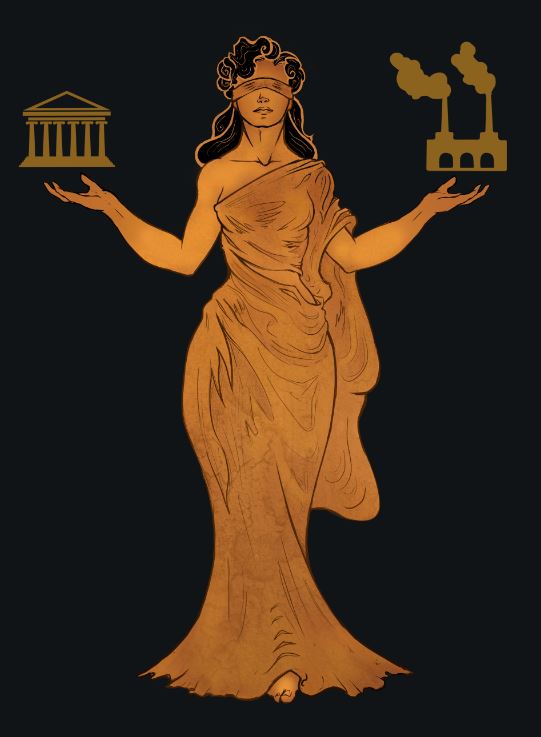

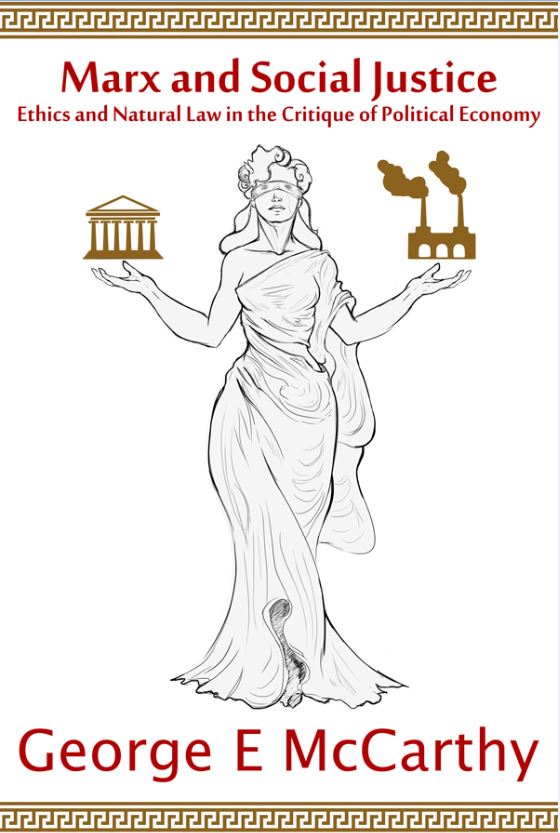
****************************
****************
********
*****
Prose Poem Meditations
on the
Dreams of Reason
Sociology as the Wings of Philosophy
&
Dreams of Ithaca and Social Justice
Sociology, when at its best, is philosophy with wings in search of Ithaka,
theory with praxis, ideas with application, values with facts,
ethics with politics, virtue with political economy, and justice with social science;
that is, it makes ideas and ethics historically and empirically concrete and relevant
to understanding and resolving today's complex social and environmental problems.
Philosophy without Sociology is theoretically speculative, meaningless, and empty --
without Content and Spirit,
whereas Sociology without Philosophy is overwhelmingly factual, visionless, and blind --
without Concepts and Heart.
However, together they offer unlimited horizons, creative visions, and hopeful futures.
(Durkheim regarded both Plato and Aristotle as the first sociologists
in his essay, "Sociology in France in the Nineteenth Century," 1900)
Social Theory, when integrating sociology and philosophy, is the
poetry of the Mind and science of the Spirit. It is the
soulful yearning for human dignity, beauty, and justice
articulated in the political, economic and cultural institutions of society
that, unfortunately today, is lost in a positivist world of
disciplinary fragmentation, surface phenomena, and alienated consciousness.
Philosophy helps give sociology ethical and social purpose, meaning, and ideals --
it encourages sociologists to dream and hope for a better future,
whereas Sociology helps make philosophy historically and socially
real, alive, and practical --
it encourages philosophers to implement and actualize their thoughts in the modern world.
A clear vision and broad range of classical ideals also help make empirical research possible.
They provide the horizons and focus, the breadth and depth for research and science.
Without the integration of sociology and philosophy into a comprehensive and critical
social theory, one only produces a disenchantment and eclipse of reason -- that is,
an endless spinning of metaphysical ideas and mindless accumulation of
empirical facts accompanied by the loss of ethical reason and the
ideals of social justice. This is then followed by a crippling
inability and political unwillingness to resist the distortions
of public and private language and the rise of fascism.
(G. E. M., April 2019)
"Thoughts without Content are Empty,
Intuitions without Concepts are Blind."
(Kant, Critique of Pure Reason, p. 93)
For of the last man in the iron cage, it may truly be said:
"Specialists without Spirit, sensualists without Heart."
(Weber, The Protestant Ethic, p. 182)
Without Content and Spirit -- Without Science: empirical, interpretive, and historical research
and
Without Objective Spirit or Justice: reason, beauty, and self-determination expressed
in objective social, economic, and political institutions
(Hegel, Marx, and Durkheim)
&
Without Concepts and Heart -- Without Ideas: substantive reason and social ideals
and
Without Morality: virtue, sentiment, compassion, and the common good
(Hume, Kant, Hegel, and Weber)
**************
The true power and grace of nineteenth-century Classical Social Theory
lies in its integration of Social Science with Social Justice --
Political Economy and History with Moral Economy and Ethics
Economic Structures, Contradictions, and Crises
with Virtue, Politics, and Democracy
European Sociology with German Philosophy
Classical Social Theory with Classical Greece
English Factory with the Parthenon and Greek Beauty
Moderns with the Ancients
Marx, Weber, and Durkheim with
Epicurus & Aristotle and
Goethe & Schiller
********************
"As you set out for Ithaka
hope your road is a long one,
full of adventure, full of discovery.
Laestrygonians, Cyclops,
angry Poseidon -- don't be afraid of them:
you'll never find things like that on your way
as long as you keep your thoughts raised high,
as long as a rare excitement
stirs your spirit and your body...
Keep Ithaka always in your mind.
Arriving there is what you're destined for..."
(Constantine Cavafy, Ithaka, trans. by
Edmund Keeley, October 1911)
Dramatic reading of Cavafy's full poem "Ithaka"
https://www.youtube.com/watch?v=1n3n2Ox4Yfk
(poem recited by Sean Connery with music by Vangelis)
Searching for Ithaca--
Learning to Dream with
Aesthetic Creativity and Political Ideals
to realize
Classical Beauty and Social Justice
Descent into Darkness
Crossing the Acheron
into the Silence And Shades
of Modern Liberalism
(Integrating Horkheimer, Dante, and Camus)
American Positivism and Analytic Philosophy
have sadly misunderstood and forgotten the
classical and contemporary dreams of European social theory.
They have fragmented and scientized the disciplines just as
they have repressed the social ideals and classical traditions of the academy
to the point where liberal arts is a lonely and isolated political ideology
incapable of reason, dreams, or theoretical visions of the future.
The academy was once an exalted place of hope and purpose, of dedication and
enlightenment, of intellectual and spiritual exploration, of rebellion and ideals,
and of individual growth and communal moral responsibility.
Now all that remains is a marketplace of ideas, soulless empiricism and
mechanical rationalism, formal and disenchanted science, and a
narcissistic and never-ending search for academic recognition
and power accompanied by the desire for metaphysical
solace and material comfort.
We live in an authoritarian world that still yearns for the
classical ideals and dreams of democracy, equality, and freedom,
but has no understanding of what that means or entails.
We see concentration camps and family separation cages for very young
immigrants on our Southern border, watch Nazis and Nationalists march in
the streets with impunity and arrogance, and are astounded by the kidnapping
and arrest of peaceful anti-racist protesters by paramilitary secret police
as we vaguely remember a time past that echoes throughout the present.
We also see a general imprisonment of Americans in camps of
concentrated inequality, poverty, homelessness, shipping container
housing, debilitating debt, poor education, inadequate health care,
and despondent human misery all over the country, even for
those who believe that hard work will set them free or that
compassionate liberalism and the welfare state will provide
for their economic well-being and personal quality of life.
There is a frightening hollowing out of any remaining ethical
and political values in society in favor of corporate power
by the right-wing judiciary and fawning politicians.
It is another form of economic slavery under
the guise of market freedom and natural rights.
It represents just another form of chattel and
wage slavery in the modern ghettos and iron
cages of monopoly capital and the rule of
the political elite and top 1%. And
beyond that, there is no recognition
of their abuse or even need for
immediate social change.
There is predatory and oppressive capitalism, looting and tax evasion,
corporate lobbying, white nationalism, apartheid racism, militarism,
maintenance of a global economic empire, along with homophobia,
misogyny. redlining, dark money, super PACs, gerrymandering,
resegregation, vigilantism, and new Jim Crow laws, voter
intimidation and suppression, legislative election subversion,
and Citizens United publicly revealing the rise of American
fascism; union busting, dehumanizing and mindless work,
massive and pervasive class inequality and worker
oppression, and disruptive and distorting income,
wealth, and power distribution expressed in the
crushing violence and poverty of the mind, body,
and spirit; misplaced personal identities,
paralyzed potentialities, and lost futures;
a market economy of rapacious materialism
and consoling consumerism replacing the
emptiness of our souls and the loss of
our ethical, spiritual, and human needs;
brutish narcissism and nasty egoism
replacing a moral economy of love,
kindness and friendship; false
imprisonment due to race, ethnicity,
and class; and air pollution, global warming,
industrialized farming, ecological crisis
which call into question the sustainability
of the human race. This social system
also leads to a gross incoherence and
amnesic indifference among the adults
accompanied by pervasive anxiety,
growing psychological fear, clinical
depression, self-loathing, and
intense, inner isolation and
loneliness among the young
and vulnerable. There are no
ideals, no hope, no future in
a radically individualistic,
materialistic, and hedonistic
society that has lost all
existential and ethical
direction, purpose, and
meaning in human life.
and life in general.
From Point Comfort, Richmond, Colfax, Tulsa
and Birmingham to Selma and Montgomery,
from Wounded Knee, Manzanar, and
Topaz to Charlottesville,
from Haymarket to Kent State,
from Columbine and Sandy Hook,
Ferguson and Parkland
to Buffalo and Uvalde,
from Hamburg and Dresden
to Tokyo and Nagasaki,
from Korea and Vietnam
to Iran, Iraq, and
Afghanistan,
from Chile and Panama
to El Salvador and Nicaragua,
from firebombings, saturation and
carpet bombings in free-fire zones
against civilians and children
to search and destroy missions,
from social violence, war crimes,
crimes against humanity, and slavery,
there has been mass intolerance,
oppression, and genocide by the
United States unnoticed and hidden
behind a deceptive and deflective
ideology of expanding international
peace, prosperity, and personal
freedom in the early free markets to
neoliberalism. This is not a country
that protects innocent children, families,
and human life. But no one recognizes
these blatant and soul-crushing,
moral outrages, just as sorrowful
and reflective tears fall upon a
desert floor unheard and
unnoticed by anyone.
And they still call this system a democracy?
Have they not lost their sense of
honor, shame, or decency
or for that matter even their sense of irony?
Or are these social pathologies simply economic
and ethical externalities and inconveniences
out of sight and out of mind as we descend
deeper and deeper down the darkened and
perilous path to the same soulless and
tragic end as the shadows of Weimar --
the rise of fascism, nationalism,
militarism, and the capitalist elite.
And all that remains among these frozen and
treacherous shades in the ninth circle is a
tormenting and unreasonable silence
unrelenting without love, trust, or tears.
Today, in our own distinctive world of
tortured and homeless shadows, there
is a sickness and silence unto death
in our concepts, theories, and
actions that are a direct betrayal
of reason, democracy, and
humanity -- Silence is a
betrayal of the dreams
of romantic Ithaka and
social justice.
This void of silence and social justice in the academy is a
product of the "decadence," "disenchantment," "anomie,"
"liquidation" of objective reason, and the "alienation"
and loss of the classical horizons of critical social
theory and its European traditions.
Theory has been displaced and forgotten in the academy by
positivism and its critical questions suppressed by
methodological and scientistic narrowness and purity.
A will to methods and power has replaced ethics and
justice along with our ability to imagine and
speak with strength, depth, and vision.
The end product is a naturalization and
abdication of the critical, public voice
of reason and hope resulting in an
existential and spiritual emptiness,
a nihilistic void of meaning and
purpose in human life, and a
continuing and deepening despair
among the morally uncommitted and
despised souls along the shores
of the Acheron. These wretched souls
are lost in the horrid and blinding
darkness, squalor, and hypocrisy of
Western liberal democracy grounded
in the structures of the --
military industrial complex
neoliberalism
neocolonialism
monopoly capital
class plutocracy
evolving fascism
pervasive racism
ecological crisis
workplace slavery
and caste hatred.
This is a vacuous world of indistinct,
vague shadows among the forgotten
and angry souls of Hades --
people who never stood and
fought at a Thermopylae --
who lived
without meaning and values,
without concepts and ideas,
without hopes and dreams,
and
without compassion and love.
For them, freedom, liberty,
and individual rights meant
property ownership and
wealth accumulation,
market opportunities,
material self-interest,
and consumer choices,
along with a strong distrust
and fear of others.
The essence of humanity's
potential was measured by
the actualities of the market
and not by the ideals and
institutions of the human
spirit and social justice.
Democracy was calculated as
a free market choice of
political consumption and
not viewed as an expression
of humanity's highest ethical
principles of political virtue,
human dignity, and
the common good.
This is an empty, corrupt
world of the morally displaced
and abandoned shades who
cannot remember the past,
cannot change the present,
and
have no hope for the future.
The material and class poverty
of liberalism is matched only by the
degrading and dehumanizing poverty
of its spirit, soul, and ideas.
It is a place in which people can't breathe
because this form of democracy
itself is lifeless --
We all can't breathe.
It is here in the deepest and darkest caverns of mindless anger
and promoted aggression that democracy is eternally confused
and conflated with an oppressive corporate oligarchy
engaged in a monopoly control of the economy and
state. How can it be that so few people in politics
or the academy notice the logical inconsistencies,
contradictions, and incoherence of this position?
How can it be that so few people speak out?
And how have we lost our broad cultural
horizons, collective consciousness, and
creative voice to counter this
hellish barbarism?
The notions of liberal democracy and freedom
with their economic rights and liberties are
ideals and realities of false consciousness
and distorted political economy that
could only have been sustained by
the numbing cries and languishing
screams of those forsaken and
compassionless shades
of chrematistike,
who undermined the ideals of
classical Athens and modern
socialism, and whose
terrifying and distant
sounds can still be heard
coming from the inner
circle of deceitful
traitors beyond
the Acheron.
************************
And then came Trump who only
crystalized these class forms
of economic decay and social
decadence, making worse and
public that which previously had
been hidden and unexamined.
This is part of the unintentional
process of unmasking the ideology,
illusions, and blindness of
modern society as the decline
in ethics, politics, and
ecology only intensifies.
************************
Final Note: Silence After the First Alien
Encounter from Planet B
Presently, we are patiently searching the distant
heavens, stars, and planetary systems for alien
beings with whom we might share our collective
knowledge. experience, and wisdom of
social justice. Unfortunately, we can only
offer them the ethical principles and political
ideals of 'American liberal democracy' that are
based on "militarism, racism, and capitalism."
(MLK, 3/1967)
After the initial encounter with
extraterrestrial sapient life forms,
what can our adventurous and intrepid
star trekkers truly offer these
advanced and knowledgeable beings
when we have nothing to offer ourselves?
Where once there were better angels
and strong, ethical visionaries,
now there are only the "short,
brutish, and nasty." Where once
there were dreams, inspiration,
and light, now there is only
darkness, despair, and silence.
And, where once there was hope
of democratic freedoms, rights,
and institutions, now there is
only exploitative and alienating
pleasures and perversions,
and advertising perniciousness,
class production and property,
privilege and power,
pollution and poverty,
populism and polarization,
politics and plutocracy.
Is this the only true Gift
we have to present to
a remote exoplanet
civilization? It may now
be truly said that the
Beacon on the Hill has
finally gone out due to ---
The Silence of Nihilism and Positivism,
Eclipse of Reason and Justice,
and
Betrayal of Democracy and
Humanity.
************************
However, this is not a time for loneliness,
isolation, fear, resignation, or retreat,
but a time to resist, to imagine, and
to build --
(G. E. M., July 2020)
***************************
*******************
**********
"Keep Ithaka always in your mind..."
and
"Honor to those who in the life they lead
define and guard a Thermopylae.
Never betraying what is right,
consistent and just in all they do
but showing pity also, and compassion..."
(Constantine Cavafy, Thermopylae,
translated by
Edmund Keeley & Philip Sherrard)
"The only thing necessary for the triumph of evil is that
good men should do nothing."
(attributed to Edmund Burke and John Stuart Mill)
"Neither love nor terror makes one blind: indifference makes one blind."
(James Baldwin, If Beale Street Could Talk,
June 17, 1974)
"Silence = Death"
Silence = Death Project
(New York City, 1987)
Due to rise of radical Protestantism, nominalism, and positivism (Hume) --
"Reason has liquidated itself as an agency of
ethical, moral, and religious insight,"
(Max Horkheimer, Eclipse of Reason,
1947)
"Silence is Betrayal,"
(Martin Luther King, Jr., Beyond Vietnam,
Speech on Vietnam War, 1967)
"[W]e are saying that something is wrong with capitalism.
There must be a better distribution of wealth and maybe America
must move toward a democratic socialism."
(MLK, Speech to his Staff, 1966)
"The evils of capitalism are as real as the evils of militarism
and evils of racism."
(MLK, Speech to Southern Christian
Leadership Conference, March 30, 1967)
"We must see now that the evils of racism, economic exploitation
and militarism are all tied together...you can't really get rid of one
without getting rid of the others...the whole structure of American life
must be changed. America is a hypocritical nation and [we] must put [our]
own house in order."
(MLK, Report to Southern Christian Leadership
Conference Staff, May 1967)
"Black capitalism won't save us
You can't end racial inequality with consumerism...or opportunity zones."
(Aaron Ross Coleman, The Nation, May 2018)
"'I can't breathe' is a kind of shorthand for all of the ways that policy
violence is suffocating the life out of people & democracy itself" --
including death and strangulation by police violence, poverty,
class and low wealth, poor health insurance, voter suppression, etc.
(Rev. Dr. William Barber, Twitter, June 12, 2020 and his
sermon "America, Accepting Death Is Not an Option Anymore!,"
June 14, 2020 at https://www.youtube.com/watch?v=SioVKIPltq0)
"First they came for the socialists, and I did not speak out because I was not a socialist.
Then they came for the trade unionists, and I did not speak out because I was not a trade unionist.
Then they came for the Jews, and I did not speak out because I was not a Jew.
Then they came for me and there was no one left to speak for me."
(Martin Niemöller, Post-War Confession of a
German Lutheran Pastor,
1946)
Elie Wiesel, noted Holocaust survivor and Nobel Laureate, said he was often asked
the question: "Where was God at Auschwitz?"
His response was, "Where was Man at Auschwitz?"
(Elie Wiesel, Speech at Kenyon College,
February 23, 1983)
"I swore never to be silent whenever and wherever human beings endure suffering
and humiliation. We must always take sides. Neutrality helps the oppressor,
never the victim. Silence encourages the tormentor, never the tormented.
(Elie Wiesel, Nobel Peace Prize Speech, 1986)
"At its core the work of justice is the work of the heart, the work of love:
exasperating, unexpected, reconciling, fully human, fearless and flawed.
Love and justice are not about success or failure, but about the human work
to which they call us all. Education without a commitment to social responsibility
and justice, without conscience, is ultimately an empty way of living.
Remember - remember - that the only legacy of value we leave behind us is love.
That is the great final lesson for our wild and precious life."
(Royal Rhodes, "What I Hope My Life and Teaching Have Meant,"
prose poem, June 2, 2026)
"The liberal arts of the humanities and social sciences in the American academy
have lost the ideals and traditions of a true democracy and community of social justice.
They have lost the ability to dream beyond the present with a vision of a
more humane and caring society based on love, friendship, and compassion.
There are no real concepts and thoughts left beyond American self-interest, greed,
and materialism within a capitalist democracy nor ideas of a future in which all
human beings are free from racial, gender, and class inequality. There is only the
oppression of a present authoritarian oligarchy and corporate elite masking themselves
with the illusions of fairness and wisdom which now permeates the inner core of
American liberal arts education. And, as the academy becomes more specialized,
more scientific, more technical, and more fragmented, we can only anticipate a
further narrowing and eclipse of reason. We are presently experiencing the
death of dreams of social justice in an academy without continental social theory,
political economy, progressive economics, history, social justice, and the
classical traditions of the ancient Hebrews, Hellenes, and Hellenists -- from the
legal codes of Deuteronomy and Leviticus and the social ideals of the Jewish prophets,
the ethics and political philosophy of the ancient Greeks to the Synoptic Gospels
of the early Christians. Camus was right:
We are living among the silent and unrecognized shades of the Acheron."
(George E. McCarthy, "Death of Dreams in the American Academy," June 8, 2026)
"American Exceptionalism:
Greatest income and wealth inequality, highest poverty rate
Greatest number of children in poverty, worst child well-being
Lowest social mobility, highest health care costs
Most people with no health care, highest infant mortality rate
Highest obesity rate, highest anti-depressant use
Shortest life-expectancy at birth
Highest carbon emissions, worst gender inequality
Highest military spending, most arms sales
Highest incarceration rate, worst murder rate"
(Internet Satire based on the following: top 10% of
American households own 70% of U.S. total wealth;
middle class and upper middle class own 28% of wealth;
and the bottom 50% own 1-2.5% of U.S. wealth.
The top 10 richest individuals own more wealth
than the bottom 50% of Americans)
(Satirical Political Meme on the Internet, April 8, 2015)
Old and New Testament Love vs. Trump's One Big Beautiful Bill (OBBBA, July 4, 2025) and More
Old Testament: Deuteronomy 10:18-19; Leviticus 19:9-10 and 23:22;
Proverbs 19:37; Exodus 15:26; and Jeremiah 30-17
New Testament: Luke 10:25-37; Matthew 25:31-46, 4:23,
14:13-21, and 10:8; and James 1:27.
"Love Thy Neighbor vs. Tax Cuts of over 1 trillion dollars for the wealthy and large
corporations, and cutting funds for the Child Tax Credit and Higher Education Programs.
This occurs at a time when the federal deficit is over $40 trillion. These tax
and benefit cuts help reinforce the class system where the top 10% of American
households own nearly 80% of the nation's wealth and the net worth of the top 1% of
households is $38 million to the detriment of democratic equality, fraternity, the
common good, and general welfare. Sixty percent of American adults live paycheck
to paycheck and more than 1/3 of households have less than $400 in the bank, while
the median compensation for top CEOs is between $17 and $30 million annually.
All this has occurred while the President of the U.S. has been found guilty of
grifted corruption, business and tax fraud, and self-enrichment of over $2 billion
in the past year. The Supreme Court just weakened the equal rights and anti-
discrimination clause in the Voting Rights Act of 1965 (Section 2) that protected
racial minorities from the creation of gerrymandered districts specifically
intended to weaken their voting power. Trump continues to attempt to
'Save America' by voter suppression, election interference, eliminating
mail-in voting, intimidation of voters by the collection of voting and
personal information, the presence of ICE and government officials as
election monitors, suspension of civil rights, providing government
access to election ballots and creating a national security emergency that
contests and cancels election results, and dismantling the Campaign Finance
Laws of the 1970s by permitting political parties unlimited and coordinated
private campaign fund raising and spending on political candidates
based on the principle of free speech. Citizens United and Save America
Act were designed to undermine and buy fair elections and repress
public discussions about real structural, social, and class issues
facing Americans. These issues were to be decided not by our
neighbors, but by billionaires and large corporations who could buy
free speech, liberal democracy, and American elections. Elon Musk
donated $250 million to Trump's 2024 presidential campaign. To
further these ends, there was an attempt to repeal Birthright
Citizenship and limit the large immigrant population in the U.S.
All these proposals undermine the civic community of neighbors
voters and could potentially disenfranchise millions of Americans,
while further ensuring the stability and power of an
unenlightened, white nationalist autocracy.
Feed the Poor vs. Cutting Safety Net for the poor by slashing food benefits in SNAP,
WIC, NSLP, CEP, TEFAP, Head Start, summer food assistance programs for
children, in EBT and SFSP, and Medicaid programs, and accelerating
the insolvency date for Social Security benefits which are
scheduled to be down 20% by 2032. And, at this moment,
776,000 children are no longer receiving SNAP food assistance,
1 in 5 American children live in hunger with not enough nutritious
food for a healthy life, and 13 million children live in
systemic poverty. And all this when we are spending
close to $1.5 trillion a year on the military-industrial
complex, continuous, never-ending wars, and the
maintenance of the worldwide American empire
and the rule of the wealthy.
Welcome the Stranger and Foreigner vs. identifying and arresting 2,000 to 3,000
immigrants per day, dropping Medicare benefits for immigrants, placing immigrants
and foreigners with their families and young children in violent, abusive,
and for-profit ICE concentration camps, imprisoning over 500 toddlers and
babies since the beginning of Trump's second term without appropriate food and
health care, mass deporting of millions of people to other countries, and dismantling
of USAID that could result in the death of 9.4 million foreigners by 2030. And
today (6/25/26), the Supreme Court issued a decision of 'blind racism' that could end
the Temporary Protected Status (TPS) for over 300,000 Haitians and Syrians
and affect over 1.3 million foreigners and migrants who could
then be detained and deported from the U.S. A second decision made by
the Court referenced the Southern Border Policy making it more
difficult for foreigners to seek refuge and asylum in the U.S.
Some have likened this to the turning away of 937 Jewish
refugees fleeing Nazi Germany in 1939 who arrived at
the U.S. by sea, but were not granted asylum
and were forced to return to Europe where
28% died in concentration camps. Shockingly, there
were only 913 Jewish refugees officially admitted
to the U.S. by Roosevelt during the WWII and they
were held in a detention camp at Fort Ontario, NY.
Heal the Sick vs. creating financial instability in hospitals resulting in the closing of
rural hospitals, rising medical debt, rising health insurance costs, cutting health care
benefits and subsidies for the poor and lower class in Medicare, the Affordable Care
Act (ACA) tax credits and CHIP, and slashing Medicaid benefits by 1 trillion dollars
resulting in 20 million individuals losing health care coverage. This will place
enormous financial and staff burdens on hospitals and the medical system resulting
in an estimated 16,000 to 51,000 preventable deaths each year. As a result
of these changes more people will lose their health insurance, more
people will get sick, more people will need medical care, more medical
facilities and staff will be overwhelmed, and more people will die."
So Much for the Moral Imperative to Care for One's Neighbor, the Poor,
the Stranger, and the Sick in the Hebrew Torah and Prophets,
and the Synoptic Gospels
"Issues of ancient, classical, and modern ethics, social justice,
and democracy are not compatible with the values and
institutions of modern capitalism. This may help explain
why the U.S. is classified as a "flawed democracy" and
ranked 34th in the world among leading democratic
countries in the Economist Group Democracy Index,
23rd in the World Happiness Report by the
Wellbeing Research Centre at the University of
Oxford, 64th in the World Press Freedom Index,
and last globally among high-income nations in its
healthcare system by the Commonwealth Fund.
Today is ironically July 4, 2026, the 250th
anniversary of the signing of the "Declaration
of Independence" and founding of the United States.
After all this time, we haven't seemed to learn
much about the principles, ideals, and history
of a true democracy and moral or communal
economy. It is sad to say, but Americans still do
not know or dream of Social Justice. They appear to
care for the poor, the sick, and the elderly, but only
from within the limited perspective of liberalism, a
market economy, and the welfare state.
Republicans argue for market freedoms, individual liberties,
limited government, pro-growth policy, corporate deregulation,
individual meritocracy, lower taxes for the wealthy in
trickle-down economics, fiscal responsibility, national security,
higher military spending, and boarder security. They support
Citizens United, more dark money, Super PACs, and corporate
lobbyists in an attempt to directly influence elections and to
further limit political campaign finance restrictions as they
advocate for election gerrymandering, undermining workers'
rights while protecting gun rights, raising the national debt,
supporting racial and ethnic profiling, undermining the voting
and civil rights acts of the 1960s, government censorship (FCC)
of free speech and news agencies, dismantling large parts of the
state bureaucracy for greater authoritarian control by the
the executive branch, in particular CISA the cybersecurity
agency protecting against election interference, using state
and local fusion centers to gather information against
immigrants to facilitate their arrest and expulsion from
the U.S. by the secret police (ICE), eliminating
Diversity, Equity, and Inclusion (DEI) programs, and the
ending of Temporary Protective Status (TPS) for hundreds
of thousands of immigrants from Haiti and Syria. The
results are remigration and the creation of a new historical
and racist period of Redemption and Terror through voter
intimidation and suppression, and more recently approving
detention centers, mass deportation, and ICE illegal
searches, disruption of protests, and the murders
of non-violent protesters and immigrants. The DHS
has in its Operation Puppet Master also initiated a
secret undercover government surveillance of political
protesters and groups who are engaged in resistance
to its immigration policy and its political violence
and cruelty in order to gather personal and financial
information to be used later to undermine election
integrity and the validity of election results.
In addition, the collection by Kristi Noem
of state voter records looking for fraud
has been viewed by some as preparation
for a possible rejection and overthrow
of the next presidential election in
2028, using the Insurrectionist Act, ICE,
DHS, DOJ, and the pardoned January 6
insurrectionists as a private militia.
Republicans are said to hold the principles of a pro-life party
except for their support for military spending, foreign wars,
extensive civilian deaths, gun rights and violence, cuts in
health care policies and their implications for domestic and
world hunger, reductions in ecological policies that negatively
affect the environment and human life, and maintenance of an
oppressive neo-colonial empire and rising authoritarian state.
They have used the Department of Government Efficiency (DOGE)
headed by Elon Musk for its massive purging within essential
government agencies, including the Departments of Defense,
Treasury, Agriculture, Health, and Education. These changes
in Trump's second term also included the hollowing out of
the Department of Justice by the resignation of over
3,000 senior lawyers following the government's
administrative policies and direct political interference
in legal and civil rights cases. Also, extensive cuts by
Trump were made to Medicare, Medicaid, and Obamacare in
his One Big Beautiful Bill Act, which included dismantling
various programs and policies of the Social Safety Net
and public health infrastructure, including general health
care, vaccinations and disease control, rural hospitals, and
crucial medical research and professionals in the federal
agencies of the CDC, NIH, and FDA, and also extensive cuts
in civilian foreign aid in USAID to the poorest countries
resulting in millions of children under 5 dying over the
next few years. Musk has referred to USAID, which feeds
about 60 million poor and hungry people annually, as a
'criminal organization'. And all this was done to help
pay for the massive tax cuts of more than $1 trillion
over the next ten years for wealthy billionaires.
Millions will die, so billionaires can live better lives.
What does this say about those who believe in the
Old and New Testament ethical doctrines of caring for
the sick, homeless, poor, and strangers? What does
this say about American ideals of democracy and
social justice? Have these religious and political
traditions all been lost and forgotten? Trump, who
failed in the 2020 election, attempted a violent coup
at the nation's Capitol to overthrow the fairly and
legally elected Joe Biden in order to regain the
presidency and then, later in his second term,
pardoned and commuted those engaged in this
violent political action. It is in his second
term that he intensified this culture of
corruption and racism, presidential profiteering and
corporate extortion, deception and class exploitation through
corporate bribery, political slush funds, and even
government purchasing of minority ownership in 30 private
corporations. He has reduced the DOJ's investigations into
large multinational corporation and corporate elite fraud
cases and redirected its attention to smaller-scale,
lower-level employee and government waste cases
in the hope of encouraging more corporate
contributions to his various political and
gilded monument projects, as he continues
to cut crucial social welfare programs
and federal agencies that protect American
health, safety, and financial security.
A congressional staff report, 'Pardons, Inc.'
claims that Trump has a cash-for-clemency
system for wealthy corporate executives found
guilty of financial and corporate fraud. They
are given pardons in exchange for massive
monetary donations. The executive branch
of government has even been able to
integrate the Supreme Court, Congress,
the DOJ, FBI, billionaires, and large
corporations into its web of
power, corruption, and abuse.
Republicans say they are pro-life at the same time they
reject many life-affirming activities and basic
human needs, such as the
-- Universal and Necessary Human Need for --
women's and workers' rights, health care,
living wages, education, quality work,
and affordable food and housing in the
richest country in the world that would
make life more meaningful, loving,
caring, joyful, democratic, and just.
Unfortunately, these are not the ethical
and political values of corporate capitalism,
whose heart lies in the crudest values of
Hobbesian possessive and corrupted
individualism, class maintained
private property, corporate power,
oligarchic greed and self-interest,
and extensive spiritual and physical
poverty and human suffering for a
large number of Americans. These
Republican ideals of meritocracy
and power of the wealthy are not
the heart and soul of democracy,
equality, and freedom. Rather,
their political ideal is 'a government
of the corporations, by the billionaires,
and for the special interests.'
(A.L., "Gettysburg Address," 1863
revised by E.S., Aug. 5, 2026)
And further, their economic ideal is an
economy 'from each according to their
forced and exploited labor, to each
according to their business success,
class status, and wealth'.
(Luke, Acts 2:45 revised by G.E.M, Aug. 7, 2026)
All these political actions by the Republicans
in control of the state have been done in order
to maintain their political and economic power,
while they continue to cut social welfare, food
aid to hungry children, along with poverty, retirement,
and educational benefits, and deny global warming,
climate science, and environmental regulations
as they downsize the EPA. However, they want to
dismantle the Welfare State for the poor and
strengthen the authoritarian Deep State for the wealthy --
Oligarchy and Monopoly Capital over Democracy and
Equality. In the end, they have systematically and
continuously failed to realize that the real purpose of
the Welfare State is to support, hide, and repress the
general exploitation and manipulation of workers, the
middle class, and the poor under the false illusions
of democracy, market fairness and freedom, personal
liberties and individual merit and accomplishments in
a repressive market economy. Republicans have failed
to realize that the actual role of the Welfare State
in American society is that of a necessary,
ideological, and structural support of the
Deep State and its oppressive
corporate economy.
On the other hand, Democrats want to expand education,
health care, and retirement benefits, minimum and living
wages, environmental protection, a progressive tax system,
civil and labor rights, social welfare programs,
reproductive freedoms, helping the poor and lower
classes with food and housing, and supporting
feminism and voting rights. The Democrats appear
to be more compassionate and caring than Republicans,
but to different degrees both approaches are distorted
forms of false consciousness and political
ideology since neither sees nor understands,
questions nor challenges, theorizes nor acts
to change the deep underlying structural and
economic inequality and poverty of their own
class system based upon a 'poor, nasty. and
brutish war of all against all' between
the wealthy and lower classes, gender
and racial discrimination, monopoly
capital, labor exploitation, voter
interference and suppression by dark money,
the isolation, anxiety, and fear created by
social media and debilitating individualism, a
pathological oligarchy bordering on fascism,
and the loss of a moral economy, egalitarian
community, predistribution, and the real ethical
and social possibilities of a genuine democracy.
Democrats instead focus on the surface and
quantitative phenomena of affordability,
inflation, general costs and prices, poverty,
healthcare, education, etc. -- which are
very important, but unfortunately never get to
the underlying root causes and structural
foundations of these forms of social pathology
in the institutions and culture of American
capitalism -- wealth, property, power,
class, corruption, corporations, and capital.
Where Republicans believe in free market
rationality and individual rights and freedom,
liberal individualism and representative
government, the actual economic and political
reality in America, on the contrary, is one of
class power and unrelenting conflict reflected
in its multinational corporations, oligarchy,
and autocracy that control the economy and
state for their own benefit and pleasure. These
institutions and structures make substantive
and liberational change nearly impossible.
We have to come up with a new creative
understanding of the traditions of democracy,
equality, freedom, and social justice.
This is the Silence of Language and Reason causing
America's 'Fall.' In the past 250 years, America
has only created Liberal Democracy --
'Militarism, Racism, and Materialism'.
("The Three Evils of Society," MLK,
Aug. 1967). Have we completely lost
our concepts and ideals, our hopes
and our future? Why can't we see
beyond the surface phenomena of society?
Have we lost our ability to develop critical
social theories about the deep structures
and social institutions of contemporary
political economy? Democrats seem to have
more heart than Republicans, but neither
are able to get to the heart of these complex
economic and historical problems in
American society. What does this say about our
political and educational systems that we really
do not understand this lost speech, eclipse
of ethics and social theory, and the silence
of critical language and concepts that make
social action and change possible?
As the social sciences -- Psychology, Economics,
Political Science, and Sociology -- move more
and more toward the methods and theories of
positivism and the natural sciences, and as
the humanities -- Culture, History, Arts,
Literature, Philosophy, and Language -- move
more and more away from the social sciences,
they encounter the 'Shadows of the Enlightenment'.
In the process they unfortunately lose the
essential ideas and traditions for a true
critical and reflective science of modern
life and a vision for the future. Some
say that 'Democracy dies in Darkness'
(WP), but the expanded truth is that Democracy
dies in the Darkness of Crony Capitalism and
the Enlightenment. The former kills humanity
in its economic quest to dominate labor,
the market, and wealth, while the latter
kills nature in its scientific quest
to dominate the environment,
technology, and industry. And
along with the death of democracy
follows the death of both social
dreamers and the inspiration and
memory of their dreams.
Should American now start looking to the Nordic
countries for our democracy, dreams, and
inspiration, at the same time we reconstruct
and reconsider the past ideals and paths
to social justice in the writings of the
Ancient Hebrews, Greeks, Hellenists,
Medieval Christians, and Early Socialists,
to the modern social philosophers of
Continental Philosophy, Liberation Theology,
the Frankfurt School, and Radical Political
Economics of URPE? Both Political
and Economic Democracy 'of the people
and by the people' are the foundations
for Social Justice -- participatory democracy
and a moral economy are the real social
bedrock upon which rest the common good,
general welfare, and an egalitarian
community of individual freedom,
worker creativity and self-determination,
and human happiness in both the polity
and the economy. This is the true Spirit
and Heart of Humanity from the call for
biblical compassion, friendship, and
love, the longing for ancient Ithaca
and the classical Athenian polis, and
the search by modern European philosophers
for social ethics and justice, to the
contemporary odyssey of the socialists'
journey to democracy and social justice.
This ability to Dream of a better,
more loving, and more caring
world reflects the true
Beauty and Wisdom of Humanity.
But, unfortunately and sadly, the
principles of love, compassion,
friendship, community, and moral
economy at the foundation of ancient
Hebrew, Greek, and Medieval societies --
no matter how limited and unrealized
they were within their own historical moment --
are incompatible with modern capitalism
and its values of self-interest,
greed, profits, materialism, class
inequality and oligarchy, possessive
individualism, poverty, militarism,
racism, and neocolonialism. The solution
to these social problems cannot be resolved
through liberal democracy or capitalism.
It is capitalism and liberalism which
are their cause. The real answer lies
in the integration of the Beauty and
Inspiration of classical and communal
democracy with modern socialism."
(G. McCarthy, "Eclipse of Compassion and Language in America," July 4, 2026)
The Need for a New Vision and New Hope for the Future
"With American Exceptionalism and American Capitalism,
with the growing poverty and inequality of income, wealth,
housing, food, health care, education, and employment,
with growing human misery and the decline of the human spirit,
with the undermining of the last vestiges of American democracy
by an unrestrained market economy, oligarchy, and autocracy,
and also by Citizens United, Super PACs, and Dark Money,
we must seek a new Vision and new Hope for American society
based on love, compassion, equality, community, freedom,
and political and economic democracy.
And this must begin before we forget that there was a
time we once had Dreams of Democracy and Social Justice.
We must begin before the tyranny of the wealthy or global
warming ends humanity's stewardship of the earth and
the ability to imagine and create a new future.
Too many Americans live in cultural and economic
poverty, but many also live in an existential and spiritual
Poverty of Dreams and Thoughts. The real danger in
today's society is that we do not have the language,
ideas, or theories of a free, egalitarian, and
caring moral community that can help guide us
into the future. Concern for the poor, dispossessed
and homeless is always phrased within a capitalist
economy which is built on structural inequality, class,
poverty, self-interest, and monopoly capital.
Solutions to these social problems unconsciously
accept the underling structural causes of the
problems as their initial starting point of
analysis and solutions. Politicians do not
realize that their recommended solutions are,
in fact, the actual causes of these very problems.
Capitalism is the cause of these problems,
not their solution. We must move beyond
and free ourselves from this outdated
and oppressive vocabulary which is the
hallmark of our political and educational
systems today.
At the moment, we are sadly lost and without
inspiration, imagination, or direction. We are
in the 'bourgeois hell' of the silence of reason
and moral thought of Camus's The Fall.
The betrayal of language results in the
death of humanity and its visions, as
well as the 'abandonment of all hope.'
Who could have imagined that we could
have traveled deeper past the Acheron
into the silence and emptiness of the
inner circles of capitalist society
since Camus's post-WWII novel.
What we desperately need now is
a new, broader, and clearer vision of
political and economic democracy
and a more comprehensive view of the
values of community, freedom, equality,
citizenship, and human rights from the
academy and polity. The 250 years of a
violent and Hobbesian capitalist democracy
have run their course and should now
be replaced by a more peaceful,
caring, and creative society.
What we really need is a life-affirming
country that cares for the well-being
of all its citizens and not just the
wealthy few. It is truly sad that a
nation like the U.S., with its
rich history, accomplishments,
and possibilities, is so blind
and speechless with regards to the
future horizons of a true democracy.
There is no Beauty in its Language,
no Vision in its Speech;
there is no Grace in its Soul,
no Self-Awareness in its Memory.
It has lost the Intellect, Heart, and
Spirit of the Ancient Traditions.
It has become a Blind and Silent
Country without Thought and Hope,
without Imagination and Reason,
without Insights and Ideals,
lost in the inner concentric
circles of Washington D.C.
without a Virgil to guide us
to a worldly paradise of
social justice and an ethical
life of communal happiness --
public virtue, civic duty, practical
reason, and moral excellence."
(G. McCarthy, "Dream Now and Keep Hope Alive," June 21, 2026)
Louis Brandeis, before he became a Supreme Court Justice, said in 1910:
"We can have democracy in this country, or we can have great wealth
concentrated in the hands of a few, but we can't have both."
(Louis Brandeis, spoken in 1910)
"Socialism is secular Christianity," Fanny Howe
(line in poem, Jacket Magazine, 2009)
Critical of the economic and educational evils of American capitalism --
crippling of individuals through self-interest, greed, and competition,
Albert Eienstein once wrote: "I am convinced there is only one way to
eliminate these grave evils, namely through the establishment
of a socialist economy, accompanied by an educational system which would be
oriented toward social goals." Referring to the educational system in
American he said: "This crippling of individuals I consider the worst evil
of capitalism. Our whole educational system suffers from this evil".
(Albert Einstein, "Why Socialism," 1949)
"Democracy and capitalism are incompatible social systems. Democracy requires
individual equality, freedom, workers' rights and control, and a strong
ethical and political community with a firm commitment to the
common good and general welfare to enhance worker nobility,
human dignity, and public discourse and participation in
both the polity and the economy, while capitalism
produces only self-interest, Hobbesian greed,
worker exploitation, concentrated wealth,
class inequality, extensive poverty,
political oligarchies, gilded
elites, class and racial
antagonisms, forever
warfare, and
continuous and
unending human
insecurity,
degradation,
and misery."
(George E. McCarthy, August 2025)
"A country based on massive income and wealth inequality, corporate capitalism in
a private market economy, and an oligarchic political system with extensive
poverty and welfare programs for the poor, including Medicaid, ACA
(Obamacare), SNAP, CHIP, TANF, WIC, SSI, Head Start, and LIHEAP
benefits, minimum wages, etc. cannot by any stretch of the
imagination be conceived of as a real democracy.
Democracy is only possible in a decentralized,
equal, and free form of worker self-determination
and participation in both politics and production.
Democrats and Republicans always talk past
each other and past the important
questions because they never
discuss the underlying
structures of power
and class in
society."
(George E. McCarthy, Nov. 4, 2025)
"A country that cannot provide adequate food, housing, health
care, and education -- basic human rights -- for its
citizens cannot be considered by any reasonable
standard to be a real democracy "
(George E. McCarthy, Nov. 1, 2025)
"And they say Americans should believe in
and love their country:
But who is going to love the poor,
hungry, and homeless?
Who is going to love the children who
suffer from exploitation, child labor,
trafficking, gun violence, and death
at such an early age?
Who is going to love the elderly and
and sick who have lost their
health care and welfare benefits?
Who is going to love the
poorly educated and those
left behind in the economy?
And, who is going to love
all those forgotten by the
rich and powerful in an
unmerciful and unforgiving
class system in America?
And these self-anointed
Patriots continue to
cry out without
awareness, shame,
or guilt that people
should love their
country and God."
(G.E.M., December 20, 2025)
Throughout the Old and New Testaments of
the Bible there is a clear and demanding
moral imperative that human beings --
Love their Neighbor,
Feed the Poor,
Heal the Sick, and
Welcome Strangers.
These Jewish and Christian traditions
are now intimately connected and
forever bonded with the
structural principles and
social ideals of democratic
socialism."
(G.E.M., December 25, 2025)
"Please, sir, may I have some more."
(Charles Dickens, Oliver Twist, 1838
and again in the U.S. in Nov 2025)
Democracy without Socialism is not a Democracy.
A true democracy requires both political and
economic freedoms, rights, and equality.
A democracy without worker collectives
and shared property ownership is not
a real democracy, but a political
system run by the ruling oligarchy
of citizens united and hidden
beneath the shadows of the
distorting political
ideologies of market
freedom and liberalism.
John Stuart Mill, Principles of Political Economy
(1871) and "Chapters On Socialism" in vol. 5 of his
The Collected Works (1879)
American democracy has become an example of the "eclipse of reason" ---
the loss of meaning, purpose, ethics, and objective
reason in society because of the Enlightenment,
positivism, and science and the "middle-class
hell" of existentialism -- silence of
traitors without language, ideals,
vision, dreams, and social
justice because of
utilitarianism and
liberalism.
As we cross the Acheron and Hudson with Charon to enter the United
States, we notice a land characterized by the "deafening silence
of the primeval forest, heavy with threats," and "peopled with
bad dreams." It is a land of silent shadows and voiceless
reason inhabited by traitors to humanity in the face of
moral decadence, ecological disdain, and political
evil. Perhaps the saddest and most cowardly of
these wretched souls are those who lived
quietly and indifferently "without
disgrace, yet without praise."
And inscribed on its gilded
and marble entrance gate
is the decree to
"Abandon all hope,
ye who enter here."
(Expanding Dante, The Inferno, 1321,
Camus, The Fall, 1956, and
Horkheimer, Eclipse of Reason, 1947)
"Where there is no vision, people perish."
{Proverbs 29:18)
"From each according to their ability,
to each according to their needs."
(Marx, Critique of the Gotha Program," 1875,
variations of this phrase are also found in
Acts 4: 35; Matthew 25:15, and
Acts 11:29)
"Christ led me to Marx...For me, the four gospels are all equally communist."
(Father Ernesto Cardenal, Catholic poet and revolutionary,
1984 interview mentioned in The New York Times Obituary,
March 2, 2020)
"I like your Christ. I do not like your Christians.
Your Christian are so unlike your Christ."
(Mahatma Gandhi)
Honor to the memory of the German students of the White Rose at the University
of Munich in the early 1940s who did not remain silent but
resisted Hitler and Nazism.
(Richard Hanser, A Noble Treason)
Watch the movies Die Weisse Rose and Sophie Scholl
See the tribute to the members of the White Rose
by Stephan Beneking at
https://www.youtube.com/watch?v=E9DAShTtd44
and also see the short award winning 2012 documentary
"The Legacy of the White Rose" at
https://www.youtube.com/watch?v=767yxeIreF4
NEVER AGAIN --
GENOCIDE, HUMAN RIGHTS ABUSE, OR
ECONOMIC, POLITICAL, AND CLASS OPPRESSION
NEVER AGAIN AGAINST ANY RELIGIOUS, ETHNIC,
RACIAL, GENDER, WORKING-CLASS, POOR,
OR POLITICAL GROUP
NEVER AGAIN FOR ALL PEOPLE
NEVER AGAIN
AND
NEVER FORGET



WIKIPEDIA
ARISTOTELIAN PHILOSOPHERS
HERBERT MARCUSE OFFICIAL WEBSITE
DIGITAL KENYON GALLERY
THE ONLINE COMPUTER LIBRARY CENTER (OCLC)
WORLDCAT IDENTITIES: BOOKS
https://en.wikipedia.org/wiki/George_E._McCarthy
https://en.wikipedia.org/wiki/Category:Aristotelian_philosophers
https://www.marcuse.org/herbert/scholars-activists/george-e-mccarthy.html
https://works.bepress.com/george_mccarthy/
https://www.kenyon.edu/directory/mac-mccarthy/
and
http://worldcat.org/identities/lccn-n87917357/
****************************
SOCIOLOGY AT A DISTANCE
Sociology is a discipline created in the 19th and early 20th century in Continental Europe to explore the nature of modern industrial society. It is distinctive in that it focuses on the totality of society with special emphasis on its economic and political structures and institutions and how they affect the development of other social institutions, individual psychology and identity, social class and consciousness, culture, values, ideals, and modern science (Parsons and Habermas). It is a holistic discipline that comprehends the complex and interconnected parts of the total social system, thus requiring multiple methods and theories to understand the enormous breadth and depth of modern society. That is, its goal is to examine the interaction of all social institutions in creating the comprehensive system of capitalism and liberalism and making critical evaluations of its political economy, social institutions, and culture based on the ethical ideals from Classical Greece to Modern Philosophy. From this perspective, sociology is applied philosophy that joins together the ideals and ethics of philosophy with the historical and critical science of sociology. In this way sociology moves from ethics to politics, philosophy to political economy, moral philosophy to moral economy, epistemology to sociology of knowledge and science, and political philosophy to social theory. It makes philosophy -- its hopes, ideals, imagination, and horizons -- real, concrete, historical, and relevant.
With the growing specialization, scientization (nominalism and positivism), and fragmentation of both the humanities and social sciences in the American academy, the Classical and Continental approach to the study of society is becoming more and more important, while it becomes a more and more difficult, if not impossible, task today. In this context, it is relevant to remember that Durkheim argued in one of his earliest writings, "Sociology in France in the Nineteenth Century," 1900, that Plato and Aristotle were the first sociologists, while Horkheimer maintained in his lectures at Columbia University in February and March of 1944, as mentioned above, that the critical sociologists might be the last with the growing dialectic and eclipse of reason, theory, and the classical traditions in the American academy. Horkheimer's concerns about the broader implications of the technical rationalization and formal disenchantment of society only intensified his growing fears of the rise of fascism in the United States. "Reason has been liquidated" as a form of objective and substantive concepts, ideas, and theories; we are lost without a sense of the past or a vision of the future. The implications of this Holocaust of Ideas is that we have no poetic language, no aesthetic imagination, and no concrete historical hope for a just society. Without reason and the ability to form ethical and political concepts, without the ability to see beyond the present, without the ability of reason to move beyond one simple scientific and naturalistic method in the social sciences, and without the ability to form a comprehensive and holistic theory and critical vision of the future, we are losing the capacity to frame the ideals, institutions, and historical images of a democratic and socialist society. Social theory and social justice are being replaced today by the narrowing hypothesis construction, social explanations, and empirical predictions of technical social science -- the dark side or shadows of the Enlightenment. According to Horkheimer, the signs of rising fascism are expressed in the loss of objective and critical reason; rise of technical, pragmatic, and positivistic science; loss of community and communal values; reduction of democracy to self-interest, consumerism, market rationality, efficiency, and tolerance; transformation of the state into an aggressive, oppressive, and authoritarian Leviathan; and, finally, reduction of formal reason into moral and political nihilism and relativism. Even the theoretical and philosophical ability to resist fascism in the academy is being seriously undermined (Horkheimer, Eclipse of Reason, pp. 18-31).
Horkheimer's fears of fascism and the loss of social theory -- Sociology as a Science without Social Theory -- are now in the second decade of the twenty-first century becoming more evident, real, and magnified than ever before. With the death of theory, who can resist fascism; where are the voices for fairness, democracy, equality, and freedom; and what has become of the liberal arts in the American academy other than as a vehicle for the functional and ideological rationalization of these dramatic changes to society and education? On the other hand, turning sociology into a form of aesthetic labor and poetic imagination would broaden the range of theories and methods in critical, historical social theory and create the conditions for the integration of History, Political Economy, and Philosophy. Under these conditions, sociology would be inspired by the past, enlightened by the present, and beckoned by the future, thereby integrating romantic ideals, empirical reality, and the longing for social justice.
SOCIOLOGY
&
PHILOSOPHY AND HISTORY
Sociology seeks to answer questions such as: How do economic and political institutions in American society influence its culture, values, and ideals? How do these ideals, in turn, act back upon and influence these institutions? How do American social and political ideals justify and legitimate modern society? How does the transformation of American political economy in the past half-century toward monopoly capitalism and the military-industrial complex affect the class structure, distribution of income and wealth, chances for social mobility, patterns of racism and sexism, medicine and health care, ecological crisis, and opportunities for true democracy and social justice? And what is a good and just society? What are the different schools of social and political thought which discuss these issues of ethics and social justice? The answers to these questions require that we see sociology as both an historical and philosophical discipline. Philosophy and history are related disciplines, as they form the heart and soul of sociology.
The classical sociologists of the nineteenth and twentieth centuries were all trained in philosophy: Karl Marx in the writings of Epicurus, Democritus, Aristotle, Locke, Kant, Hegel, Rousseau, Smith, Spinoza, Schiller, Heine, and the Left Hegelians: Strauss, Bauer, Feuerbach, Ruge, and Stirner; Max Weber in the works of Kant, Hegel, Rickert, and Nietzsche; Emile Durkheim in Plato, Kant, Rousseau, Montesquieu, and Schopenhauer (he also taught philosophy at various lycees or state secondary schools of Sens, Saint-Quentin, and Troyes between 1882 and 1887 and social philosophy and social science at the University of Bordeaux between 1887-1902); Freud in Plato, Schopenhauer, Feuerbach, Nietzsche and Brentano (Freud took five philosophy courses with Franz Brentano at the University of Vienna between 1874 and 1876); and George Herbert Mead in Kant, James, Dewey, Hegel, and Dilthey. Adjusting Kant's famous phrase about intuitions and concepts from the Critique of Pure Reason, it may truly be said that Sociology without Philosophy is directionless, aimless, and Blind, while Philosophy without Sociology is abstract, meaningless, and Empty. Philosophy gives Sociology vision and life to Dream, while Sociology gives Philosophy empirical substance and historical content to Act and to Create. Separating them into distinct and disparate disciplines -- just as separating Aristotle's Ethics from his Politics or Marx's Philosophy from his Political Economy -- makes both irrelevant to the creation of an enlightened, free, and democratic community -- whether that is the academy or polis. This is the "eclipse of reason" within the American academy that replaces political enlightenment and moral courage with frozen tranquility and social blindness. And even when there is awareness of particular social problems, they are usually isolated and disconnected from any comprehensive, cohesive, and critical theory of political economy capable of offering concrete and structural solutions necessary for radical social change. The isolation and specialization within the academy lead to social moralizing and ineffective and abstract criticism, but not to a recognition of the real historical and economic foundations of present-day social and cultural issues. This is why it is so easy to deflect and displace serious structural concerns about class, corporate power, inequality, poverty, racism, militarism, multinational corporations, neo-colonialism, gerrymandering, voter suppression, etc. onto cultural and "woke issues."
Philosophy can shed important light on the history of Western principles that have been used to justify and critique modern capitalist society (natural rights theory, utilitarianism, theories of market efficiency and productivity, historicism, socialism, phenomenology, existentialism, etc.). Not to evaluate and judge the institutions and values of modern industrial society is academically dishonest, socially irresponsible, and personally immoral. Philosophy provides us with the tools to help in this direction. It helps us clarify the debates within sociology, epistemology, methodology, philosophy of science, and ethics over the nature of social science, values, and objectivity. It shows us the rich intellectual traditions and competing views of science in the nineteenth and twentieth centuries and how they affected the different views of sociology as a science -- interpretive science, historical science, moral science, hermeneutical science, and humane science, which attempt to understand social reality (Weber and Gadamer), ethical, critical, and dialectical science, which reveals the inner contradictions between social principles and economic structures within history (Marx and Habermas), and positivistic science, which attempts to explain social reality by relying on empirical data and universal laws (early Durkheim, Comte, and Popper).
These discussions about knowledge and truth, ethics and justice, vision and hope guide the sociologist in a return to classical antiquity and the world of ancient Greek art, philosophy, and literature. This is where the true intellectual origins of sociology lie -- where its vision, imagination, creativity, and social critique were born. History is the other half of the discipline which attempts to locate our study of society within a broader temporal context. Sociological investigation into issues of wealth and power, class and stratification, inequality and poverty, racism, misogyny, and homophobia, identity development and personality formation, and democracy and freedom require that we understand the historical origins of how the present society came to be constructed. This means that we must look for the origins of modern capitalism in the transformation of medieval economic, political, religious, and scientific institutions and values. The structures of our contemporary society rest in the formation of the modern nation-state (fifteenth and sixteenth centuries), Protestant Reformation (sixteenth century), scientific revolutions (sixteenth and seventeenth centuries), Enlightenment (seventeenth and eighteenth centuries), industrial revolution and factory system (nineteenth century), welfare state (twentieth century), and so forth. Without history, we repress our past, forget our origins, and fail to see our true human possibilities.
It was Martin Luther King, Jr. who recognized in a 1967 speech at the National Conference on New Politics that the very foundations of modern American liberal democracy must be understood as resting on the institutions of capitalism, racism, and militarism -- poverty and class inequality, racial prejudice and hatred, and continuous military expenditures, mindless warfare, and neo-colonialism. (Note: Bishop William Barber helped launch the Poor People's Campaign Poverty Congress in June 2023. In his address he added two more features to King's list of these three evils of society: Christian nationalism and the ecological crisis.) Rev. M.L. King was influenced by a group of socialists and Christian socialists that included the following: J. Pious Barbour, Walter Rauschenbusch (influenced by British Fabian Socialism), Reinhold Niebuhr, Paul Tillich, Richard Tawney, W.E.B. Du Bois, Benjamin Mays, Paul Robeson, A. Philip Randolph, and Bayard Rustin -- see Paul Le Blanc, "Martin Luther King: Christian Core, Socialist Bedrock," Against the Current, no. 96 (Jan.-Feb. 2002) and Mergione Pitre, "The Economic Philosophy of Martin L. King, Jr.," The Review of Black Political Economy, vol. 9, issue 2 (1979), pp. 191-198. In 1948 King enter Crozer Theological Seminary and during Christmas of 1949 he started reading Marx. He accepted much of the latter's critique of capitalism, but concluded in his Stride Toward Freedom (1958) that "Marx posited a metaphysical materialism, an ethical relativism, and a strangulating totalitarianism." Given the time of his writing, it was unfortunate for civil and human rights and intellectual and racial history that King would not have access to today's works on Marx. As seen above, Marx's blending of historical materialism, classical humanism, democratic socialism, and social justice would have offered him a broader and more comprehensive ethical and social critique of American capitalism. In spite of these limits, King was able to integrate Christian spirituality, the Social Gospel, and democratic socialism into a critique of both racial injustice and economic injustice; for him the two were historically and socially interlinked. He also added a belief in Gandhian non-violent protest to the mixture. Much of this goes unnoticed today because of the narrow focus and evolution of contemporary disciplines in the academy and mass media which produce a more moralizing and less incisive critique of today's social problems and structural pathologies. However, sociology is the discipline grounded in the horizons of the classical world of Ancient Greece, as it looks forward to a better world based on the ideals of community, the common good, human rights, personal freedom, and social justice. Restricting sociology to the narrow, specialized collection of quantitative and qualitative data and the creation of universal laws of explanatory and naturalistic science only reenforces the unquestioning ideology of the present social system without developing a framework for social critique or social change.
************************ ************************ ************************
************************ ************************
PICTURE ALBUM

Montage of
Ancient Corinth and Athens
Greece
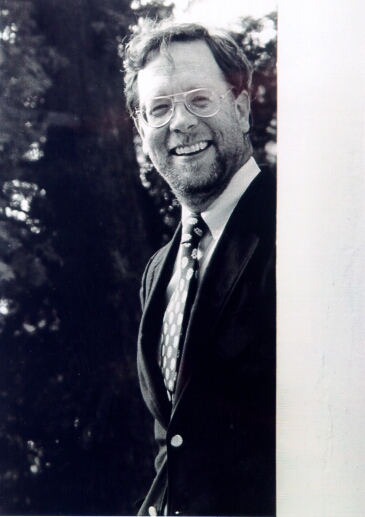
Palme House
Gambier, Ohio
Die Weisse Rose
"Liebe, Freundschaft, und Mut zum Widerstand"
Social Dreams and Classical Ideals
"Beauty will save the world," Fyodor Dostoevsky
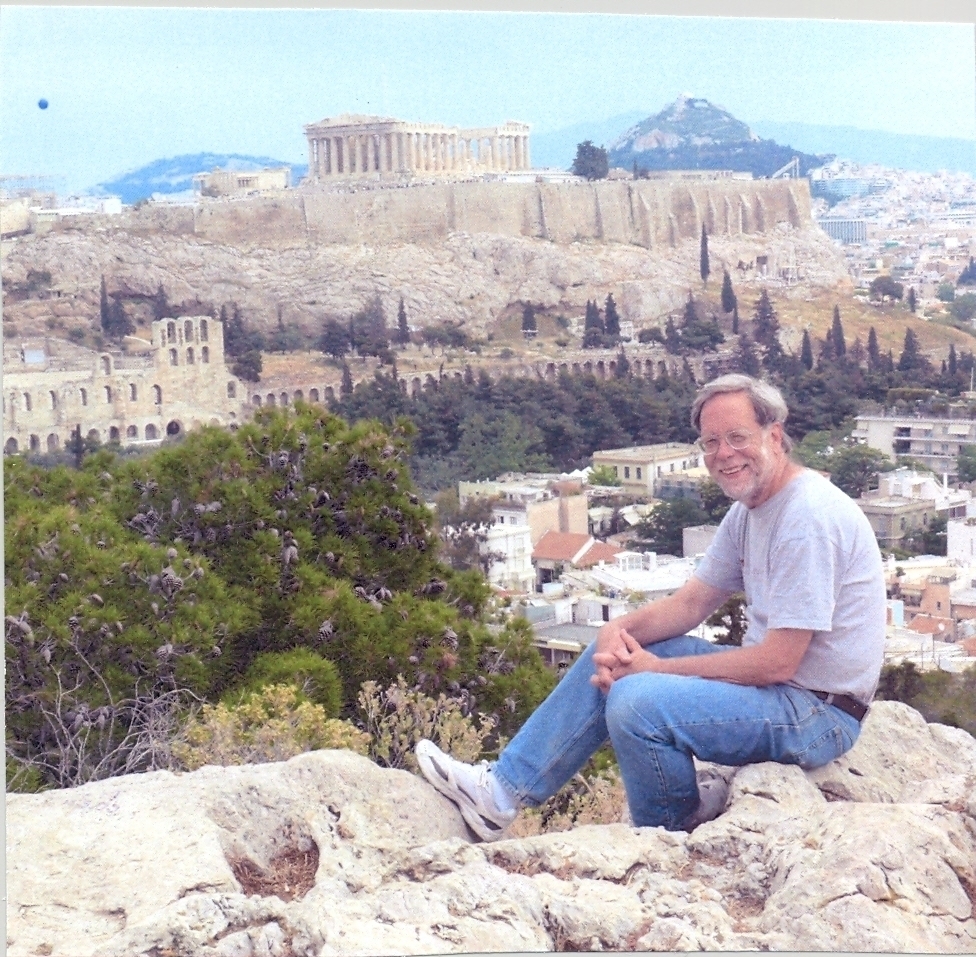
"Expanding the Classical Horizons of the
Ancients and the Moderns"
Acropolis and Parthenon
Athens, Greece
Ho ti kalon philon aei
(A thing of beauty is a joy forever)
Euripides, Bakkhai
"Beauty is truth, truth beauty, - that is all
Ye know on earth and all ye need to know."
John Keats, Ode on a Grecian Urn
And the ultimate Beauty of the World is
Social Justice
Expressed in the form of Art, Ethics,
Economics, Politics, and Ecology --
Human Dignity and Human Excellence,
Creative Self-Determination, and
Social and Economic Democracy

"Dancing Star" & Friend
Eugene, Oregon
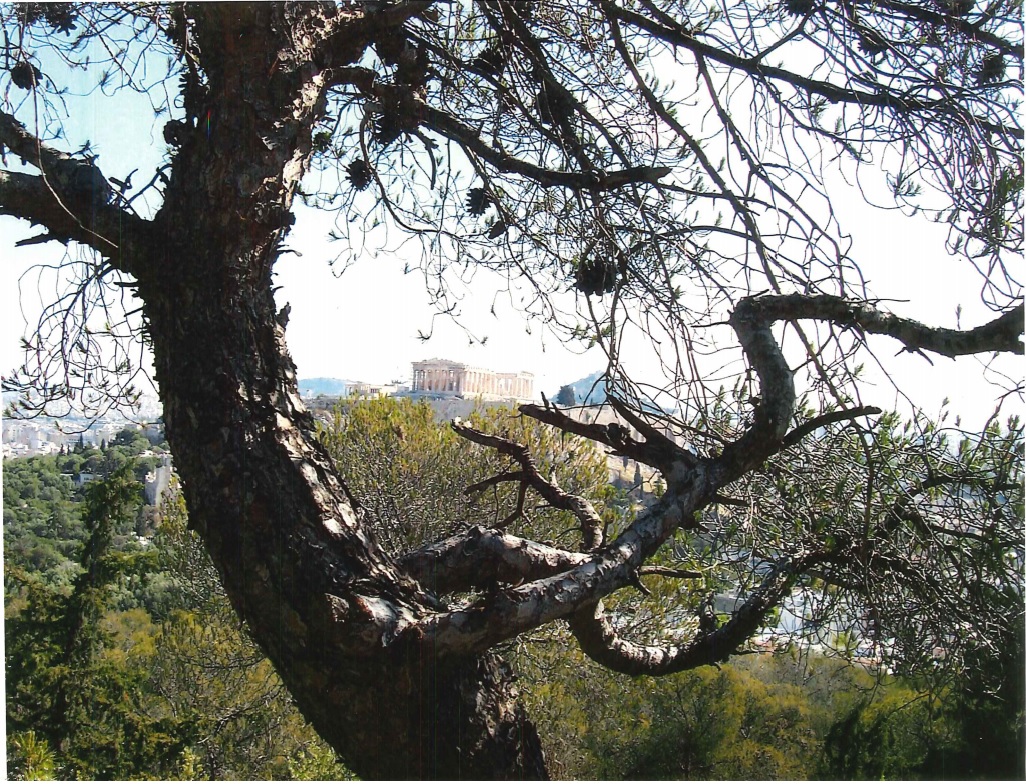
"Classical Dreams of Justice and Beauty"
Herein lies the Inspiration for Nineteenth-Century
Classical Social Theory of
Marx, Weber, and Durkheim
Parthenon from the Pnyx
Athens, Greece
Home of the Athenian Assembly
The True Beauty of Classical Greece lies in the
Grace, Elegance, and Harmony of the
Athenian Polity and Social Justice
Dreaming into the Future
Integrating Beauty, Reciprocity, and Grace


April 2015
"Modern Impressions of Classical Beauty"


April 2015


August 2021
WHAT THE PROPHETS SAW
We shun them, living exiles, labeled mad,
who see the world turned upside down we shrink
by private ownership of all each hand
imprints, and in our iron cage we think
we're free. The mad behold this human treason
and scream against the death of nature's reason.
But dreams reveal to what were blinded eyes
the truth that Justice holds that never dies.
The Commune, like far Ithaka, contains
ideals we journey towards before we die,
when like gods we break our final chains
to boldly face our own Thermopylae.
Life itself is found in simple joy,
in beauty, love, and art the spinning earth
in all the random grace that hearts employ
will see a new creation at its birth.
In dreams an ancient wisdom whispers: Heal
our modern madness, help the heavens move,
seek a newer world and make it real,
with hearts the sun and stars unite in love.
--- Royal Rhodes
Endpiece in Marx and Social Justice
2018
WEBSITE ADDRESS
http://personal.kenyon.edu/mccarthy/
****************************
********************
*************
*********
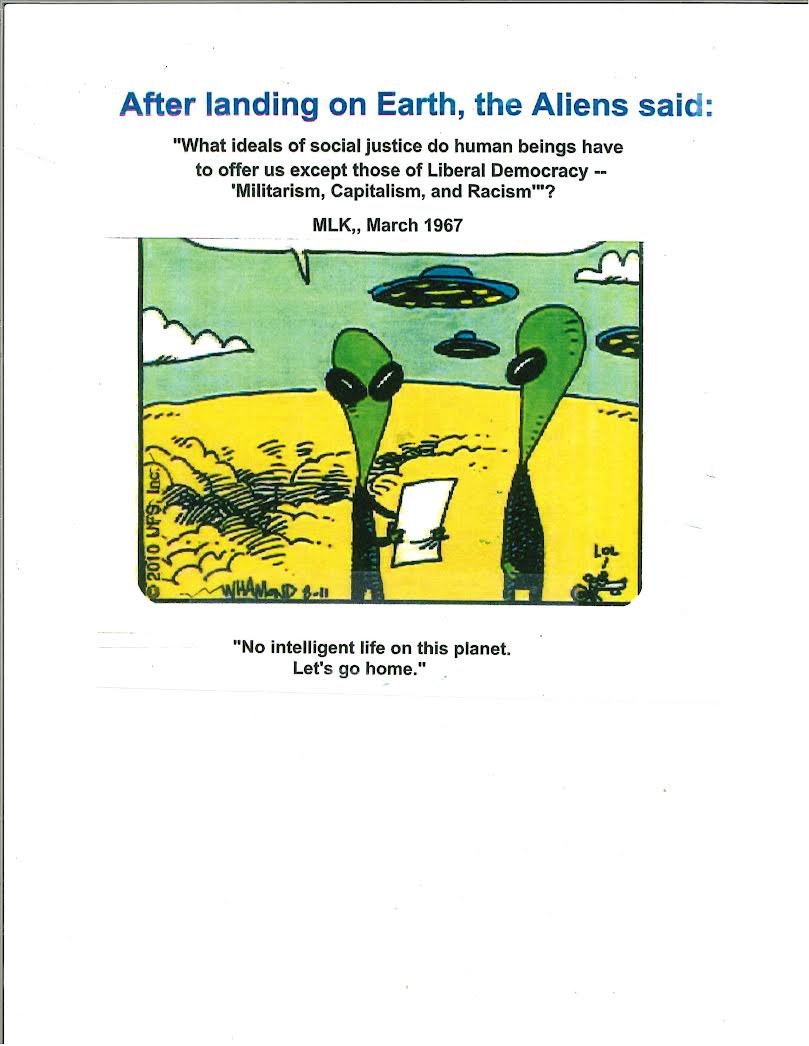
************************
********************
****************
*************